Viral Israel–Palestine Debate Explodes Across America as Gaza Hospital Claims, U.S. Aid, and Antisemitism Accusations Collide
Viral Israel–Palestine Debate Explodes Across America as Gaza Hospital Claims, U.S. Aid, and Antisemitism Accusations Collide
A fiery online debate over Israel, Gaza, and America’s relationship with its most controversial Middle Eastern ally has erupted across U.S. political media, after two commentators clashed over one of the most explosive questions of the war: did Israel conduct a targeted campaign against Hamas, or did it bomb Gaza with reckless disregard for civilian life?
The confrontation, now spreading through debate channels and political livestream circles, began with a dispute over hospitals in Gaza. One side argued that Israel’s campaign showed clear evidence of indiscriminate bombing, pointing to hospitals that were reportedly nonfunctional, partially functioning, damaged, destroyed, or unable to operate at full capacity. In his view, when hospitals can no longer save lives, perform surgery, or treat the wounded, the technical distinction between “destroyed” and “not fully functioning” becomes morally meaningless.
The other side pushed back hard.
He argued that language matters, especially in war. Saying “all but one hospital was destroyed,” he insisted, is not the same as saying some hospitals are partially functioning, non-operational, inaccessible, damaged, or facing shortages. In his view, critics of Israel often use the strongest possible wording first, then retreat into softer definitions when challenged.
That semantic battle became the center of the debate.
For pro-Palestinian audiences, the hospital issue is a moral indictment. Hospitals are supposed to be protected spaces, places where civilians, doctors, children, and the wounded should be safe from the battlefield. If a large portion of Gaza’s medical system collapses during an Israeli campaign, critics argue, that collapse speaks for itself.
For pro-Israel audiences, the situation is more complicated. The pro-Israel debater argued that Hamas has repeatedly used civilian infrastructure, including hospitals, mosques, churches, tunnels, and apartment buildings, for military purposes. He said the question cannot simply be whether a hospital was damaged, but whether Hamas was operating from or beneath that site at the time.
That is where the dispute became explosive.
The Israel critic said doctors who worked in the hospitals testified that they did not see Hamas operating there. The pro-Israel debater dismissed that as insufficient, arguing that doctors may not know who is Hamas, especially if fighters operate in civilian clothes, use hidden tunnels, or move through restricted areas of hospital compounds. To him, the absence of a doctor personally seeing Hamas does not prove Hamas was absent.
The debate then turned to the legal and moral question of war.
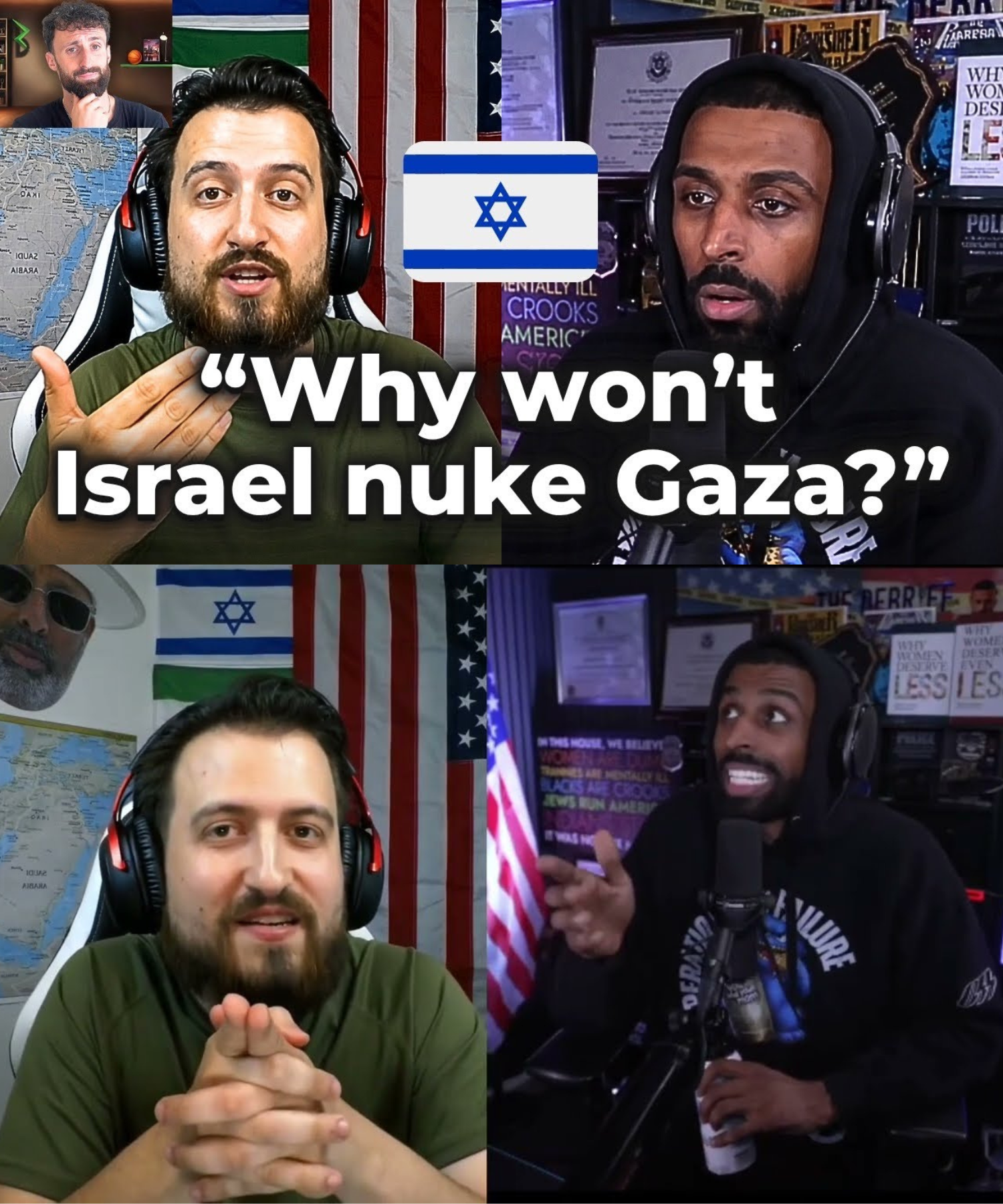
The pro-Israel side argued that international law does not grant absolute immunity to hospitals if enemy forces use them for military purposes. He cited the logic that protected civilian sites can lose protection when used by belligerents. The critic responded that even if Hamas uses some hospitals, that cannot become a blank check to destroy half of Gaza’s medical infrastructure and claim every strike was justified.
In other words, the clash was not really about one building.
It was about trust.
Do viewers trust Israel’s intelligence? Do they trust doctors on the ground? Do they trust Hamas-controlled information? Do they trust U.S. media? Do they trust social media clips? Or has the war become so politically poisoned that every number, every image, and every word is treated as propaganda?
The pro-Israel debater then introduced a mathematical argument that has become popular among Israel’s defenders. If Israel truly bombed indiscriminately, he argued, the death toll would be far closer to the percentage of buildings destroyed. In his view, the gap between structural destruction and population casualties suggests that Israel was targeting, warning, evacuating, or otherwise distinguishing between buildings and people.
The critic rejected that as too clean and abstract. He argued that the reality of Gaza cannot be reduced to a ratio. Civilian structures, religious sites, hospitals, homes, and entire neighborhoods have been hit. Even if Hamas embeds itself in civilian areas, he said, there must still be limits. Otherwise, any target can be justified after the fact by saying Hamas was nearby.
Then the debate shifted from Gaza to Washington.
Asked about America’s relationship with Israel, the pro-Israel commentator gave an answer that surprised viewers on both sides. He said he does not support the current model of U.S. aid to Israel in the traditional sense. But his objection was not anti-Zionist. It came from what he described as a Zionist belief in self-reliance.
He argued that Israel should become less dependent on direct American aid and more focused on innovation, defense production, technology partnerships, and economic cooperation. He pointed to Israel’s heavy investment in research and development, its defense innovation, and the presence of major global technology firms operating in Israel. In his view, the U.S.–Israel relationship should move away from taxpayer-funded aid and toward a more equal partnership based on weapons development, medical breakthroughs, cybersecurity, artificial intelligence, and strategic technology.
That argument struck a nerve in America.
For years, critics of Israel have attacked U.S. aid as proof that Washington is funding occupation, war, and Palestinian suffering. Pro-Israel advocates often respond that much of the aid returns to the American defense industry and supports U.S. strategic interests. But this speaker took a different path: end the dependency, remove some of the restrictions, and let Israel innovate more freely.
His opponent took the opposite approach.
He argued that the U.S. should give Israel an ultimatum: resolve the Palestinian question within a set timeframe or face the loss of American aid, diplomatic cover, and political protection. He said the unresolved Palestinian issue is the root of repeated wars, regional hostility, and stalled normalization with Arab states.
He floated both one-state and two-state possibilities, but acknowledged the brutal problems with each. A one-state solution would threaten Israel’s Jewish majority. A two-state solution would require Israel to accept a Palestinian state next door, potentially with serious security risks. Still, he argued, America should force movement because the status quo only produces more war.
Then the debate took a darker turn.
The Israel critic moved into claims about Israel’s nuclear program, the USS Liberty, the JFK assassination, and 9/11. He suggested Israeli or Zionist involvement in some of America’s deepest historical wounds. The pro-Israel debater immediately challenged those claims, especially the familiar “dancing Israelis” narrative surrounding September 11. He argued that the claim has been exaggerated, distorted, and selectively remembered because the suspects were Israeli and Jewish.
That moment transformed the exchange from policy debate into a fight over antisemitism.
The pro-Israel commentator accused his opponent of using anti-Zionism as a shield for deeper hostility toward Jews. He named several public figures he believes are not merely critics of Israel but genuinely antisemitic. His argument was blunt: some people do not simply oppose Israeli policy; they use Israel as a socially acceptable way to launder older anti-Jewish narratives about control, conspiracy, betrayal, and hidden power.
That accusation is now one of the most bitter arguments in American politics.
Critics of Israel insist that opposing Zionism, Israeli military policy, or U.S. support for Israel is not antisemitism. Jewish communities and Israel defenders respond that some critics repeatedly cross the line by blaming Jews collectively, spreading conspiracy theories, or treating Israel as uniquely evil in ways they never apply to other countries.
The viral debate did not settle the war in Gaza.
It did something more revealing.
It showed how quickly any conversation about hospitals, bombs, aid, or Palestinian statehood can spiral into a larger American fight over truth, propaganda, Jewish identity, conspiracy, and moral responsibility.
One side sees Israel as a flawed but necessary ally fighting a terror group embedded in civilian life.
The other sees Israel as a powerful state shielded by Washington while Palestinians pay the price.
Between them sits the American public, exhausted, divided, and no longer sure which facts can be trusted.
And that may be the most dangerous battlefield of all.