Viral Ireland Migrant Welfare Clip Sparks Outrage in America as Locals Clash Over “Free Money” and a Country Under Pressure
Viral Ireland Migrant Welfare Clip Sparks Outrage in America as Locals Clash Over “Free Money” and a Country Under Pressure
A short street interview from Ireland has exploded across the American internet, igniting a furious debate over immigration, welfare, national identity, and the growing fear that Western governments are losing control of their own countries.
The clip, taken from a recent investigative video by YouTuber Tyler Oliveira, appears at first to be just another tense exchange on a European sidewalk. But within seconds, it becomes something much bigger: a raw confrontation between a migrant receiving state support and two Irish men who say their country is being pushed past the breaking point.
For many American viewers, the scene feels uncomfortably familiar.
The United States has spent years arguing over the southern border, sanctuary cities, hotel shelters, emergency migrant funding, overwhelmed schools, rising housing pressure, and taxpayers demanding to know why government money seems to move faster for newcomers than for struggling citizens. Now, the Ireland clip has become a warning sign in U.S. political circles: what if the same battle is no longer only American, but Western?
The exchange begins when Oliveira asks the migrant a simple question: would he recommend other asylum seekers or refugees come to Ireland?
The answer is not what some viewers expected.
The man says no. He says that, based on recent events, including the killing of a Black man, he would not advise others to come. “You’re not welcome,” he says, suggesting that Ireland has become tense, hostile, and dangerous for people like him.
But standing nearby, two Irish lads hear something very different. They do not hear a victim. They hear another example of a system they believe has turned against them.
“Get a job while you’re here,” one of them fires back.
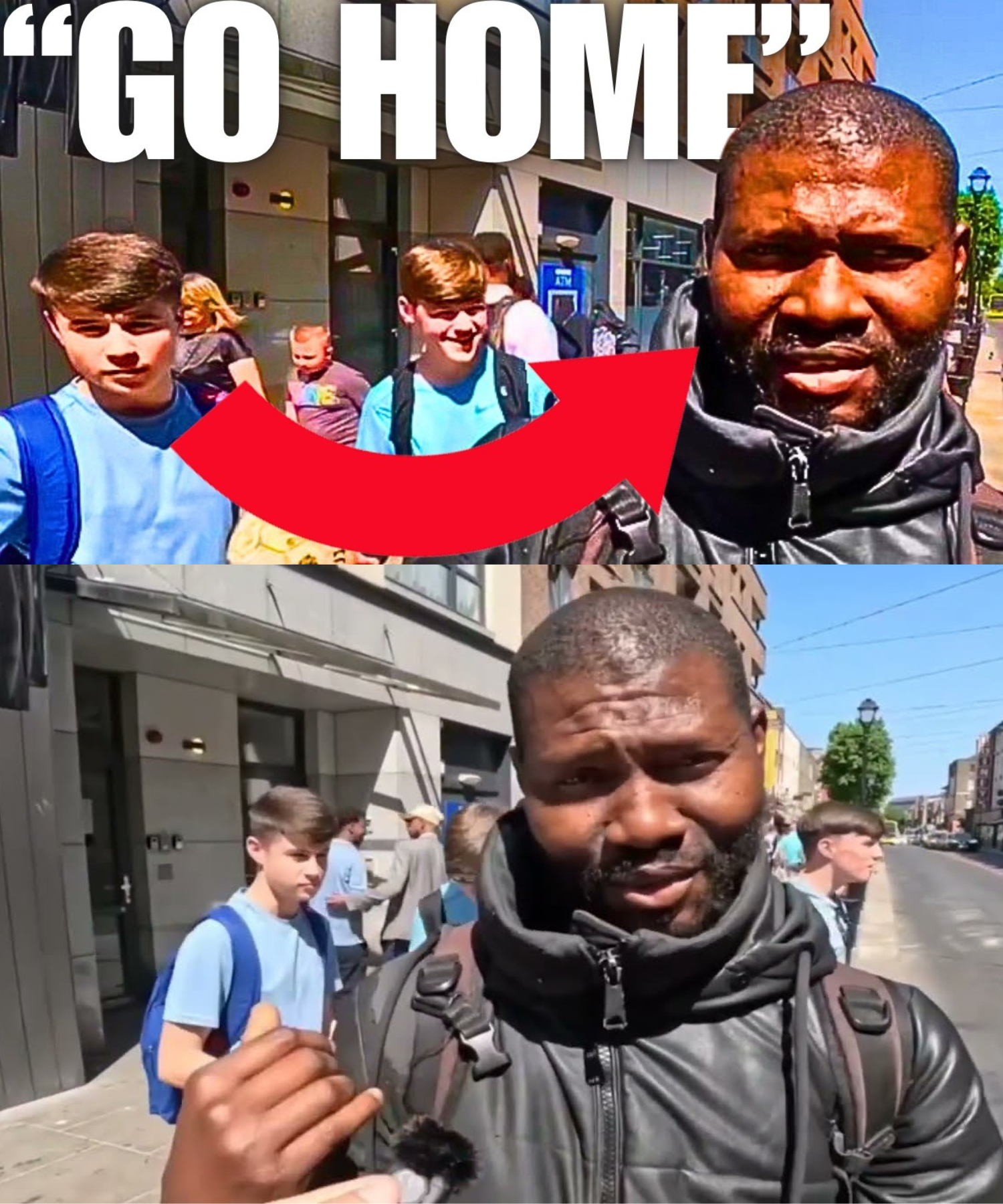
The migrant answers that he is not qualified. The response only sharpens the frustration. The Irish men accuse migrants of receiving “free phones, free cars, free everything.” They say migrants do not pay for anything. They say the government takes care of them while locals are left watching their own country change around them.
Oliveira presses the migrant directly: what did he get for free?
The man pushes back. He says people are ignorant of his real situation. He says he is homeless. He says he does not have the free luxuries they are accusing him of receiving. When asked whether he got a free phone, he denies it and says he relies on charity shops.
For a moment, the narrative becomes complicated. The migrant is not presenting himself as comfortable or wealthy. He says he is homeless. He says he is surviving, not thriving.
Then comes the line that sets off the entire controversy.
“How do you survive if you don’t have a job?” Oliveira asks.
The migrant answers that he receives weekly payments.
The number, according to the clip, is 113 per week.
That single figure became the lightning strike.
To immigration critics, it is proof that European governments are using taxpayer-backed systems to support people who entered through asylum and refugee channels while citizens face homelessness, cost-of-living pressure, and social decline. To defenders of migrant aid, the number is hardly lavish. They argue that a person sleeping rough and receiving a small weekly allowance is not living like a king. He is barely surviving.
But viral politics rarely leaves room for nuance.
The Irish men in the clip are not focused on the amount. They are focused on the principle. In their view, any government-funded payment to a non-working migrant becomes offensive when ordinary Irish citizens feel forgotten. To them, the issue is not just 113 per week. It is what the payment represents: a government that seems quicker to support outsiders than its own people.
That is why the clip exploded in the United States.
American viewers immediately connected Ireland’s welfare dispute to their own cities. In New York, residents have watched city officials spend billions on migrant shelter systems while local homelessness remains unsolved. In Chicago, anger has erupted over shelters, school gyms, public buildings, and neighborhood resources. In Denver, Boston, Los Angeles, and other cities, officials have warned that migrant costs are straining budgets.
The Ireland clip becomes powerful because it compresses that entire crisis into one sidewalk exchange.
One migrant says he is homeless and misunderstood.
Two locals say the system is broken and unfair.
A reporter asks the questions everyone else is afraid to ask.
The narrator of the video then takes aim at the European Union, claiming that the migrant’s payment is connected to migration funding and arguing that this is exactly why many Britons wanted to leave the EU. The message is blunt: European bureaucracy is financially encouraging mass migration, while ordinary people are expected to absorb the consequences.
For Americans, that part of the clip carries a second meaning. The EU becomes a symbol of distant, unaccountable power — the same way many U.S. voters view Washington, federal agencies, global NGOs, and elite institutions that shape immigration policy without facing the neighborhoods affected by it.
The political question becomes impossible to ignore: who decides the future of a country?
Is it voters?
Is it courts?
Is it international law?
Is it humanitarian agencies?
Is it unelected bureaucrats?
Or is it the emotional force of crisis itself?
Ireland has become a flashpoint because it was long seen by outsiders as a small, proud, culturally distinct country with deep local roots. Now, like many European nations, it is being pulled into the same immigration conflict consuming Britain, France, Germany, Sweden, and the United States.
Supporters of asylum programs argue that Ireland has moral obligations. People fleeing war, poverty, persecution, and chaos need shelter. A wealthy Western nation, they say, cannot simply turn its back on human suffering.
But critics argue that compassion without limits becomes national suicide. They say housing is finite. Welfare money is finite. Public patience is finite. And if governments keep importing need while ignoring citizens already in need, resentment will not disappear — it will explode.
That explosion is what the clip captures.
The most dramatic part is not the weekly payment. It is the body language. The Irish men look furious. The migrant looks defensive. Oliveira looks like a man standing between two incompatible realities. Everyone is speaking English, but they are not speaking the same moral language.
To the migrant, the system is not generous enough. He is homeless.
To the locals, the system is already too generous. He receives support while not working.
To the audience, both statements can feel true at the same time.
That is what makes the video so dangerous politically. It shows that the migrant crisis is not only about borders. It is about trust. Once citizens stop trusting that their government prioritizes them, every payment becomes suspicious, every newcomer becomes controversial, and every official explanation sounds like betrayal.
The United States should pay attention.
Because Ireland’s argument is America’s argument in miniature.
A country can support immigration. A country can support asylum. A country can show mercy to outsiders. But if citizens believe that mercy comes at their expense, the social contract begins to crack.
The Ireland clip is not just a viral moment.
It is a warning from across the Atlantic.
When working people, homeless citizens, struggling families, and angry locals begin asking why newcomers receive state support while they feel abandoned, politicians can only dodge the question for so long.
Sooner or later, every Western government will have to answer:
Who is the country for?