Viral Debate Over Quran, Crusades, and Palestine History Ignites Explosive Free Speech Battle in the U.S.
Viral Debate Over Quran, Crusades, and Palestine History Ignites Explosive Free Speech Battle in the U.S.
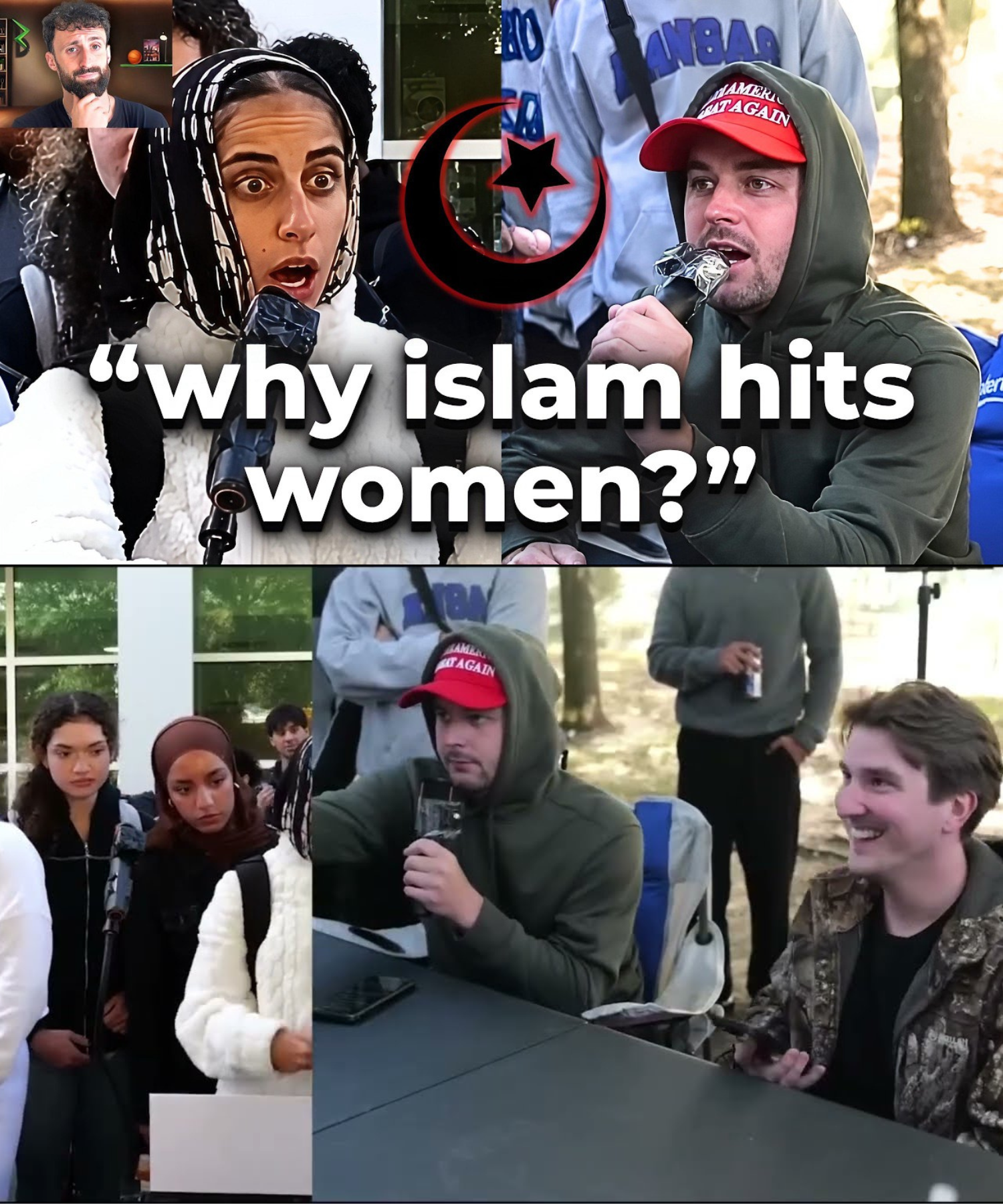
New York — A heated on-camera confrontation between political commentator Cam Higby and a Muslim guest has gone viral across American social media, reigniting one of the most sensitive and polarizing debates in the West: the interpretation of Islamic scripture, the history of conquest, and the legitimacy of modern Middle Eastern borders.
The exchange, filmed in a public debate format, quickly escalated from theological discussion into a full-scale clash over history, colonialism, war, and identity — leaving viewers deeply divided over whether the conversation represented necessary truth-telling or dangerous generalization.
At the center of the controversy is a reference to Surah Muhammad (47:4), a Quranic verse that speaks of combat during warfare. Higby cites the verse, arguing that it commands believers to strike non-believers in battle. The Muslim guest immediately pushes back, insisting the verse cannot be understood without historical context, and that it refers to specific wartime conditions during early Islamic conflicts rather than a universal command.
But the disagreement does not stay confined to scripture for long.
Higby expands his argument by referencing multiple hadith narrations and claims that certain texts have been interpreted to justify violence in both historical and modern extremist ideologies. He links these interpretations to contemporary groups such as Hamas, arguing that religious texts are sometimes used to legitimize political violence.
The Muslim guest rejects that framing, arguing that extremist groups selectively interpret religious texts and that mainstream Islamic scholarship emphasizes context, jurisprudence, and non-literal interpretation. She warns against conflating scripture with political movements.
That disagreement becomes the foundation for a much larger argument — one that moves from theology into history.
The Battle Over Palestine’s Origins
Higby then shifts the conversation toward the history of Palestine and Israel, arguing that there has never been a historically sovereign Palestinian state in the modern political sense. He states that the region was controlled by the Ottoman Empire and later administered under the British Mandate before the establishment of Israel in 1948.
The guest challenges this claim, emphasizing that Palestinian identity is rooted in generations of families living in cities such as Jaffa, Haifa, and Safed. She argues that regardless of formal statehood, people identify as Palestinian based on continuity of residence and displacement following war.
This is where the debate becomes especially volatile.
Higby responds by introducing etymological history, arguing that the term “Palestine” derives from Roman renaming — Syria Palaestina — following the suppression of Jewish revolts. He further connects the term to the ancient Philistines, a non-Arab people historically located in parts of the Levant. From his perspective, modern Palestinian identity is layered over much older historical populations and political rebranding.
The guest pushes back, arguing that historical naming conventions do not invalidate modern national identity or lived experience. She insists that populations evolve over time and that cultural continuity cannot be erased by administrative history.
Colonialism, Conquest, and Religious Expansion
The debate intensifies as both speakers turn to broader questions of conquest and colonialism.
Higby argues that Arab expansion in the 7th century involved large-scale military conquest across the Middle East and North Africa, resulting in long-term cultural and linguistic transformation. He frames this as a form of colonial expansion similar to European imperial history.
The Muslim guest challenges this comparison, questioning whether applying modern definitions of colonialism equally across all historical empires is accurate or fair. She argues that historical events must be understood in context rather than through modern political frameworks.
Higby then introduces the concept of the jizya tax and dhimmi system, arguing that non-Muslims under Islamic rule were historically subject to special taxation and restrictions, which he describes as second-class legal status. He cites historical documents such as the Pact of Umar, claiming they illustrate structured inequality under Islamic governance.
The guest does not fully deny historical legal distinctions but argues that these systems varied significantly across regions and eras, and that modern interpretations often oversimplify complex legal and social arrangements.
Crusades and Competing Historical Narratives
The discussion then shifts to the Crusades.
Higby argues that Crusader campaigns were largely defensive responses to Islamic expansion into historically Christian territories, including Spain and the Levant. The guest rejects this framing, pointing to widespread violence during Crusader conquests and arguing that neither side can be reduced to purely defensive or offensive roles.
At this point, the debate moves beyond facts into competing civilizational narratives.
Each side accuses the other of selective history.
Each side claims the other is omitting key context.
The Question of Literalism and Interpretation
The conversation briefly returns to theology when the guest challenges Higby’s interpretation of religious texts, arguing that many Quranic verses are interpreted metaphorically or within jurisprudential frameworks rather than literal wartime commands.
Higby counters by arguing that some extremist ideologies explicitly rely on literal readings of scripture and that historical and modern acts of violence have been justified through religious interpretation. He argues that ignoring literal interpretations allows dangerous ideas to persist unchallenged.
The guest responds by warning against overgeneralization and insists that mainstream religious practice cannot be judged by extremist interpretation.
The Clash Over “Common Ground”
As the debate nears its conclusion, both speakers attempt to establish interpretive ground rules.
The guest emphasizes the importance of shared historical understanding and warns that denying Palestinian identity or selectively interpreting scripture prevents meaningful dialogue.
Higby argues that without agreement on foundational historical facts — including the nature of conquest, the existence of ancient states, and the meaning of modern identity — any discussion becomes impossible.
Neither side fully concedes.
A Debate That Reflects a Larger American Crisis
The viral clip has resonated across the United States not simply because of its content, but because of what it represents: the growing collision between free speech, religious interpretation, historical identity, and geopolitical conflict.
On one side, supporters of Higby argue that uncomfortable historical truths must be spoken openly, even if they offend. On the other, critics warn that sweeping interpretations of scripture and history risk reinforcing stereotypes and inflaming tensions between communities.
The Muslim guest’s defenders say she represents necessary context and interpretive nuance in religious discourse. Critics argue that some of her responses avoid direct engagement with difficult historical claims.
What makes the debate so combustible is that it refuses simplification.
Every claim opens another layer of history.
Every counterargument raises another unresolved question.
And every attempt at closure leads back to the same unresolved fault lines: scripture, conquest, identity, and legitimacy.
A Conflict With No Final Narrative
As the video ends, no consensus is reached.
Instead, what remains is a fragmented picture of history itself — one where scripture is interpreted through competing lenses, where ancient empires shape modern politics, and where identity is constantly contested between memory and narrative.
For American audiences, the debate reflects a broader reality: the struggle not only over what happened in history, but over who has the authority to define it.
And in that struggle, there are no final answers — only competing truths still fighting for dominance in the public square.