Viral Christian Livestream Shocks America After Muslim Seeker and Jehovah’s Witness Caller Face Emotional Breakthroughs Over Jesus
Viral Christian Livestream Shocks America After Muslim Seeker and Jehovah’s Witness Caller Face Emotional Breakthroughs Over Jesus
A dramatic Christian apologetics livestream has ignited intense reaction across American religious media after two callers — one from a Muslim background and another identifying with Jehovah’s Witness teachings — entered the conversation with questions about Jesus and left viewers stunned by what many described as a rare, emotional moment of spiritual collapse and rebirth in real time.
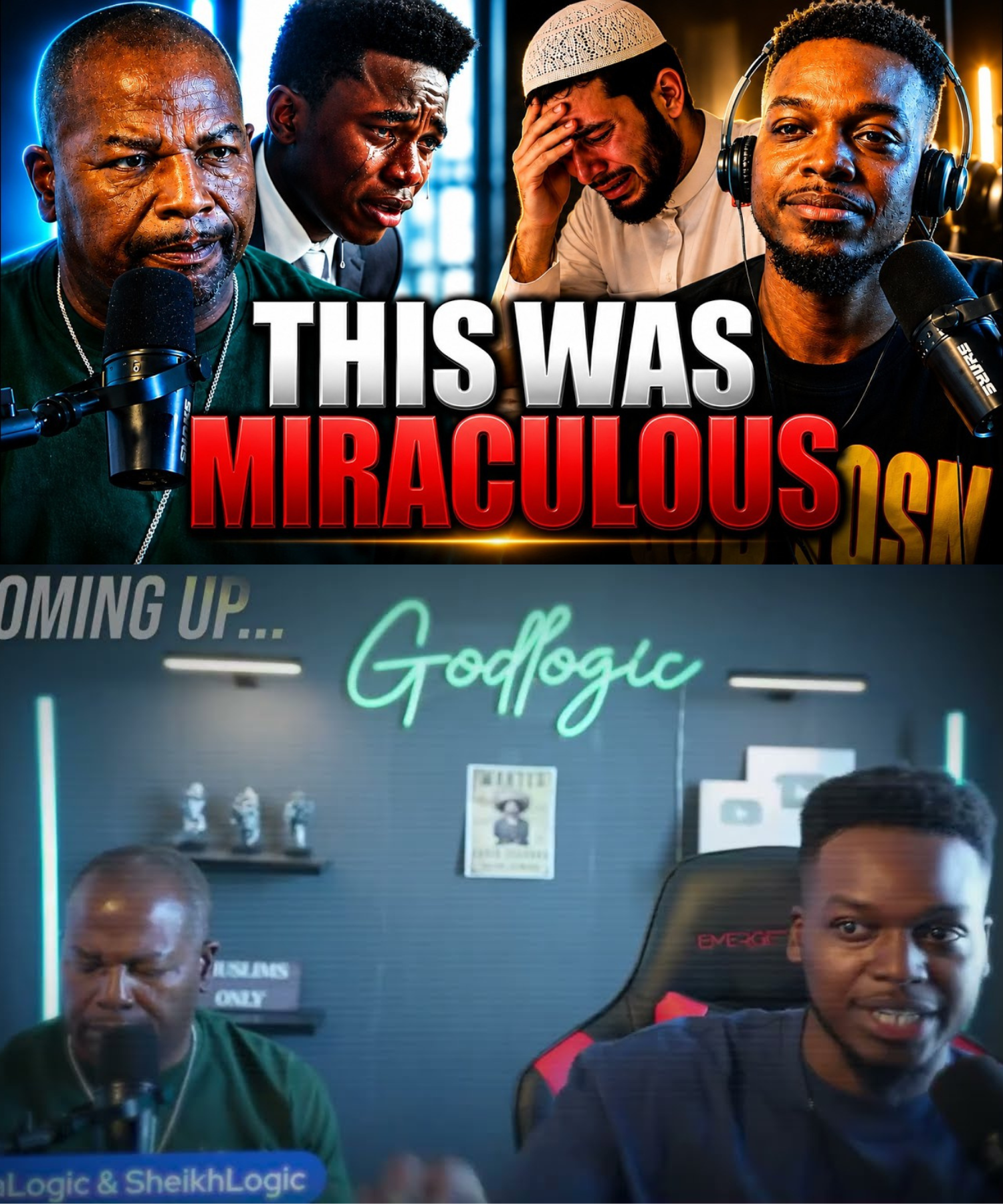
The stream, hosted by Christian apologist GodLogic, began like many online theology debates: sharp questions, Bible passages pulled onto the screen, disagreement over doctrine, and a familiar clash between Christianity, Islam, and Jehovah’s Witness theology. But as the conversation unfolded, it shifted from debate into something far more personal. By the end, the host, his father, Christian Prince, and hundreds of live viewers were reacting not simply to arguments, but to two men wrestling openly with faith, fear, family, and salvation.
The first major moment came from a caller named Salem, who appeared to come from a Muslim background and said he had been deeply affected by a previous livestream discussion about Jesus, prophecy, crucifixion, and resurrection. He told GodLogic that he had been thinking for days about what he heard, especially the claim that the Old Testament prophets pointed toward Christ’s suffering and victory before it happened.
Then Salem asked a question that has divided Christians, Muslims, skeptics, and secular historians for centuries: did Jesus rise physically from the dead, or was the resurrection merely spiritual, symbolic, or visionary?
GodLogic answered by turning to Luke 24, where the women find the tomb empty and where Jesus later appears to His followers. The host emphasized the missing body, then read the passage where Jesus tells the frightened disciples to look at His hands and feet, touch Him, and see that a spirit does not have flesh and bones. He also pointed to Jesus eating fish in front of them as further evidence that the resurrection being described was bodily and physical.
The argument was direct: if Jesus could be touched, if He had wounds, if He ate food, and if His tomb was empty, then the Gospel writers were not describing a ghostly vision.
GodLogic then moved to John 20, where Thomas refuses to believe unless he can touch the wounds of the risen Christ. According to the passage, Jesus later appears and invites Thomas to place his finger in the nail marks and his hand in His side. Thomas responds, “My Lord and my God.” GodLogic stressed that Jesus did not rebuke Thomas for blasphemy, but accepted the confession and blessed those who would believe without seeing.
For Salem, the explanation seemed to land heavily.
He asked whether only the apostles saw Jesus after the resurrection. GodLogic answered with 1 Corinthians 15, describing an early Christian creed that says Christ died, was buried, was raised on the third day, and appeared to Peter, the Twelve, more than 500 believers at one time, James, the apostles, and finally Paul. The host argued that the resurrection was not a private mystical experience, but a public claim made while many witnesses were still alive.
Then the conversation moved from evidence to cost.
Salem told the host that recognizing Jesus and leaving Islam is not simply changing a religious opinion. For many Muslims, he said, leaving Islam can mean losing culture, family, social belonging, and nearly every relationship that gives life stability. He spoke with visible pain about the burden carried by people who may be convinced intellectually but remain terrified of what it would cost to act on that conviction.
That moment shifted the tone of the livestream.
Christian Prince, an Arab Christian apologist, responded by saying that salvation must be valued above culture, family approval, or social acceptance. He acknowledged that suffering is real and that following Christ does not make life easy. Instead, he argued that Christianity calls believers into a struggle against sin, fear, and falsehood. He told Salem that the true family is not always the one born under the same roof, but the one that loves, receives, and stands with a person in truth.
GodLogic then read Matthew 10, where Jesus warns that truth can divide households and that whoever loves father or mother more than Him is not worthy of Him. He also read John 14, where Jesus says He goes to prepare a place for His followers and will come again to take them to Himself. For the host, this was the emotional contrast: not a distant God who leaves believers guessing, but Christ personally promising to come for His people.
Then came the moment that sent the chat into eruption.
Salem said he was feeling something he had never felt before. He described warmth, goosebumps, shaking, and an overwhelming sense that something was being peeled from his eyes. He said he had prayed for a sign for more than a year and a half and had received nothing. Then, after a passing remark from a manager — “if God doesn’t come to you, you need to go to Him” — he searched online, found GodLogic’s videos, and began watching.
Now, on the livestream, he said the message had reached his heart and soul.
GodLogic identified the experience as the work of the Holy Spirit and read Romans 10:9–11, telling Salem that if he confessed Jesus as Lord and believed in his heart that God raised Him from the dead, he would be saved. Salem did not make a full public confession in that moment, but he told the host that thousands of people were in the same situation — convinced, searching, and afraid to accept what they were finding.
If the stream had ended there, it would already have been viral.
But then came Charles.
Charles, calling from Africa and identifying with Jehovah’s Witness belief, began questioning the deity of Christ. He explained that Jehovah’s Witnesses typically understand Jesus as the firstborn of creation, not as Almighty God. GodLogic responded by challenging that reading of Colossians, arguing that “firstborn” can refer to rank and supremacy rather than literal creation. He cited David and Ephraim as biblical examples where “firstborn” is used for status, not birth order.
The debate then moved to whether Jesus is “mighty God” or “Almighty God.” GodLogic argued from Isaiah 10 that Yahweh Himself is called “mighty God,” undermining the idea that “mighty God” is a lesser divine category. He then argued from Psalm 83 and Psalm 113 that only Yahweh is Most High and sits on high. When Hebrews 1 says Jesus sat down at the right hand of Majesty on high, GodLogic pressed the point: if only Yahweh sits on high, what does it mean that Jesus does too?
Charles pushed back respectfully, asking how Jesus could be the Son of the Most High if He Himself shares the nature of the Most High. GodLogic answered with Trinitarian language: the Son is not the Father, but shares the divine nature with the Father.
Then came the key passage: Isaiah 6 and John 12.
GodLogic showed Isaiah seeing Jehovah’s glory in the temple. Then he turned to John 12, where the apostle says Isaiah said these things because he saw His glory and spoke about Him — in a context referring to Jesus. Step by step, Charles followed the argument and eventually acknowledged the conclusion: John identifies Jesus with the Jehovah whom Isaiah saw.
That acknowledgment became the turning point.
Charles then asked what he should do if salvation depends on believing in the true identity of Christ. GodLogic told him to confess Jesus as Lord and God, the divine Son who died for his sins and rose again. Charles, audibly emotional, said he believed Jesus Christ is the divine Son of God.
The host welcomed him into the family of God.
The livestream ended with GodLogic and his father visibly moved. His father called the moment one of the greatest gifts he could have received, saying he had watched his son patiently guide a sincere seeker through confusion and into clarity.
Across American Christian media, the clip is being celebrated as more than a debate. Supporters see it as evidence that online apologetics can reach people trapped in fear, confusion, or inherited doctrine. Critics may view it as emotional religious persuasion. But no one can deny the power of the moment.
In one stream, a Muslim seeker trembled under the weight of the resurrection, and a Jehovah’s Witness caller confessed Christ’s divinity.
For believers watching, it was not just content.
It was a rescue mission happening live.