Viral Campus-Style Debate Over Quran, Crusades, and Palestine Ignites Free Speech Firestorm in America
Viral Campus-Style Debate Over Quran, Crusades, and Palestine Ignites Free Speech Firestorm in America
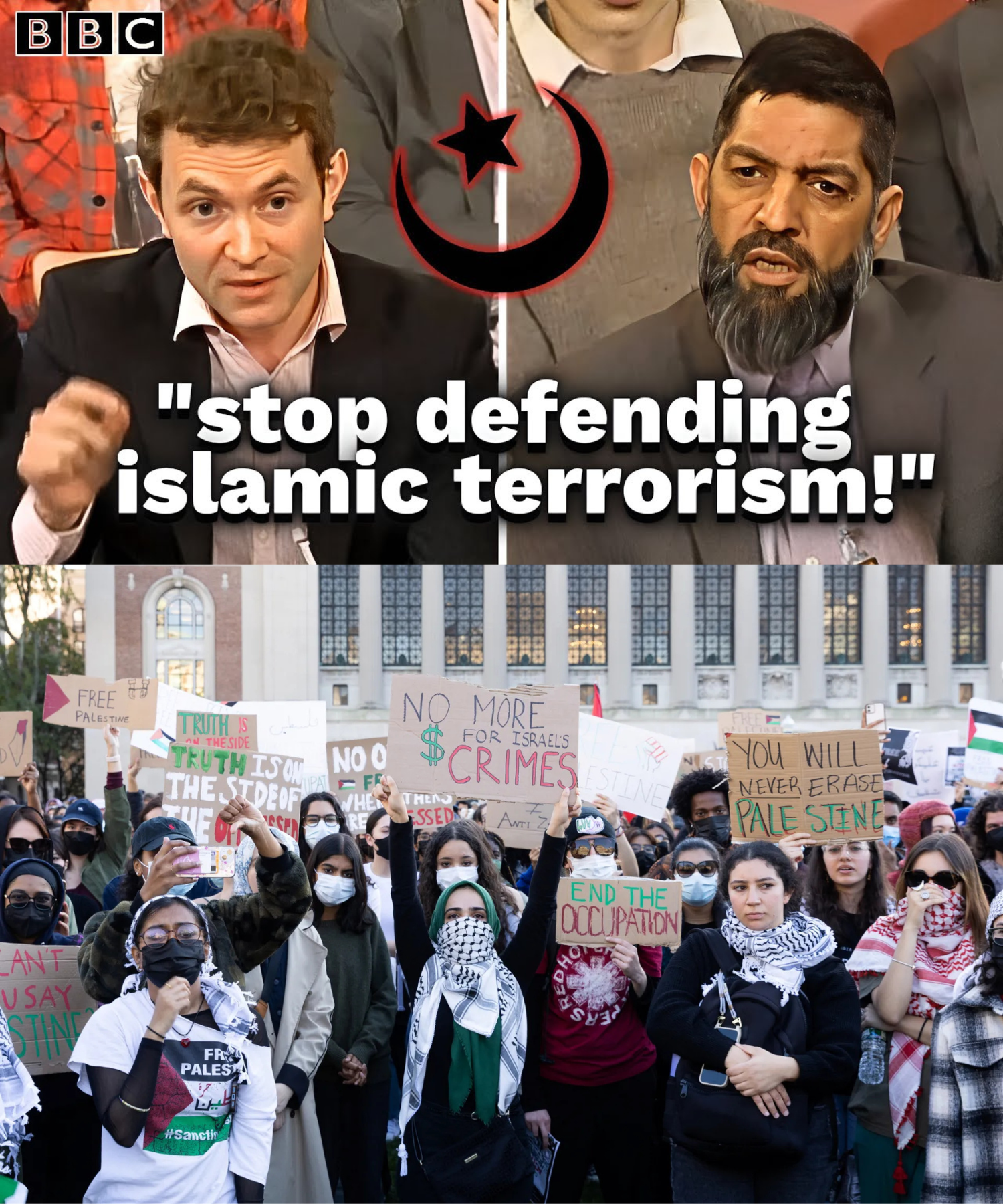
New York — A heated on-camera debate between political commentator Cam Higby and a Muslim guest has gone viral across U.S. social media, reigniting one of the most explosive cultural fault lines in Western discourse: the interpretation of Islamic scripture, the history of conquest, and the legitimacy of modern Middle Eastern identity and borders.
What begins as a discussion on extremism quickly escalates into a sweeping argument over jihad, colonial history, religious texts, and the Israel–Palestine conflict — leaving viewers sharply divided over whether the exchange represents honest historical critique or dangerous generalization.
At the center of the controversy is a citation from Surah Muhammad (47:4), a Quranic verse referring to combat in wartime. Higby argues that the verse explicitly commands believers to strike disbelievers in battle. The Muslim guest immediately challenges this interpretation, insisting that the verse must be understood within its historical context — specific conflicts during the early formation of the Muslim community — and not as a universal command applied outside of war.
This disagreement becomes the entry point into a far broader confrontation.
Scripture, Jihad, and Interpretation
Higby expands his argument by referencing additional hadith literature and claims that certain prophetic narrations have been interpreted by extremist groups to justify violence. He connects these interpretations to modern militant organizations, including Hamas, arguing that ideological continuity exists between historical texts and contemporary political violence.
The Muslim guest rejects this framing, arguing that extremist groups selectively interpret religious texts while mainstream Islamic scholarship emphasizes context, legal interpretation, and historical circumstance. She warns that isolating individual verses without scholarly framework creates distortion.
The debate intensifies when Higby introduces claims about eschatological hadiths related to end-times conflict, including disputed narrations involving Jews and apocalyptic battles. The guest challenges the relevance of such interpretations in modern political discussion, emphasizing the difference between theology and political ideology.
The Clash Over Israel, Palestine, and Historical Identity
The conversation then pivots sharply toward the Israel–Palestine conflict.
Higby argues that “Palestine” has never existed as a sovereign modern state, stating that the region was historically under Ottoman rule and later British mandate administration before the creation of Israel in 1948. He frames Palestinian national identity as a modern political development layered onto older imperial naming systems.
The Muslim guest strongly disagrees, emphasizing that Palestinian identity is rooted in continuous generational presence in cities such as Jaffa, Haifa, Safed, and others. She argues that statehood is not the sole measure of national identity and that displacement following conflict is central to Palestinian historical memory.
This disagreement becomes one of the most emotionally charged parts of the exchange.
Etymology Wars and Ancient History
Higby shifts the discussion into linguistic and historical territory, arguing that the term “Palestine” originates from Roman renaming — Syria Palaestina — after the suppression of Jewish revolts. He further claims that the word is derived from the Philistines, an ancient Aegean people unrelated to modern Arabs, suggesting that Palestinian identity is historically distinct from the ancient origins of the term.
The guest pushes back, arguing that historical naming conventions do not invalidate modern identity or lived continuity. She insists that populations evolve, merge, and transform over time, and that identity cannot be reduced to ancient etymology alone.
Colonialism, Conquest, and Religious Expansion
The debate then expands into one of the most sensitive areas: historical conquest.
Higby argues that Arab expansion in the 7th century involved large-scale military conquest across the Middle East and North Africa, followed by cultural and linguistic transformation. He frames this as comparable to colonialism as defined in modern Western discourse.
The Muslim guest questions this comparison, arguing that applying modern political categories retroactively oversimplifies complex historical realities. She challenges whether all forms of conquest should be equated with colonial oppression.
Higby responds by citing the jizya tax system and dhimmi status, arguing that non-Muslims under Islamic rule historically faced structured legal and financial inequality. He references documents such as the Pact of Umar as evidence of institutional hierarchy within early Islamic governance.
The guest does not fully dispute historical distinctions but argues that such systems varied widely and cannot be reduced to a single oppressive framework across centuries and regions.
Crusades and Competing Civilizational Narratives
The discussion then shifts to the Crusades.
Higby argues that Crusader campaigns were largely defensive responses to Islamic expansion into historically Christian territories, including parts of Europe and the Levant. The Muslim guest rejects this interpretation, pointing to widespread violence during Crusader conquests and arguing that both Islamic and Christian forces committed atrocities that cannot be reduced to defensive or offensive narratives alone.
At this point, the debate stops being about specific historical facts and becomes a clash of civilizational storytelling.
Each side accuses the other of selective history.
The Pedophilia Controversy and Scriptural Interpretation
One of the most explosive moments comes when Higby raises the controversial historical debate over the age of Aisha at the time of her marriage to Prophet Muhammad. He cites traditional hadith narrations indicating she was very young, while the Muslim guest disputes the interpretation and suggests alternative scholarly views exist.
Higby argues that modern moral standards cannot ignore classical textual claims. The guest responds that religious texts must be interpreted through scholarly tradition rather than isolated literal readings.
The exchange quickly becomes emotional and divisive, reflecting one of the most sensitive theological debates in modern interfaith discourse.
From Theology to Political Identity
As the debate progresses, both participants attempt to connect historical interpretation to modern political consequences.
Higby argues that extremist interpretations of scripture are not fringe but historically rooted in certain readings of religious texts. The guest insists that conflating scripture with extremist ideology is misleading and dangerous.
The conversation then briefly shifts into comparisons with Christianity, the Crusades, and modern Western moral standards, with both sides attempting to highlight perceived inconsistencies in the other’s argument.
A Debate That Mirrors America’s Cultural Divide
The viral clip has resonated across the United States not only because of its content, but because it reflects a broader cultural struggle over free speech, religion, history, and identity.
On one side are those who argue that uncomfortable historical truths must be discussed openly, even if they offend. On the other are those who warn that selective interpretation of religious texts and history can fuel misunderstanding, prejudice, and social division.
The Muslim guest’s defenders argue she represents contextual scholarship and resistance to oversimplification. Higby’s supporters argue he is exposing patterns of ideological continuity that are often ignored in mainstream discourse.
No Resolution, Only Escalation
By the end of the exchange, no agreement is reached.
Instead, the debate crystallizes into competing frameworks of history:
One sees scripture as context-bound and open to interpretation.
The other sees it as a foundational text with real-world ideological consequences.
One sees Palestinian identity as lived continuity.
The other sees it as a modern political construction rooted in layered historical naming.
Neither side fully yields.
The Bigger Question
The viral nature of the debate reflects a deeper American reality: history, religion, and geopolitics are increasingly being contested not in academic journals, but in real-time public confrontation.
And in that arena, the hardest question remains unresolved:
When history itself is disputed, who gets to define the truth?