Viral Campus Interview Over Israel–Palestine Debate Sparks Explosive Clash on Genocide Claims, History, and Identity
Viral Campus Interview Over Israel–Palestine Debate Sparks Explosive Clash on Genocide Claims, History, and Identity
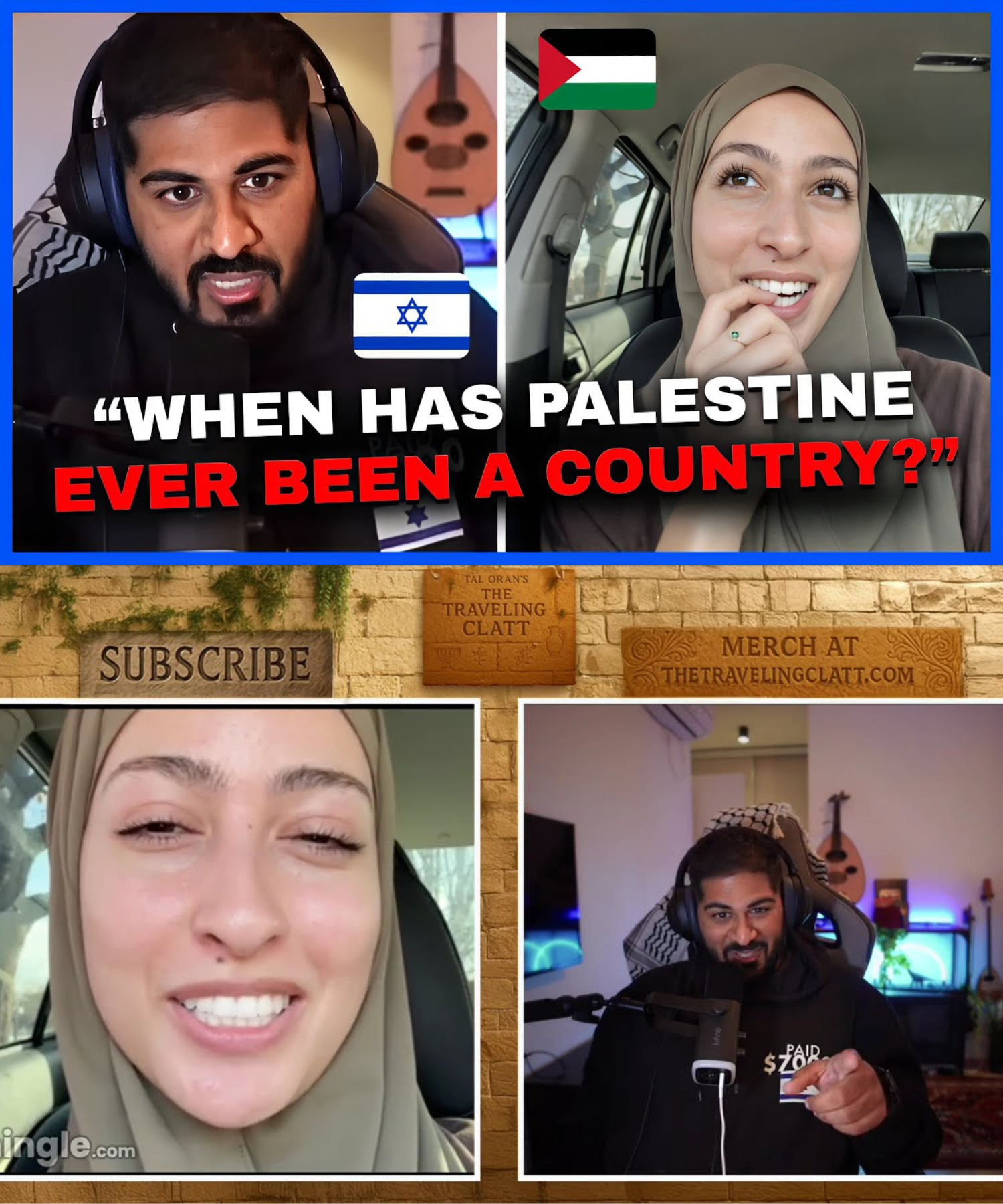
New York — A tense campus-style interview has gone viral across social media after a heated exchange between an interviewer and a young Algerian-American woman escalated into a deeply emotional and highly contested debate over the Israel–Gaza war, accusations of genocide, and competing historical narratives about the land of Israel and Palestine.
The footage, widely circulated across platforms in the United States and Europe, shows a structured but increasingly intense discussion that begins with personal identity and quickly evolves into one of the most polarizing geopolitical debates of the moment.
At the center of the controversy are conflicting interpretations of history, religion, population data, and military conflict — with both participants presenting fundamentally different frameworks for understanding the same events.
“Genocide or Military Operation?” — The Core Disagreement
The interview begins with a direct challenge over how the war in Gaza should be described.
The guest argues that what many people describe as a genocide is, in her view, an “intense military operation” in which there are no true winners and no simple moral conclusions. She rejects what she sees as a simplified narrative of victimhood and blame.
The interviewer pushes back strongly, stating that the situation cannot be reduced to political framing and repeatedly presses whether large-scale civilian deaths should be interpreted as genocide under international discourse.
This disagreement becomes the central fault line of the entire exchange: whether the conflict is best understood through legal, moral, or political definitions — or whether those categories fail to capture its complexity.
Population Numbers and Competing Narratives
A significant portion of the debate centers on demographic claims.
The interviewer references historical population figures, suggesting that Palestinian population numbers have increased significantly over time despite claims of large-scale displacement and casualties.
The guest responds with uncertainty, estimating population growth in the region but acknowledging she does not have exact figures at hand.
The interviewer then asserts that population data undermines the claim of genocide, arguing that historical increases in population are inconsistent with definitions of systematic extermination.
This claim is highly controversial. Experts in conflict studies emphasize that population growth does not necessarily negate allegations of genocide, as demographic trends can be influenced by birth rates, migration patterns, and regional variations.
Historical Claims: Canaan, Israel, and the Naming of the Land
The discussion then shifts into ancient history and territorial naming conventions.
The interviewer challenges the idea that the land has always been called “Palestine,” referencing ancient names such as Canaan and arguing that the region was historically associated with the kingdoms of David and Solomon.
He also cites Jewish and Islamic historical traditions, including references to biblical figures such as Abraham, Jacob, Joseph, David, and Solomon, arguing that these figures are tied to the geographic region in question.
The guest responds that historical naming is complex and that modern political identities cannot be directly mapped onto ancient terminology.
The interviewer further argues that the absence of the name “Palestine” in certain religious texts is often used in political arguments, though scholars note that the historical naming of regions has changed multiple times across centuries and empires.
The Nakba and Competing Historical Memory
The conversation then turns to the 1948 Nakba, a deeply sensitive historical event in which hundreds of thousands of Palestinians were displaced during the creation of the State of Israel.
The guest describes the widely accepted narrative that Palestinians were displaced and that many became refugees. She cites population changes from approximately 300,000 Palestinians in 1948 to millions today, framing it as evidence of historical displacement and long-term demographic growth despite conflict.
The interviewer disputes aspects of this framing, arguing that historical records are more complex and that claims of mass forced displacement require careful scrutiny of primary sources.
Historians generally agree that 1948 involved large-scale displacement, but interpretations of cause, intent, and scale remain politically contested.
October 7 and the Question of Retaliation
One of the most intense moments comes when the conversation turns to the October 7 Hamas attack and the subsequent Israeli military response.
The interviewer asks whether the October 7 attack should be considered retaliation or an unprovoked act.
The guest initially characterizes it as retaliation, while also stating that she does not support the targeting of civilians and does not consider the methods used to be justified under Islamic principles.
The interviewer presses further, asking how any government would respond in a hypothetical scenario involving mass civilian deaths and hostage-taking.
The guest responds that diplomacy would be the first approach, though she acknowledges limits when the opposing side refuses negotiation.
The interviewer challenges this position repeatedly, arguing that in scenarios involving hostages and ongoing violence, purely diplomatic solutions may not be realistic.
This portion of the interview becomes one of the most debated segments online, with viewers divided over whether it represents a fair moral dilemma or a rhetorical trap.
Genocide Definition Becomes a Central Flashpoint
As the discussion continues, the interviewer directly challenges the use of the term “genocide,” arguing that population trends and military objectives complicate the accusation.
The guest maintains that the situation still feels like genocide based on civilian suffering and global reports of destruction.
The interviewer counters with comparative historical examples, arguing that no known genocide has resulted in population growth during the alleged period.
Experts caution that genocide definitions in international law depend on intent and conduct, not only demographic outcomes, making the debate far more legally complex than presented in the exchange.
Social Media Reaction: Deep Polarization
The viral spread of the interview has generated sharply divided reactions.
Supporters of the interviewer argue that the conversation exposes inconsistencies in popular narratives about the conflict and highlights the importance of historical and demographic context.
Supporters of the guest argue that the framing places an unfair burden on individuals to defend complex geopolitical realities in real time, and that emotional and moral dimensions of civilian suffering cannot be reduced to statistics alone.
Human rights analysts emphasize that the Israel–Gaza conflict remains one of the most contested and emotionally charged issues in global politics, with competing narratives often shaped by identity, ideology, and lived experience.
Experts Warn Against “Binary Framing” of Complex Conflicts
Political scientists and conflict researchers caution that viral interviews often reduce multi-layered geopolitical conflicts into binary arguments: genocide versus military operation, history versus denial, diplomacy versus force.
They argue that such framing can obscure important legal distinctions and deepen polarization rather than foster understanding.
Experts also note that historical claims about ancient kingdoms, religious texts, and modern national identity are frequently used in political arguments but require careful academic context to avoid oversimplification.
A Debate With No Resolution
As the video continues to circulate, no consensus has emerged.
Instead, the interview has become part of a broader global struggle over how to interpret the Israel–Palestine conflict, how to define genocide, and how history should shape modern political claims.
For some viewers, the exchange represents a necessary confrontation with uncomfortable facts and competing narratives.
For others, it reflects the limitations of debating deeply complex geopolitical issues in viral, short-form formats.
What remains clear is that the debate over land, identity, history, and violence in the region is far from settled — and continues to divide audiences across the world with no immediate resolution in sight.