Viral Campus Debate Over “White Privilege” Ignites America’s New Race, Class, and Identity War
Viral Campus Debate Over “White Privilege” Ignites America’s New Race, Class, and Identity War
New York — A viral classroom-style livestream featuring a young student being pressed to define “white privilege” has exploded across American social media, reigniting a fierce national debate over race, class, poverty, affirmative action, and whether modern America is still structured to benefit white citizens.
The clip, taken from a discussion associated with a university-style livestream, shows a speaker challenging a 19-year-old student to explain what “white privilege” means in practical terms. The exchange quickly becomes tense, not because the student is mocked, but because the host deliberately slows the conversation down and asks a question many Americans argue is rarely answered clearly: How do we know white privilege exists today?
The answer does not come easily.
The student says white privilege may show up in job markets, academic spaces, corporate leadership, and the social advantages white people may experience when compared with people of color. But when asked for a concrete example of how someone similar to her, but white, would receive privilege over her, she struggles to name one.
That moment is now at the center of the controversy.
Supporters of the clip say it exposes how frequently racial concepts are repeated without being clearly defined. Critics argue that the student’s difficulty answering under pressure does not disprove the existence of racial advantage, especially given America’s long history of slavery, segregation, redlining, exclusion, and unequal wealth accumulation.
A Classroom Question Becomes a National Firestorm
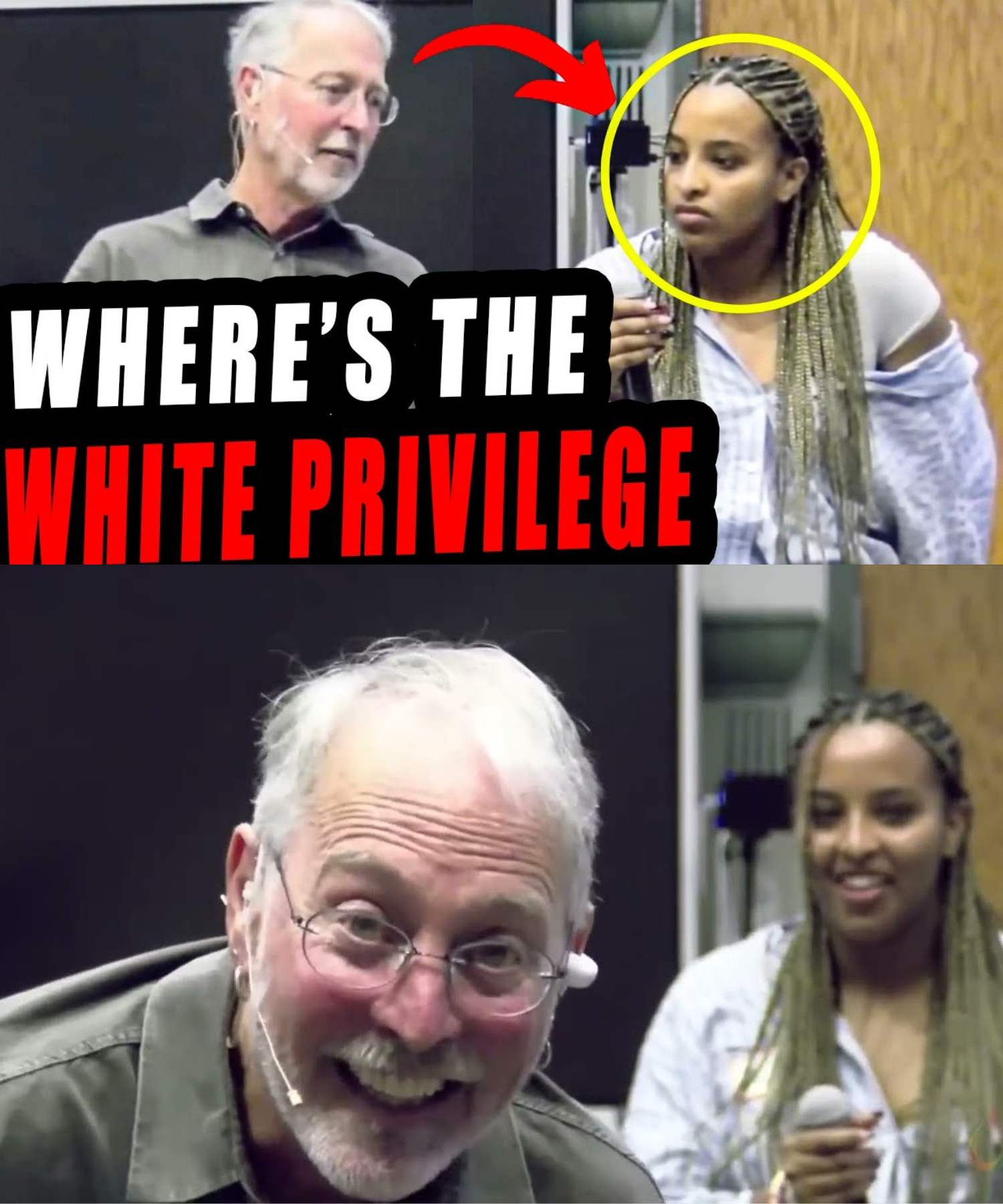
The host appears careful to point out that the student is young, under pressure, and facing a difficult question in front of an audience. He says viewers should not assume they are smarter than her simply because she cannot give a perfect answer.
That remark has been widely praised by some viewers as a rare moment of fairness in online debate culture.
But the conversation still lands like a bomb.
The host then presents population maps and demographic data, noting that non-Hispanic white Americans made up a smaller share of the population in 2020 than in 2010. He highlights geographic variation across the country, showing that some regions remain heavily white, while others — especially parts of California, the Southwest, border regions, major urban centers, and Native reservations — are far more diverse.
The point, according to the lecture, is that many Americans grow up in radically different racial environments. A student in rural Maine may experience America very differently from a student in Los Angeles, Houston, Queens, Miami, or the Rio Grande Valley.
That geographic reality complicates simple slogans.
Poverty Data Challenges the Popular Narrative
The most explosive section of the discussion comes when the host turns to poverty.
The transcript references a graphic showing that a large share of poor Americans are white. The argument is not that white poverty cancels out racism, but that poverty in America cannot be understood through race alone.
This point has resonated strongly with working-class viewers, especially those from Appalachia, the Midwest, rural Pennsylvania, West Virginia, Kentucky, Ohio, and parts of the South.
To them, the phrase “white privilege” often feels disconnected from lived reality. They see families struggling with rent, drugs, medical debt, factory closures, broken schools, low wages, and dying towns. When they hear they are privileged, many feel mocked rather than understood.
Supporters of the livestream argue that this is exactly why the national conversation needs to shift from race-only explanations to a broader view of class, family structure, education, and culture.
Critics counter that white poverty is real, but it does not erase racial disparities. They argue that privilege does not mean every white person is rich or powerful. It means white Americans may not face certain race-based disadvantages that Black, Latino, Native, or Asian Americans may encounter.
That distinction is where the debate becomes explosive.
History vs Present-Day Reality
The discussion also acknowledges that historical white privilege did exist in America. The speaker notes that white Americans accumulated wealth across generations in ways Black Americans were often prevented from doing through slavery, Jim Crow, housing discrimination, exclusion from certain jobs, and unequal schooling.
But the debate shifts when the speaker asks whether that historical advantage still operates in the same way today.
This is the core divide.
One side says America has changed so dramatically that legal equality, civil rights law, affirmative action, DEI programs, and anti-discrimination protections have transformed the country. They argue that today’s America is no longer legally structured to privilege white people.
The other side says historical systems do not disappear simply because laws change. Wealth, neighborhoods, school quality, inheritance, policing patterns, and professional networks can carry past inequality into the present.
The viral clip gains power because it does not settle the question. It exposes how unresolved it remains.
Affirmative Action and DEI Under Fire
The commentary following the livestream takes an even sharper turn, criticizing affirmative action and diversity policies as attempts to correct past injustice by creating new unfairness in the present.
The argument is blunt: modern white students should not be penalized for wrongs they did not commit, just as minority students should not be reduced to historic victim status.
Supporters of this view say race-based admissions and hiring practices can damage trust, stigmatize beneficiaries, and punish individuals for inherited categories.
Defenders of affirmative action argue that it was designed to counter longstanding exclusion and expand opportunity for groups systematically kept out of elite institutions.
The debate has only intensified since the U.S. Supreme Court restricted race-conscious college admissions, forcing universities and employers to rethink diversity strategies.
“Victim Mentality” Accusation Sparks Backlash
The video commentary also criticizes what it calls a “victim hierarchy” taught in schools and universities.
According to this view, many young Americans are trained to see themselves primarily through racial grievance rather than individual agency. The speaker argues that success in modern America is more closely tied to finishing school, avoiding crime, working hard, building skills, and coming from a stable family than to race alone.
This claim has drawn fierce pushback.
Civil rights advocates warn that calling structural inequality “victim mentality” can minimize real discrimination and silence people describing genuine hardship.
Still, the clip has found a large audience because many viewers are exhausted by conversations that seem to assign guilt, innocence, power, or victimhood based on race before individual circumstances are even considered.
Family Structure Becomes the Hidden Flashpoint
Toward the end of the commentary, the speaker argues that two-parent households may be one of the strongest forms of privilege in modern America.
That line has become one of the most discussed parts of the viral debate.
Supporters say it reframes privilege away from skin color and toward family stability, discipline, education, and moral formation. Critics argue that family structure itself is shaped by history, economics, incarceration, housing, and policy decisions that cannot be separated from race.
The issue cuts across political lines because it touches something deeper than ideology: what actually helps children succeed?
America’s Unfinished Argument
The reason this clip has gone viral is not because it offers a clean answer. It does not.
It forces Americans to confront a difficult truth: the language of race has become so politically charged that many people use terms they cannot clearly define, while others reject those terms because they feel accused by them.
White privilege, systemic racism, merit, poverty, family, class, opportunity, and accountability are all being thrown into the same national argument.
And nobody agrees on the rules.
For some Americans, the livestream exposes the weakness of modern racial discourse.
For others, it reveals how difficult it is to explain structural inequality in a society that demands simple proof.
Either way, the debate is no longer confined to classrooms.
It is now a national fight over what America is, what it was, and what it still owes to its own citizens.