Texas Rangers Ignite National Debate After Hosting Faith and Family Night During Pride Month
Texas Rangers Ignite National Debate After Hosting Faith and Family Night During Pride Month
The Texas Rangers have once again found themselves at the center of America’s culture war, after hosting a Faith and Family Night in June while remaining the only Major League Baseball team without an official Pride Night.
The event, held after a Rangers game in Texas, was not a massive spectacle. There were no giant political banners, no shouting crowds, and no dramatic on-field protest. Instead, a group of players gathered in the bullpen area and spoke openly about their Christian faith, family values, and personal beliefs. But in the current American climate, the timing alone was enough to set off a national argument.
Across the country, professional sports leagues have spent years trying to position themselves as inclusive spaces. Pride Nights have become common in Major League Baseball, the NBA, the NHL, and other major leagues. Teams often use rainbow-themed logos, special merchandise, ceremonial first pitches, and community partnerships to show support for LGBTQ fans.
But the Rangers have long taken a different approach.
While the franchise says it remains committed to making all fans feel welcome at the ballpark, it has not hosted an official Pride Night. That decision has drawn criticism from LGBTQ advocacy groups and progressive sports commentators, who say the absence sends a message of exclusion. At the same time, conservative commentators have praised the organization for refusing to follow what they see as corporate pressure.
That tension exploded again when the team held its Faith and Family Night during June, the same month in which many teams promote Pride events.
For supporters of the Rangers’ decision, the message was simple: if sports teams can celebrate Pride, they can also celebrate faith.
Conservative sports commentators immediately framed the event as a direct rejection of what they call political messaging in athletics. One popular YouTube sports host argued that fans are tired of social and cultural campaigns being placed inside games. He said many Americans turn to sports for competition, tradition, and escape — not lectures about identity, politics, or morality.
To his audience, the Rangers’ decision felt like a rare act of resistance.
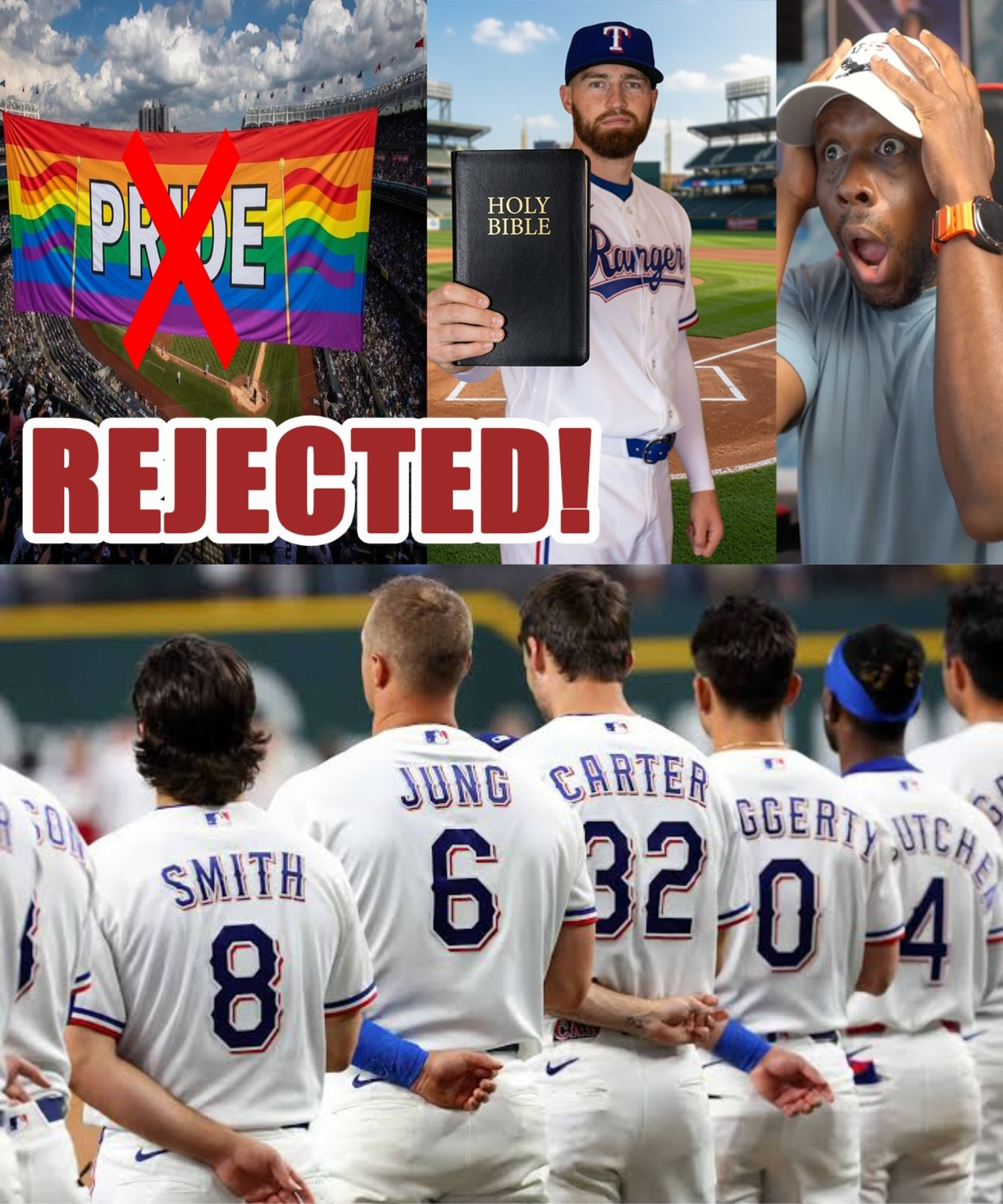
The host pointed to other teams that have embraced Pride-themed branding, including rainbow versions of logos and special event nights. He also referenced past controversy involving the Los Angeles Dodgers, who faced heavy backlash after inviting a drag performance group that some Christian critics accused of mocking religious beliefs. That incident became one of the most heated flashpoints in recent sports culture-war history.
In that context, the Rangers’ Faith and Family Night was seen by some conservatives as more than a local team event. It was viewed as a statement.
The event reportedly featured several Rangers players, including well-known names from the roster, speaking about faith after the game. Supporters noted that it did not interrupt play, did not force fans to participate, and did not require players to wear special uniforms. That detail became important in the debate. Critics of Pride Nights often argue that players should not be pressured into wearing symbols or participating in events that conflict with personal beliefs.
For many religious fans, the Rangers’ event felt different. It was voluntary, postgame, and focused on personal testimony rather than a league-wide message.
But LGBTQ supporters and progressive critics saw the matter differently. They argued that the Rangers’ refusal to host Pride Night while continuing to promote faith-based events creates an imbalance. To them, Pride Nights are not about forcing politics into sports. They are about telling LGBTQ fans that they are welcome in public spaces where they have not always felt safe.
That is the heart of the conflict.
One side sees Pride events as unnecessary political messaging. The other sees them as basic inclusion.
One side sees Faith and Family Night as a wholesome expression of religious liberty. The other questions why faith-based programming is embraced while LGBTQ recognition is avoided.
The Rangers organization has tried to stay above the shouting match. In previous statements, the team has said its commitment is to make everyone feel welcome and included at Rangers baseball, in the ballpark, at every game, and through community programs. The statement avoids directly framing the issue as left versus right, faith versus Pride, or religion versus LGBTQ identity.
But in today’s media environment, neutrality rarely satisfies anyone.
For conservative commentators, the Rangers’ approach is not merely neutral. It is courageous. They argue that sports leagues have spent years alienating traditional fans by embracing causes associated with progressive politics. They point to declining fan trust, backlash against activist messaging, and controversies over special theme nights as proof that leagues have gone too far.
For progressive critics, the Rangers are avoiding a simple act of recognition that every other MLB franchise has managed to embrace. They argue that a team can host Faith and Family Night and Pride Night without one canceling the other. To them, inclusion should not be treated as a zero-sum game.
The debate also touches a deeper American question: what belongs in sports?
Fans have long disagreed over military tributes, national anthem protests, racial justice campaigns, breast cancer awareness events, religious nights, patriotic ceremonies, and Pride celebrations. Every side claims some events are “not political” while others are. But the definition often depends on the viewer.
A military appreciation night may feel patriotic to one fan and political to another. A Pride Night may feel welcoming to one fan and ideological to another. A Faith and Family Night may feel wholesome to one fan and exclusionary to another.
That is why the Rangers controversy has become so explosive.
It is not just about one baseball team in Texas. It is about a divided country trying to decide whether sports can still be a shared space when Americans no longer agree on what should be celebrated publicly.
The timing made everything more charged. Holding Faith and Family Night in June gave the event symbolic weight, even if the team did not present it as a direct response to Pride Month. In the culture-war ecosystem, symbolism is enough. Within hours, commentators turned the event into a national story, with conservatives applauding and progressives criticizing.
The players who participated appeared focused on faith, not confrontation. But the media reaction turned their postgame gathering into something far larger than a personal religious event.
For many fans in Texas, the answer is simple: the Rangers are allowed to reflect the values of their fan base. Texas has a strong religious culture, and many supporters believe the team should not be pressured to copy every other franchise. They argue that welcoming all fans does not require every identity group to receive a special theme night.
For others, the concern is also simple: visibility matters. If every team except one is willing to publicly recognize LGBTQ fans, the one that refuses will inevitably draw attention.
As the debate continues, the Rangers remain in a unique position. They are praised by one side as the last MLB team standing against cultural pressure. They are criticized by the other as the last team refusing to take a basic step toward inclusion.
And in the middle are ordinary fans who simply came to watch baseball.
That may be the most revealing part of the controversy. In modern America, even a postgame faith event in a bullpen can become a national referendum on politics, religion, sexuality, corporate power, and free expression.
The Texas Rangers did not need a loud announcement to ignite the debate.
All they had to do was hold Faith and Family Night in June.
And once again, America turned a baseball field into a battlefield.