Sunni-Shia Unity Fight Explodes in America as New York Politics, Iran, and Online Influencers Collide
Sunni-Shia Unity Fight Explodes in America as New York Politics, Iran, and Online Influencers Collide
A fierce new debate over Muslim unity, Sunni-Shia rivalry, Iran, Gaza, and New York politics has erupted across the American internet, exposing a question many Western politicians rarely want to touch: can a divided religious world suddenly unite when power is on the table?
The controversy began with a viral discussion about Sunni and Shia Muslims, after commentators reacted to claims that declaring mainstream Shia Muslims as disbelievers is a fringe and unacceptable position. That argument may sound theological, but in 2026 America, it is no longer confined to mosques, scholars, or online religious circles. It now touches elections, foreign policy, campus activism, Middle East lobbying, and the rise of Muslim political figures in major American cities.
At the heart of the dispute is the old wound inside Islam: the Sunni-Shia split. For centuries, the division has shaped dynasties, religious authority, wars, alliances, and identity across the Middle East and beyond. In modern politics, it often appears through the rivalry between Sunni-led Gulf states and Shia-led Iran. But now, as the Gaza war, anti-Israel protests, and Muslim political activism reshape Western debates, some influencers are calling for a renewed “Ummah” — a united Muslim community that puts sectarian arguments aside.
That call for unity is being praised by some as long overdue.
Others see it as dangerous, dishonest, or impossible.
In the viral exchange, one side argued that Sunni scholars historically did not treat mainstream Shia Muslims as disbelievers, and that the harshest anti-Shia views came from more extreme or more recent movements. The message was clear: Muslims should stop tearing each other apart over sect and unite over shared causes, especially Palestine.
But critics fired back with brutal skepticism. They argued that Muslim unity is often invoked only when politically convenient, while Sunni-Shia hostility, ethnic divisions, racial hierarchies, and national rivalries remain deeply embedded across many societies. They pointed to tensions between Arabs, Turks, Persians, Pakistanis, Bangladeshis, Africans, Gulf states, Iranians, and converts in the West. In their view, the dream of Muslim unity collapses the moment real power, history, doctrine, or national interest enters the room.
That argument is now landing inside America because the United States is home to millions of Muslims from different backgrounds — Sunni, Shia, immigrant, Black American, Arab, South Asian, Iranian, Turkish, African, Bosnian, Albanian, and converts. In daily American life, many of these communities coexist peacefully. But online, the global conflicts often follow them.
Nowhere is that more politically sensitive than New York.
The transcript references allegations surrounding Mayor Zohran Mamdani and whether he presents himself differently in Sunni religious spaces despite claims about Shia background or Shia-adjacent identity. The argument itself remains part of the online commentary ecosystem, not a settled public fact. But the reason it matters is obvious: Mamdani is not just a private citizen. He is one of the most visible Muslim political figures in America, and his rise has turned Muslim identity into a mainstream political subject in the country’s largest city.
For supporters, Mamdani represents a historic breakthrough — proof that New York’s immigrant, Muslim, progressive, and working-class communities can build real power. For critics, his rise is a warning that religious identity, anti-Israel politics, and far-left organizing are converging in ways the Democratic establishment does not fully understand.
That is where the Sunni-Shia debate becomes bigger than theology.
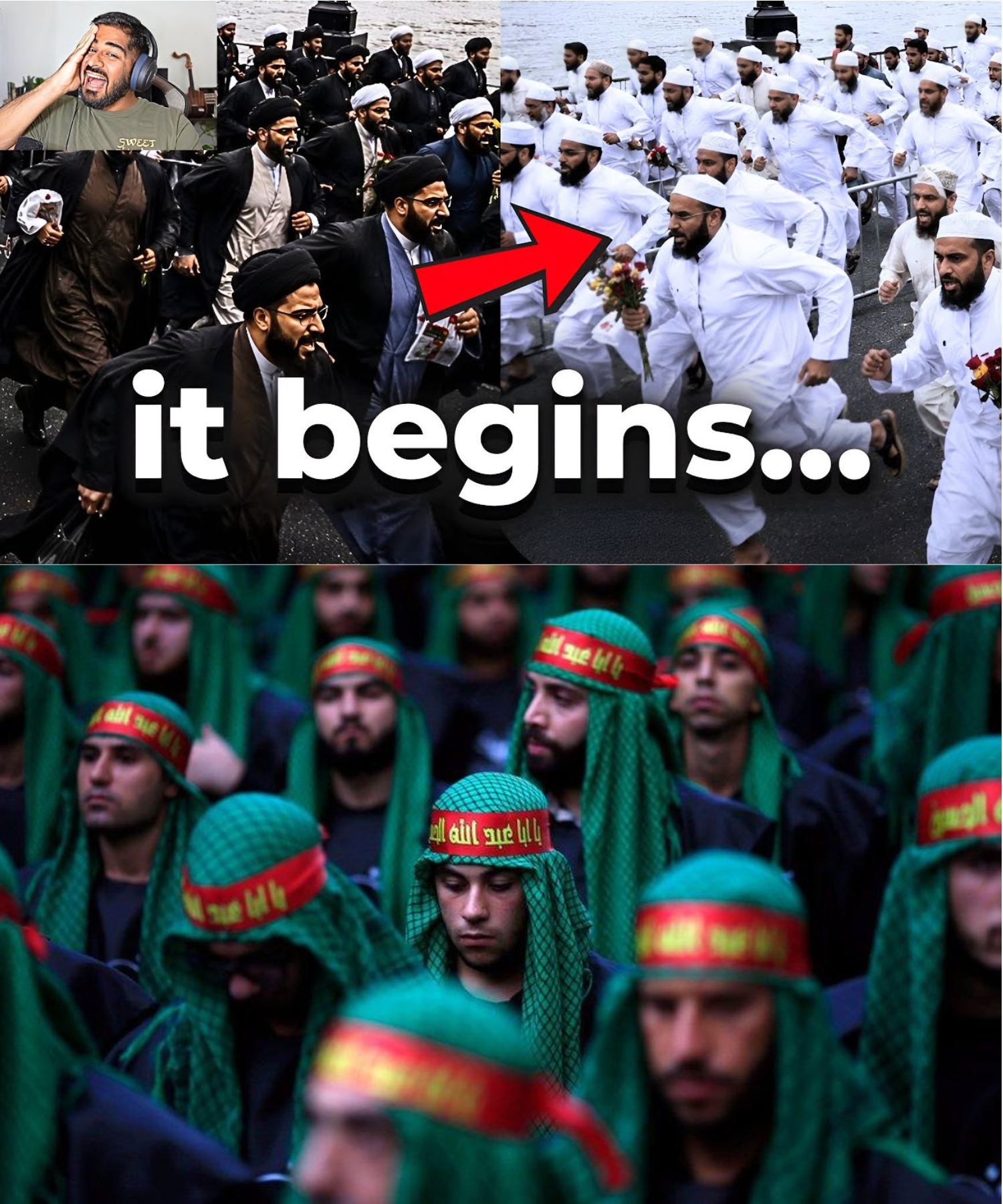
If Muslim activists in America seek political unity, which version of Islam becomes the public face? Sunni? Shia? Progressive? Islamist? Nationalist? Anti-Zionist? American civic Muslim? Each camp has different priorities, different histories, and different enemies. A rallying cry for unity may sound powerful on a livestream, but on the ground, unity requires groups with deep disagreements to suppress old arguments for a common cause.
Gaza has become that common cause for many.
Across campuses, city streets, and social media platforms, the Palestinian issue has pulled together Muslims from different backgrounds, along with left-wing activists, anti-war organizers, some Christians, some Jews, and secular progressives. The emotional force is undeniable. For many Muslims, Gaza is not simply a foreign-policy issue. It is a test of whether the world values Muslim life.
But the Gaza cause has also exposed fractures.
Some activists praise Iran as the only state willing to confront Israel and support armed resistance. Others reject Iran as an authoritarian Shia regime that has its own record of repression and regional violence. Gulf states, meanwhile, are often attacked by online activists as cowardly, compromised, or too close to Washington and normalization politics. The UAE, Saudi Arabia, Bahrain, Qatar, Jordan, and Egypt all face accusations from different directions: too passive, too pragmatic, too self-interested, or too afraid.
In American terms, this becomes a foreign-policy nightmare.
Washington wants stable Gulf partners, energy security, counterterrorism cooperation, normalization agreements, and containment of Iran. But online Muslim activism increasingly divides the map differently: not by U.S. strategic interests, but by who is seen as resisting Israel, supporting Palestinians, or betraying the Ummah.
That divide is now being imported into American political discourse.
The debate also reveals the strange power of influencers. Figures who recently converted to Islam or built political brands online are now speaking about centuries-old sectarian disputes, Iran, the Muslim Brotherhood, Salafism, Madkhalism, Shia authority, Sunni governments, and global resistance. To supporters, these voices are energizing a younger generation. To critics, they are oversimplifying explosive subjects they barely understand.
The danger is that social media rewards certainty, not wisdom.
A scholar can spend years explaining sectarian history. A TikTok clip can erase all nuance in 30 seconds. A livestream can turn a theological distinction into a street fight. A slogan can transform foreign policy into identity warfare. And once the argument reaches American politics, every group tries to weaponize it.
That is why the current debate matters.
It is not enough to say “Muslims are divided,” because that erases millions of peaceful believers who live normal lives and have no interest in sectarian conflict. But it is also dishonest to pretend the Sunni-Shia divide has no political consequences. It shapes the Middle East. It shapes alliances. It shapes attitudes toward Iran. It shapes how Muslim communities respond to Gaza. And increasingly, it shapes how Western cities understand Muslim political power.
America is watching this unfold in real time.
New York is becoming a laboratory. Campus politics is becoming a battlefield. Online religious influencers are becoming political interpreters. Gaza is becoming the emotional trigger. Iran is becoming the dividing line. And the old Sunni-Shia wound, long treated by many Americans as a distant Middle Eastern dispute, is now appearing inside American debates about identity, loyalty, and power.
The call for Muslim unity may sound inspiring.
But unity built on unresolved sectarian distrust is fragile.
The question now is not whether Muslims in America can participate in politics. They can, and they will. The deeper question is whether American politics is ready for the full complexity of the religious, ethnic, and geopolitical conflicts that may come with that rise.
Because the fight over the Ummah is no longer just happening in the Middle East.
It is happening on American screens, in American cities, and soon, perhaps, at the ballot box.