Street Clash in Manchester Goes Viral as Assault Allegation, Immigration Rhetoric, and Religious Tensions Ignite Online Firestorm
Street Clash in Manchester Goes Viral as Assault Allegation, Immigration Rhetoric, and Religious Tensions Ignite Online Firestorm
New York — A chaotic street confrontation in Manchester has gone viral across social media after a street content creator alleged he was attacked by an unidentified individual who threw a heavy object at him, triggering a heated exchange involving accusations of violence, immigration policy, religious provocation, and rising street-level tensions in the United Kingdom.
The footage, widely circulated by commentary channels in both the UK and the United States, shows a group of individuals confronting a man wearing a balaclava, while another speaker describes being struck by a thrown object moments earlier.
The incident has quickly escalated into a broader debate about urban safety, immigration enforcement, and the role of online street journalism in exposing — or inflaming — public conflict.
“He Should Be Deported” — Allegations and Immediate Escalation
At the center of the viral clip is an allegation made by the street commentator that a man known as “Elbow Boy” approached from behind and threw a heavy object, striking him in the leg.
“You can’t really defend against that sort of thing,” the narrator says in the footage, before stating that police have been contacted and demanding that the alleged attacker be deported, describing him as “dangerous” and unfit to remain in the country.
The accused individual, appearing later in the video wearing a balaclava, is confronted directly. Tensions escalate quickly as insults are exchanged, with the content creator questioning his appearance and accusing him of previous personal attacks.
The situation intensifies further as bystanders gather and the exchange becomes increasingly hostile, though no official police report has yet confirmed the details of the alleged assault.
Balaclavas, Accusations, and Street Identity
One of the most widely shared moments in the footage is the confrontation involving the balaclava-wearing individual.
The content creator repeatedly challenges him about his identity and appearance, asking why he is covering his face. The accused responds with defiance, while others in the group accuse the narrator of provoking the situation and spreading online accusations.
The exchange reflects a growing trend in UK street content culture, where anonymous or masked individuals are often confronted by independent video creators attempting to document public behavior in real time.
Supporters of such content argue it exposes antisocial behavior and crime. Critics argue it can escalate tensions and blur the line between documentation and provocation.
Religious Questions and Escalating Personal Attacks
The confrontation takes a sharper turn when religious identity is introduced into the exchange.
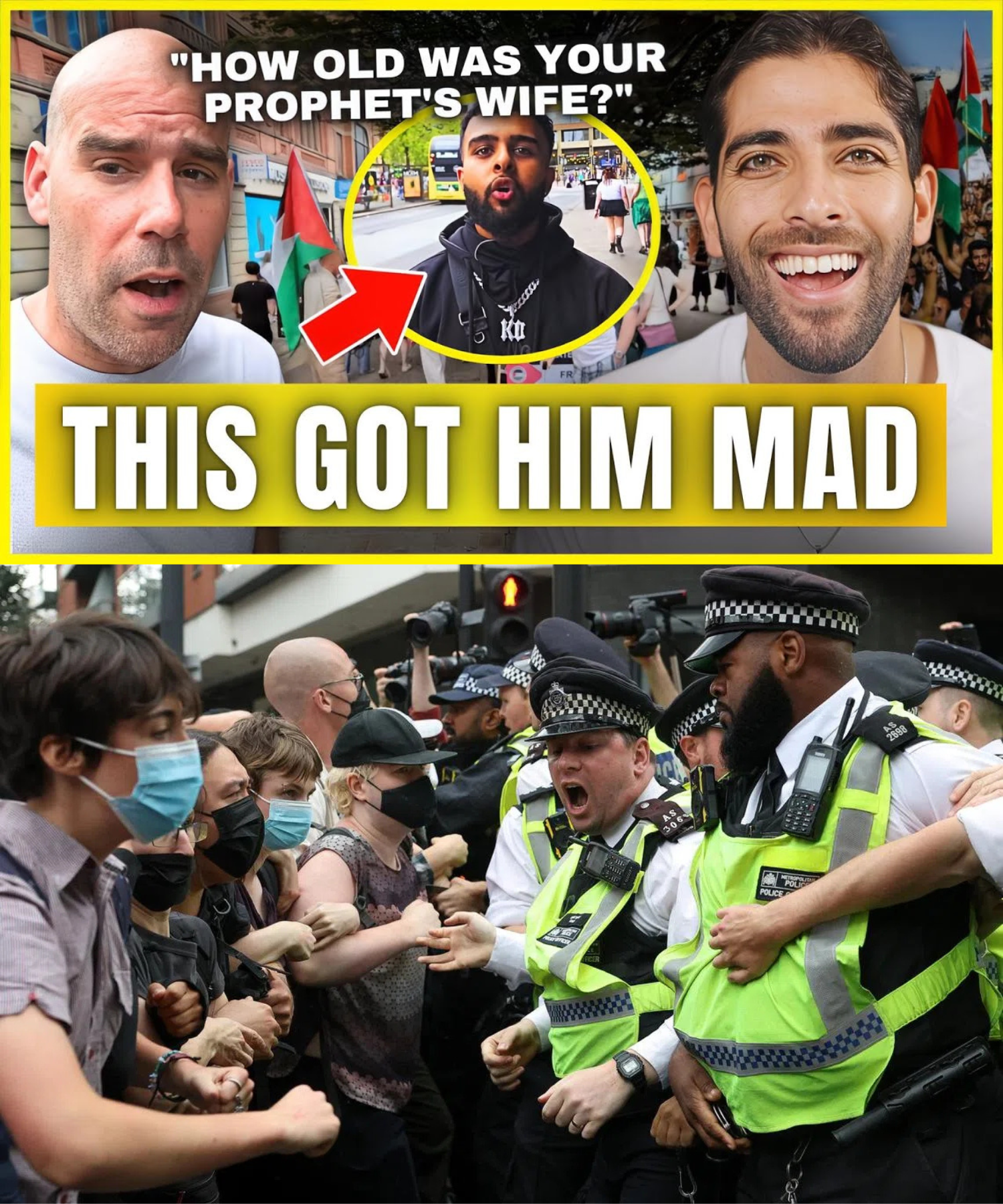
At one point, the discussion shifts toward Islam, with questions raised about the Prophet Muhammad and controversial historical narratives often cited in online debates. The accused responds, stating that Muhammad’s wife was nine years old — a claim frequently referenced in polemical discussions but also widely debated among scholars regarding historical interpretation and sources.
The conversation quickly becomes hostile, with insults exchanged on both sides. The content creator challenges the man’s religious beliefs and personal behavior, while the accused responds with verbal aggression.
Experts warn that such exchanges, especially when filmed and shared online, often strip complex theological and historical discussions of context, turning them into flashpoints for confrontation rather than dialogue.
Weapons Allegations and Public Safety Concerns
In another segment of the video, the narrator references an unrelated incident involving a separate individual allegedly detained at a music festival with a machete.
He uses this example to highlight what he describes as broader concerns about public safety at large events in Manchester, suggesting that weapons and violent behavior are becoming more common in certain environments.
The claim, however, is not independently verified in the footage and remains part of the narrator’s broader commentary on crime and disorder.
Law enforcement data in the UK shows ongoing debates over knife crime and youth violence in urban areas, though officials caution against generalizing isolated incidents into broader societal conclusions.
Street Journalism Meets Social Media Spectacle
The video also includes meta-commentary on the content creator’s own filming style, with praise for independent street journalism and its ability to capture unfiltered interactions in public spaces.
Supporters argue that such content provides transparency, exposing real-life tensions that traditional media may overlook. Critics argue that it often prioritizes confrontation over context, turning vulnerable or chaotic moments into viral entertainment.
The creator himself acknowledges the simplicity of his setup — often just a phone and minimal equipment — but argues that authenticity is more important than production value.
Immigration, Identity, and Rising Political Tensions
The confrontation soon expands into broader commentary about immigration and national identity in the UK.
The narrator suggests that individuals engaging in violence or antisocial behavior should be deported if they are not citizens, framing the incident as part of a wider failure of immigration policy.
These remarks have fueled intense debate online, with supporters arguing that governments must take stronger action against repeat offenders, while critics warn that such framing risks stigmatizing entire immigrant communities based on isolated incidents.
Social Media Reaction: Divided and Intensifying
The viral clip has sparked sharply divided reactions across social media platforms in both the UK and the United States.
Supporters of the street creator argue that he is documenting real conditions in urban Britain and exposing behavior that mainstream media ignores. They point to rising concerns about crime, public disorder, and cultural tensions as evidence that such reporting is necessary.
Critics, however, accuse the video of amplifying conflict, escalating confrontations for content, and framing complex social issues through a lens of provocation and generalization.
Some commentators also warn that religious and immigration-related discussions in such settings often lack nuance and risk inflaming already sensitive public debates.
A Larger Debate About Public Space and Online Conflict
Beyond the immediate confrontation, the incident reflects a broader transformation in how public spaces are documented and contested in the digital age.
Street interactions that once would have been private or local disputes are now instantly recorded, uploaded, and interpreted by global audiences. This has created a new ecosystem where public confrontation is not only witnessed — but monetized and amplified.
Experts say this shift raises difficult questions about accountability, safety, and responsibility in online journalism and content creation.
No Clear Resolution
As of now, no official confirmation has been released regarding the alleged assault, and the identities and circumstances of those involved remain disputed in public commentary.
What remains clear, however, is that the viral video has become more than a local street incident.
It has become a symbol of deeper tensions — over immigration, identity, religion, and the role of citizen journalism in documenting conflict.
And like many viral confrontations before it, it leaves behind more questions than answers about what really happened — and what it says about the society watching it unfold.