Piers Morgan’s Gaza Numbers Showdown Shakes U.S. Debate as War Expert Fails to Give Civilian Death Count
Piers Morgan’s Gaza Numbers Showdown Shakes U.S. Debate as War Expert Fails to Give Civilian Death Count
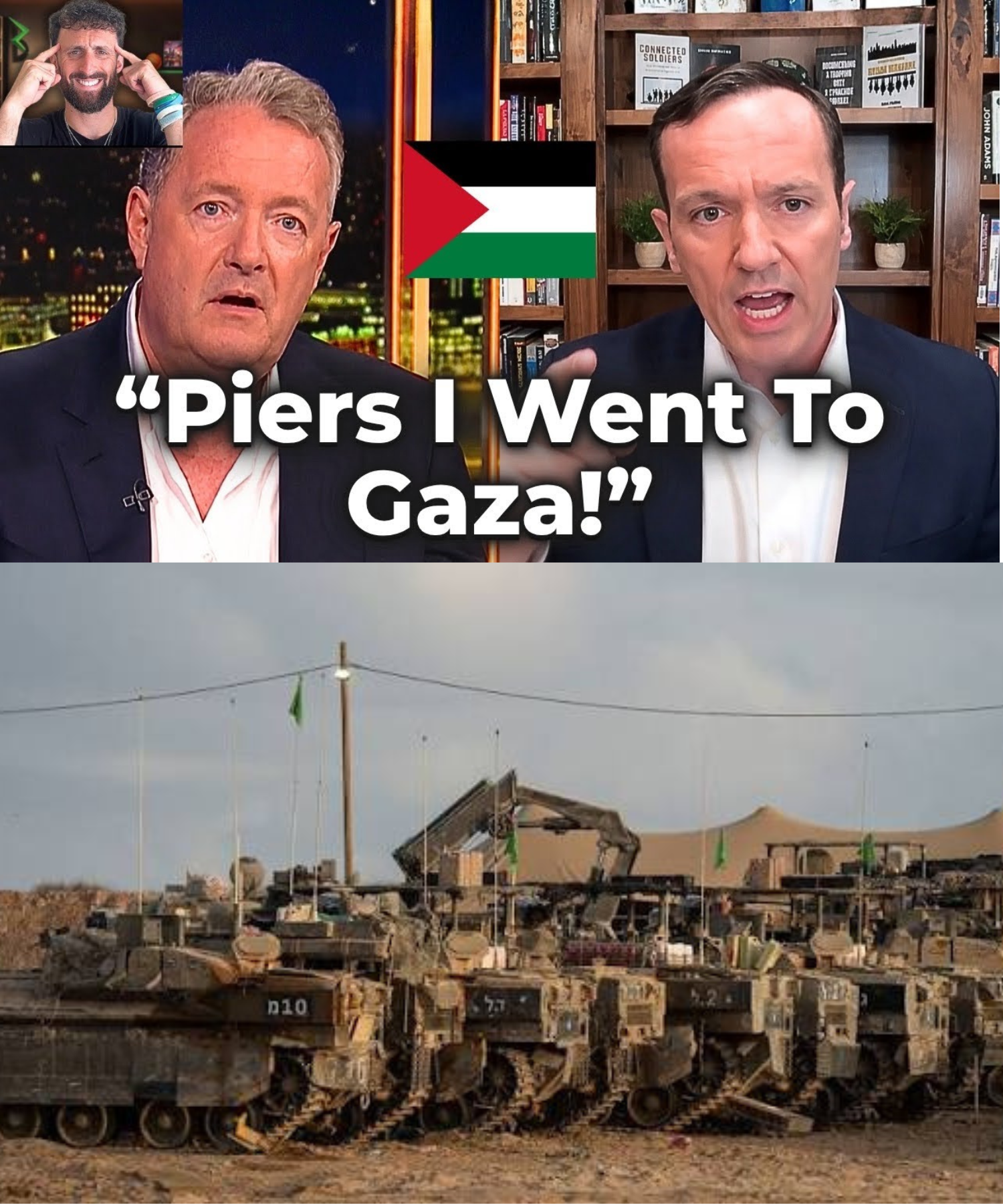
A tense exchange over Gaza’s civilian death toll has exploded across the American media landscape after Piers Morgan pressed urban warfare scholar John Spencer on one question that millions of viewers are now repeating: if Israel’s civilian-to-combatant casualty ratio is supposedly among the best in modern warfare, then how many civilians have actually been killed?
The confrontation was not just another television argument. It became a brutal test of wartime credibility, moral language, military analysis, and the limits of statistics in one of the most emotionally charged conflicts in the world.
Spencer, a prominent expert in modern urban warfare, has long argued that the Israel Defense Forces implemented extraordinary measures to reduce civilian harm in Gaza. His defenders say he understands the brutal realities of fighting an entrenched militant force inside a dense urban battlefield. His critics say his claims rely too heavily on Israeli military sources and fail to confront the scale of devastation visible across Gaza.
Morgan went directly at the weak point.
He asked how anyone could claim Gaza produced an unusually low civilian casualty ratio without knowing the two numbers that make the ratio possible: civilians killed and combatants killed.
Spencer pushed back by saying the available data is complicated, contested, and often misunderstood. Gaza’s death toll figures, commonly cited from the Gaza Health Ministry, do not clearly separate fighters from civilians. Israel publishes its own estimates of Hamas combatants killed, but those estimates are also disputed. In short, the war has produced numbers, but not clean numbers.
Morgan was not satisfied.
Again and again, he asked for the civilian figure. How many civilians were killed? How many non-combatants were killed? What is the actual number?
The exchange quickly became uncomfortable.
Spencer tried to explain the broader methodology of war analysis, comparing Gaza to other conflicts and arguing that aggregate figures require context. He pointed to urban warfare, Hamas’s use of civilian areas, evacuation warnings, the destruction of buildings used for military purposes, and the difficulty of counting combatants in a war where fighters do not always wear uniforms.
But Morgan kept returning to the same point: if you do not know the civilian number, you cannot confidently claim the ratio.
That moment is why the clip has gone viral in the United States.
For supporters of Israel, Spencer’s broader argument still matters. They say Hamas embedded itself in tunnels, homes, schools, hospitals, and dense civilian neighborhoods, making civilian harm tragically difficult to avoid. They argue that Israel warned civilians, delayed strikes, opened evacuation routes, used phone calls, leaflets, text messages, and other methods to reduce casualties. To them, the destruction in Gaza is terrible, but it does not automatically prove indiscriminate killing.
For critics of Israel, Morgan exposed the central problem with pro-Israel military analysis. They argue that Israel’s defenders often claim precision, restraint, and historic civilian protection while being unable to explain how many civilians were killed. To them, that is not a minor gap. It is the whole issue.
The fight over Gaza is no longer only about what happened. It is about who gets believed.
Israel says it fought Hamas after the October 7 attacks and took unprecedented steps to reduce civilian deaths. Palestinian authorities and human rights groups say the destruction, starvation, displacement, and death toll reflect an unbearable assault on civilian life. International lawyers debate war crimes, proportionality, distinction, forced displacement, and genocide. Activists argue in slogans. Families bury the dead.
Somewhere inside all of that, the numbers become both essential and impossible.
That is the tragedy of this debate.
Without numbers, accountability becomes vague. With numbers, propaganda becomes easy. One side cites total deaths to prove mass civilian suffering. The other subtracts alleged combatants to argue the military ratio is defensible. But if no one agrees on who is a combatant, who is a civilian, who is missing under rubble, or how many fighters have been killed, every claim becomes another weapon.
Morgan also challenged Spencer on access.
He argued that foreign journalists have not been allowed to operate freely inside Gaza and suggested that if Israel has nothing to hide, it should allow independent reporters to see the territory without military control. Spencer rejected the idea that journalist restrictions automatically prove concealment, noting that other war zones have also limited access. But for many viewers, Morgan’s point landed hard: if the world is being asked to accept official narratives, then independent eyes matter.
That issue has become one of the biggest media questions of the war.
A battlefield that cannot be freely reported becomes a battlefield narrated by power. Israel controls much of the outside access. Hamas has controlled parts of the internal information environment. Local Palestinian journalists have worked under catastrophic danger. Foreign media organizations have repeatedly demanded entry. Viewers around the world are left trying to judge reality through fragments: military briefings, ministry numbers, phone footage, satellite images, testimony, embedded visits, and partisan analysis.
For Americans, the debate cuts even deeper because the United States is not a spectator.
Washington has supplied Israel with military aid, diplomatic backing, weapons, intelligence cooperation, and political cover. American voters are therefore not merely watching a foreign war. They are watching a war tied to their tax dollars, their foreign policy, and their country’s moral reputation.
That is why Morgan’s question felt so explosive.
It was not just “How many civilians died?”
It was really: what are we defending?
If Israel’s supporters want Americans to believe the IDF fought with extraordinary restraint, they must be able to defend that claim under pressure. If Israel’s critics want Americans to accept that the war was indiscriminate or criminal, they must also confront the complexity of Hamas’s tactics and the difficulty of combatant identification in urban war.
But neither side can escape the human reality.
Behind every ratio is a body. Behind every statistical model is a family. Behind every destroyed building is someone’s home, memory, kitchen, photograph, bed, and future. Military scholars may speak in categories: combatant, non-combatant, proportionality, mitigation, operational necessity. But grief does not speak that way.
To a mother searching rubble, the ratio is irrelevant.
To a soldier fighting militants in a tunnel network, the ratio may feel unfairly detached from battlefield reality.
To an American viewer watching from thousands of miles away, the entire argument may feel impossible — yet morally unavoidable.
The Morgan-Spencer exchange did not settle the Gaza debate. It exposed why the debate cannot be settled easily.
Israel’s defenders say context changes everything.
Israel’s critics say the death toll changes everything.
Piers Morgan asked for a number.
John Spencer gave an explanation.
And in that gap between number and explanation, America’s argument over Gaza has entered a new and far more dangerous phase.