Palestinian Flag Video in California Sparks Explosive U.S. Debate Over Patriotism, Fear, and the Collapse of Empathy
Palestinian Flag Video in California Sparks Explosive U.S. Debate Over Patriotism, Fear, and the Collapse of Empathy
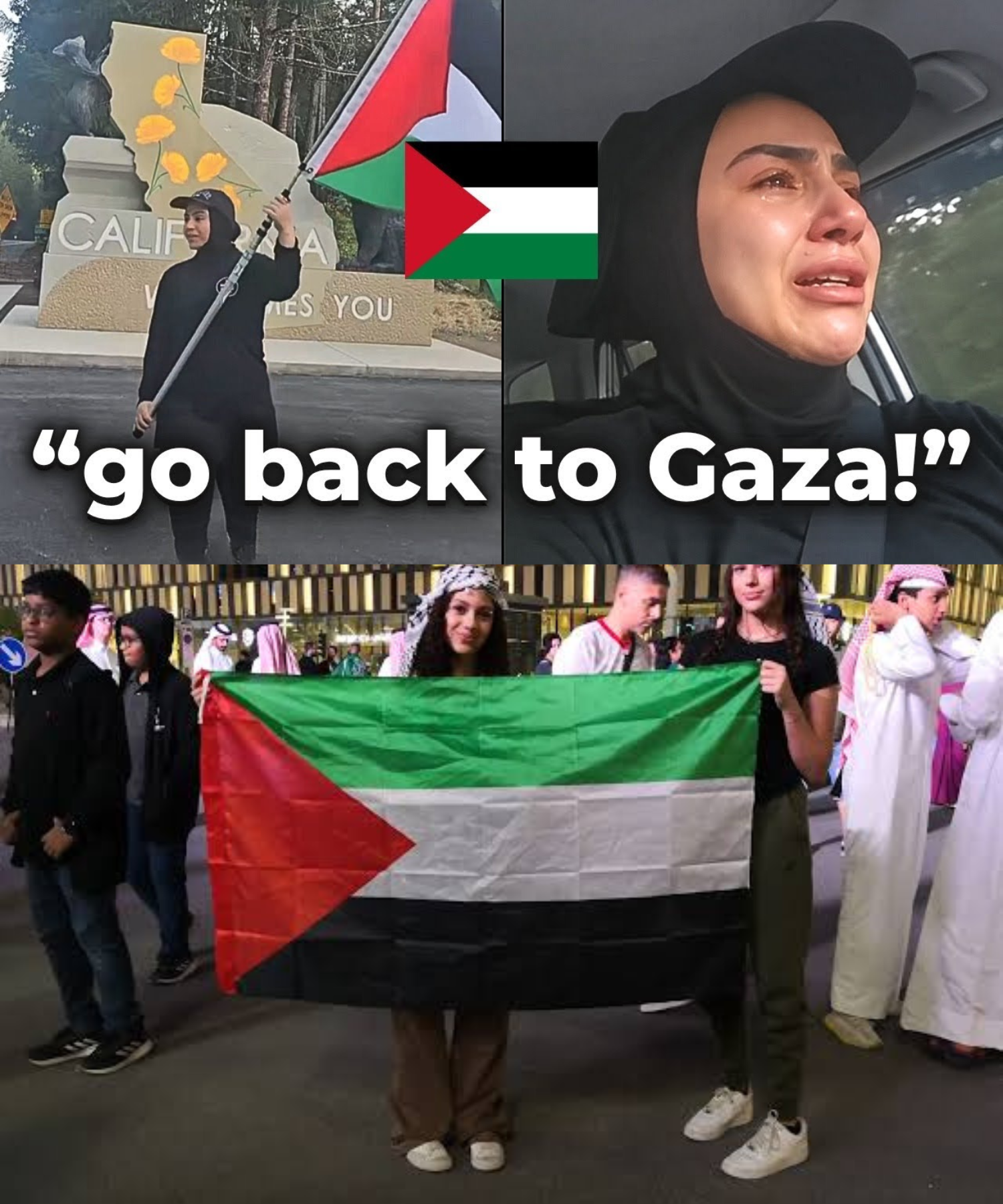
A viral video from California has ignited a fierce national debate after a woman driving with a Palestinian flag said she was cursed at, screamed at, and followed by multiple cars whose occupants shouted “USA” while confronting her on the road.
The clip, now spreading across American social media, captures one of the most volatile emotional fault lines in the country since the Israel–Hamas war erupted into global protest culture. What began as one woman’s public display of solidarity quickly turned into a frightening roadside encounter — and then into a much larger argument about flags, fear, identity, patriotism, and whether Americans are losing the ability to see one another as human beings.
According to the woman in the video, the incident happened in California, a state often seen as more politically progressive and more tolerant of public activism than many others. That made the encounter feel even more jarring to her. She said she had been driving with a Palestinian flag when not one, but several cars approached, with people yelling insults and chanting “USA.”
In the footage, the woman appears shaken after pulling over. She says she had to calm herself down, check whether anyone was following her, and process what had just happened. Her voice trembles as she says she felt transported back to junior high school, as if she were being bullied by adults who had never matured emotionally.
Her message was clear: she did not understand how people could be so hateful.
But the reaction online was anything but unified.
Supporters of the woman said the incident showed how dangerous the climate has become for anyone publicly expressing pro-Palestinian views in America. They argued that waving a Palestinian flag should not make someone a target for intimidation, harassment, or road rage. In their view, the drivers chanting “USA” were not defending America. They were betraying American principles by trying to scare someone into silence.
Civil liberties advocates echoed that point. In the United States, people have a right to display political symbols, flags, signs, and messages, even when others strongly disagree. The First Amendment protects speech that angers people, offends them, or challenges popular opinion. A Palestinian flag, an Israeli flag, an American flag, a Ukrainian flag, a religious sign, or a political banner can all become emotionally charged — but none of them gives strangers the right to threaten or harass someone on the road.
But critics of the woman saw the moment differently.
Some argued that waving a Palestinian flag in America at this particular moment is not a neutral act. Since the October 7 attacks in Israel and the war in Gaza that followed, the Palestinian flag has carried different meanings to different audiences. To some, it represents Palestinian civilians, grief, displacement, and demands for human rights. To others, especially Jewish Americans and Israelis, it can feel connected to protests where Hamas atrocities were denied, minimized, or even celebrated.
That collision of meaning is exactly why the video became so explosive.
One commentator reacting to the clip said that while the behavior of the people yelling at the woman was crude and ugly, he also questioned what she expected when waving such a flag in the United States during a time of intense national emotion. That response triggered its own backlash. Many viewers said the suggestion sounded like blaming the woman for being harassed. Others said symbols do not exist in a vacuum, and public displays can provoke strong reactions when tied to war and trauma.
The woman, still visibly emotional in the video, insisted that the people screaming at her were either ignorant of what is happening or simply did not care. She told viewers to read books, study articles, and watch something productive instead of reacting with hate.
That line opened another front in the debate.
Pro-Palestinian activists often argue that if Americans truly understood the history of Israeli occupation, Palestinian suffering, Gaza’s destruction, and civilian casualties, they would not respond with rage to a Palestinian flag. They believe ignorance allows people to treat Palestinian symbols as automatically threatening.
But pro-Israel voices pushed back just as forcefully. One response to the video argued that for every book someone recommends about Palestinian suffering or Zionism being the root of evil, Jewish people can point to their own history of trauma, persecution, massacres, terrorism, and survival. The speaker referenced the Nova Festival, where civilians were killed during the October 7 attacks, and described the pain of losing friends to radical violence.
That response shifted the debate away from one car ride and toward the deeper wound underneath it.
Both sides believe they are asking to be seen.
Palestinian supporters say they want Americans to see the devastation in Gaza, the dead children, the displaced families, the shattered neighborhoods, and the fear of a people who feel abandoned. Jewish and Israeli supporters say they want Americans to see the hostages, the murdered concertgoers, the families burned and slaughtered, the historic attempts to destroy Jews, and the fear of a people who know what it means to be hunted.
That is why the word “empathy” became the emotional center of the viral conversation.
One commentator responding to the clip said that no real progress is possible until both sides stop treating the conflict as a zero-sum game. The argument was not that policy does not matter, or that history does not matter, or that one side should surrender its claims. The argument was that without empathy, every debate becomes another battlefield. Every flag becomes a weapon. Every stranger becomes an enemy.
That message has struck a nerve in America because the Israel–Palestine conflict has become one of the most polarizing subjects in public life. Families argue about it. Students lose friendships over it. Protests erupt on campuses. Jewish Americans fear rising antisemitism. Palestinian and Muslim Americans fear being treated as terrorists or sympathizers simply for grieving Palestinian deaths.
The California video condensed all of that into a few minutes on the road.
A woman waved a flag. Drivers screamed “USA.” She pulled over shaking. The internet split instantly.
Some saw intimidation.
Some saw provocation.
Some saw patriotism.
Some saw cruelty.
But the bigger story is not only about the flag. It is about what America is becoming when global conflicts are imported into local streets, highways, campuses, restaurants, and neighborhoods. A war thousands of miles away is now shaping how Americans look at each other in traffic.
That is a dangerous place for a country to be.
If waving a Palestinian flag makes someone feel unsafe, America has a problem. If seeing that flag makes Jewish Americans feel that their trauma is being dismissed, America also has a problem. If chanting “USA” becomes a way to intimidate rather than unite, the meaning of patriotism itself is being twisted.
The United States is supposed to be a place where people can argue fiercely without trying to terrify one another. It is supposed to be a place where grief can be voiced without erasing someone else’s grief. It is supposed to be a place where empathy does not require agreement.
The California incident shows how far the country is from that ideal.
And yet, hidden beneath the anger, the video also points to the only way forward.
Not silence. Not surrender. Not harassment. Not blind loyalty to any side.
Empathy.
Until Americans can look at a Palestinian flag and an Israeli memorial with the same human seriousness, the shouting will continue — on campuses, online, in streets, and now, even on the highway.