Oxford Union Debate on Islam and Democracy Goes Viral as Free Speech Clash Ignites Global Backlash
Oxford Union Debate on Islam and Democracy Goes Viral as Free Speech Clash Ignites Global Backlash
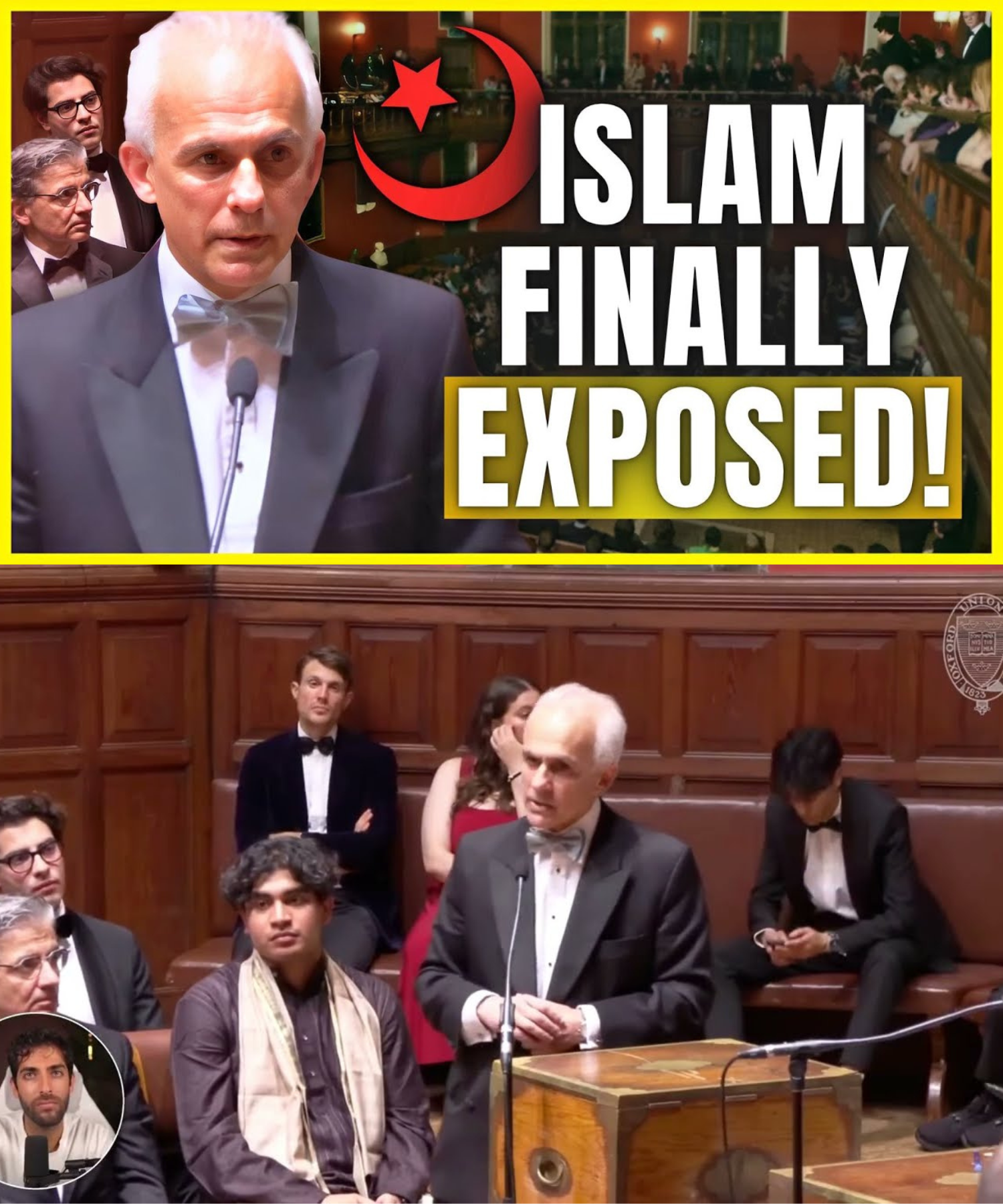
New York — A fiery speech delivered at the Oxford Union arguing that Islam is incompatible with liberal democracy has gone viral across the United States and Europe, reigniting one of the most sensitive debates in Western political discourse: whether religious doctrine can coexist with modern liberal democratic values.
The speech, delivered during a high-profile debate on whether Islam is compatible with democracy, has triggered widespread controversy, with supporters calling it a defense of free speech and critics accusing it of promoting sweeping generalizations about a global religion practiced by more than a billion people.
At the center of the debate is a speaker who argues that Islam, as currently interpreted in many contexts, cannot be reconciled with the principles of liberal democracy in the United Kingdom or broader Western society.
“This Is a Bastion of Free Speech”
The speaker opened his remarks by emphasizing the importance of free expression, stating that he would speak “without fear and without favor” in what he described as a platform committed to open debate.
He immediately reframed the motion, arguing that the relevant question is not whether Islam could theoretically coexist with democracy in abstract terms, but whether it is compatible with the specific form of liberal democracy practiced in the United Kingdom.
That distinction became central to his argument: he was not debating hypothetical future reform or alternative systems, but the current lived reality of Western liberal institutions.
Free Speech Controversy at the Core
To support his argument, the speaker referenced two contrasting incidents in British public life.
He described a case involving a university dean who defended controversial academic statements about religious imagery and gender interpretation, suggesting that the incident received limited long-term consequences.
He contrasted this with the case of a British schoolteacher in Batley who circulated caricatures of the Prophet Muhammad and subsequently faced threats, job consequences, and was forced into hiding.
The speaker argued that this disparity illustrates a fundamental tension in British society: while criticism of Christianity or Western religious figures may be socially tolerated, criticism of Islam can carry significantly higher personal risk.
This claim has become one of the most widely discussed elements of the debate, with supporters arguing it highlights a genuine imbalance in free speech protections, while critics argue it oversimplifies complex security and community dynamics.
Quran, Doctrine, and the Question of Reform
A significant portion of the speech focused on Islamic theology, particularly the Quran’s status as divine revelation.
The speaker described the Quran as the literal and perfect word of God in Islamic belief, arguing that this creates a structural challenge for reform, since divine scripture is, by definition, considered unchangeable by believers.
From this perspective, he argued, attempts to reinterpret or modernize core religious principles face inherent theological limits.
He suggested that this makes certain reforms — particularly regarding issues such as speech, criticism of religion, and legal interpretation — extremely difficult within traditional frameworks.
This claim sparked immediate backlash from scholars and religious commentators, many of whom argue that Islamic jurisprudence has historically included diverse schools of interpretation, philosophical reasoning, and adaptation to changing social contexts.
Women’s Rights, LGBTQ Issues, and Legal Compatibility
The speaker extended his argument into broader social questions, claiming that Islamic legal frameworks in some interpretations conflict with Western norms regarding women’s rights and LGBTQ equality.
He argued that in certain countries governed by strict interpretations of Islamic law, legal and social restrictions on these groups demonstrate incompatibility with liberal democratic values.
Critics of the speech argue that this framing conflates state policy in specific countries with the beliefs of all Muslims worldwide, ignoring the diversity of Muslim-majority societies and the presence of progressive Islamic thought.
Supporters, however, argue that the speaker is highlighting real-world legal outcomes in jurisdictions where religious law plays a dominant role.
Reform Debate: Can Religion Change?
A central question raised during the debate was whether Islam can reform in a way similar to other religious traditions that have undergone historical reinterpretation.
The speaker expressed skepticism, arguing that if a religious text is believed to be the unalterable word of God, then fundamental reinterpretation may be inherently limited.
He acknowledged the existence of reformist voices within Islam but questioned whether such movements could achieve widespread doctrinal change.
This argument has become a focal point in online reactions, particularly among critics who argue that Christianity and Judaism also contain doctrines that have evolved over time through interpretation rather than abandonment of core texts.
Audience Reaction and Immediate Backlash
The debate audience responded with mixed reactions, including applause, interruptions, and visible disagreement.
Some attendees supported the speaker’s emphasis on free speech and open criticism of religion, arguing that Western democracies must allow all ideas to be discussed, even controversial ones.
Others accused the speech of promoting essentialism — the idea that Islam as a whole can be defined by selective interpretations of doctrine or by the actions of specific states and groups.
The tension in the room reflected a broader cultural divide that extends far beyond Oxford.
Viral Spread in the United States
Within hours of being circulated online, the speech gained traction across American social media platforms, where it became a flashpoint in ongoing debates over immigration, religious identity, and free expression.
In the United States, similar controversies have emerged on college campuses and in public discourse, particularly following geopolitical conflicts involving the Middle East.
Supporters of the speech argue that it raises necessary questions about integration, legal pluralism, and freedom of expression in diverse societies.
Critics argue that it risks reinforcing stereotypes and fueling discrimination against Muslim communities who fully participate in democratic life.
A Debate Without Resolution
As the discussion concluded, no consensus was reached.
Instead, the debate crystallized into two opposing frameworks:
One side argues that Islam, as currently practiced in many legal and political systems, faces structural challenges in reconciling with Western liberal democracy.
The other side argues that Islam is a diverse and evolving global religion, and that focusing on its most restrictive interpretations misrepresents the beliefs of the majority of Muslims.
The Larger Question for the West
The viral nature of the debate reflects a deeper question now facing Western societies: how to balance freedom of speech with religious sensitivity, and how to discuss ideological differences without generalizing entire communities.
As the clip continues to circulate, it has become more than just an Oxford debate.
It has become a symbol of a larger unresolved conflict in Western political culture — between absolute free expression and the challenge of interpreting religion in a pluralistic world.
And for now, that conflict shows no sign of being resolved.