Muslim Student’s Question About Jesus Sparks Viral Campus Debate as Christian Apologist Challenges “Jesus Was Muslim” Claim
Muslim Student’s Question About Jesus Sparks Viral Campus Debate as Christian Apologist Challenges “Jesus Was Muslim” Claim
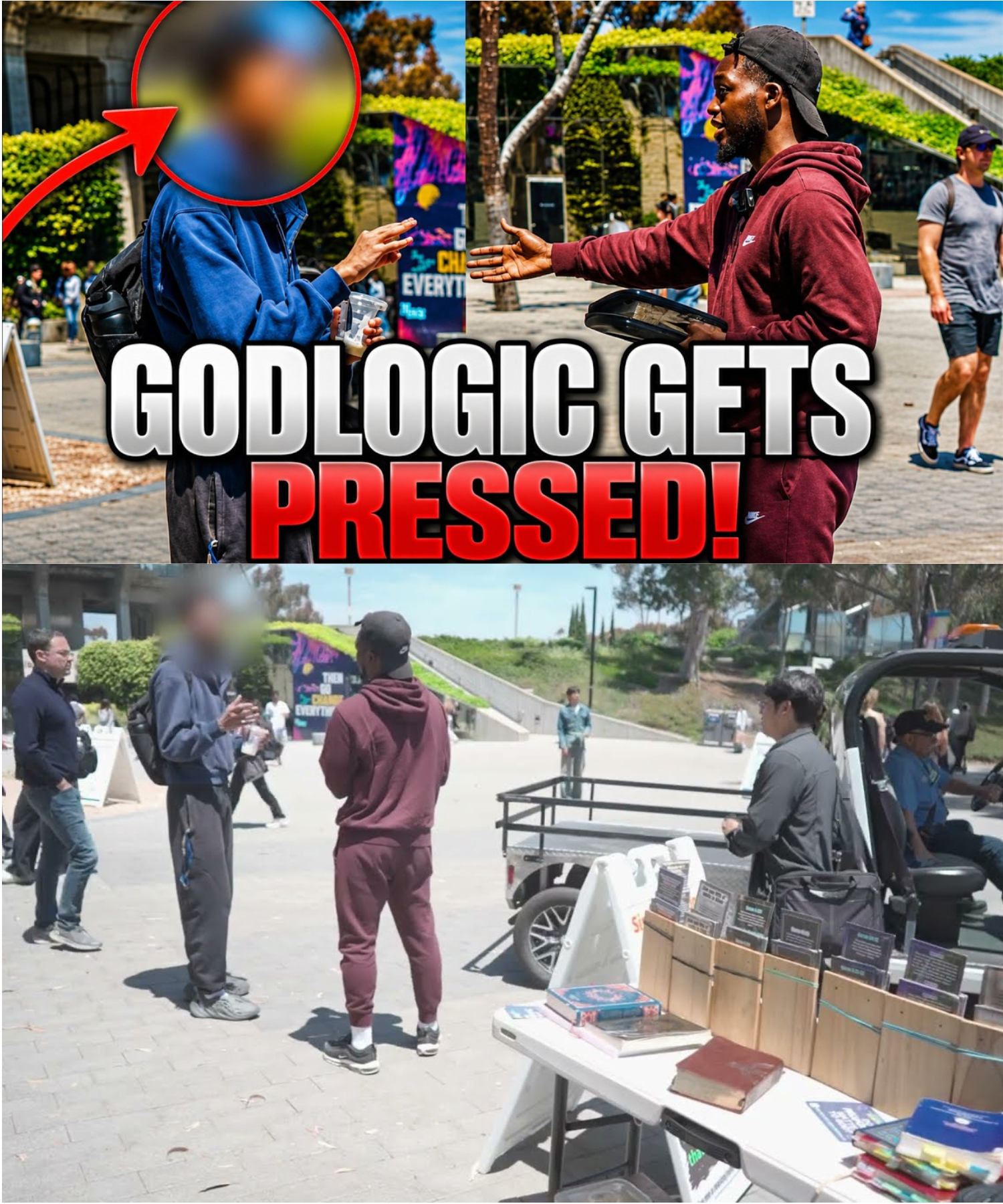
A calm but intense religious debate on an American campus is drawing attention online after a young Muslim student and a Christian street apologist locked into a long, respectful, and surprisingly deep exchange over one explosive question: was Jesus actually a Muslim?
The conversation, filmed during a campus outreach encounter in Southern California, began with a familiar Islamic argument. The Muslim student explained that Jesus submitted his will to God, and since “Muslim” means one who submits to God, Jesus should be understood as a Muslim. It is a claim often heard in street dawah, college interfaith discussions, and online apologetics battles.
But the Christian speaker immediately challenged the definition.
He asked the student to imagine a man who believes in one god, bows to one god, and submits fully to one god — but that “god” is a statue in his backyard. Would that person be a Muslim?
The student answered no.
That answer became the turning point. The Christian apologist argued that being Muslim cannot simply mean submitting to “one god” in a vague sense. It must mean submitting to the specific God described in Islam: Allah, who is eternal, uncreated, not begotten, not a Trinity, and not a father in any sense.
From there, the debate sharpened.
The Christian speaker pointed to Jesus praying in the Garden of Gethsemane, where He addresses God as “Father” and submits to the Father’s will. If Jesus calls God His Father, he argued, then Jesus is not worshiping Allah as Islam defines Allah, because Islam forbids calling Allah “Father.” The student tried to soften the point by suggesting that “father” could be a term of endearment, not literal biological fatherhood.
But the Christian apologist pressed again.
In the Quran, he argued, Allah rejects any form of fatherhood, literal or metaphorical. Muslims are to call Allah by the names He has revealed, and “Father” is not one of them. A Muslim cannot safely call Allah “Father.” The student eventually admitted that, on the safe side, he would say Muslims should not refer to Allah that way.
The Christian speaker seized the moment.
If Jesus calls God Father, and Islam does not allow that kind of address to Allah, then according to the Bible’s portrayal of Jesus, Jesus cannot be a Muslim. His prayer life, His language, and His understanding of God do not match Islamic theology.
That did not end the conversation. It opened the door to something larger.
The Muslim student then raised the question Christians hear often: if Jesus is God, why does He pray to God? Why does He submit? Why does He speak to the Father as someone distinct from Himself?
The Christian speaker answered by explaining the Trinity. He stressed that Christianity does not teach three gods. It teaches one God in three distinct persons: Father, Son, and Holy Spirit. The Son can communicate with the Father because they are distinct persons, yet they share the same divine essence. Prayer, in that framework, is not evidence that Jesus is a creature worshiping another being. It is the eternal Son communing with the Father, even after taking on human flesh.
The student listened carefully, sometimes confused, sometimes skeptical, but rarely hostile.
That is what made the exchange stand out.
In an era when religious debates online often collapse into mockery, shouting, insults, and humiliation clips, this conversation unfolded differently. The student asked questions. The Christian speaker slowed down. They repeated verses. They clarified terms. They disagreed sharply, but neither side treated the other as stupid.
Then the debate moved to the deity of Christ.
The Christian apologist argued that Jesus makes claims no prophet can make. In John 10, he said, Jesus claims to give eternal life. Not merely to announce eternal life, not merely to point toward it, but to give it. In Christian theology, only God can give eternal life, judge humanity, raise the dead, and decide the fate of souls. If Jesus claims to do those things, the speaker argued, then He is either blaspheming or He is truly divine.
The student initially compared this to prophets performing miracles by God’s permission, such as Moses parting the sea. But the Christian speaker pushed back. There is a difference, he said, between a prophet being used by God to perform a miracle and a person claiming direct authority to grant eternal life. Raising the dead by God’s power is one thing. Giving final eternal life and judging the world is another.
The conversation then shifted to creation.
Using Colossians, the Christian speaker read that all things were created through the Son and for the Son, and that in Him all things hold together. The student was visibly surprised. He said he had never heard a Christian explain that Jesus created everything. To him, the idea sounded almost impossible: how could Jesus be both human and Creator?
The answer came through John 1.
The Christian speaker read the famous passage: “In the beginning was the Word, and the Word was with God, and the Word was God.” He explained that Christians identify the Word as the preexistent Son, who later “became flesh” and lived among humanity. In other words, Jesus did not begin at His birth. His human nature began in time, but the divine Word existed before all creation.
The student struggled to grasp it.
He repeatedly returned to the same objection: if Jesus is human, how can He be Creator? The Christian reply was that Jesus is not a created being. Before taking on flesh, He existed eternally as the Word of God. The incarnation did not turn a creature into God. It was God the Son taking on human nature.
The debate then reached one of the most famous Islamic objections to Christian belief: Jesus said no one knows the hour, not even the Son, but only the Father.
The student used the verse to challenge Jesus’ omniscience. If Jesus does not know the hour of judgment, how can He be God?
The Christian apologist answered with a linguistic argument. He said the Greek word translated “know” in that passage can be understood in a declarative sense — to make known or disclose — rather than a purely cognitive sense. He compared it with Paul’s statement in 1 Corinthians that he “determined to know nothing” among the Corinthians except Jesus Christ and Him crucified. Paul did not literally forget all other knowledge, the speaker argued. He meant that he came declaring only one central message.
By that logic, the Christian argued, Jesus was not saying He lacked information about His own coming. He was saying that the authority to declare or reveal that day belonged to the Father. The student was not fully convinced, but he listened and tried to process the explanation.
Finally, the conversation turned to why God would become human.
The Christian speaker gave the core gospel answer: love, justice, and mercy. God is holy and just, and humanity has failed His standard. If God simply ignored sin, He would not be just. So, according to Christianity, the Son took on flesh, lived the perfect human life, represented humanity, and bore the punishment of sin so that God could be both just and merciful.
The student then wanted to go back to Adam, repentance, and the beginning of sin. But the conversation was interrupted by time, campus obligations, and the student’s concern about being posted online. He asked not to have his face shown. The Christian speaker agreed to blur his face and mute his name.
That final moment may be why the clip matters.
This was not only a debate about doctrine. It was a model of how serious disagreement can still end with respect. They exchanged social media information. They talked about continuing off camera. The Christian speaker praised the student for being thoughtful and calm. The Muslim student acknowledged that Christians and Muslims can be close allies even while disagreeing on the deepest questions.
On a U.S. campus, where religion, identity, and online content often collide explosively, the exchange felt unusual.
Nobody converted on camera.
Nobody stormed off.
Nobody won the entire internet.
But one thing became clear: the question of Jesus — prophet, Messiah, Son, Word, Creator, or God in flesh — remains one of the most powerful debates in America’s public square.
And when handled with patience instead of rage, even a disagreement that deep can still become a conversation worth watching.