Mathematician’s Claim That Math Is the “Language of God” Ignites America’s Faith-and-Science Debate
Mathematician’s Claim That Math Is the “Language of God” Ignites America’s Faith-and-Science Debate
A powerful conversation about mathematics, nature, and God is spreading across American Christian media, after mathematician Dr. Anthony Bosman argued that the hidden order of the universe may be one of the strongest signs that reality is not random at all.
The debate begins with a simple question that sounds almost poetic: is math the language of God?
For many people, math is something they left behind in school — equations, exams, anxiety, calculators, and numbers scribbled across a classroom board. But in this viral discussion, math becomes something far bigger. It becomes a window into the structure of reality itself.
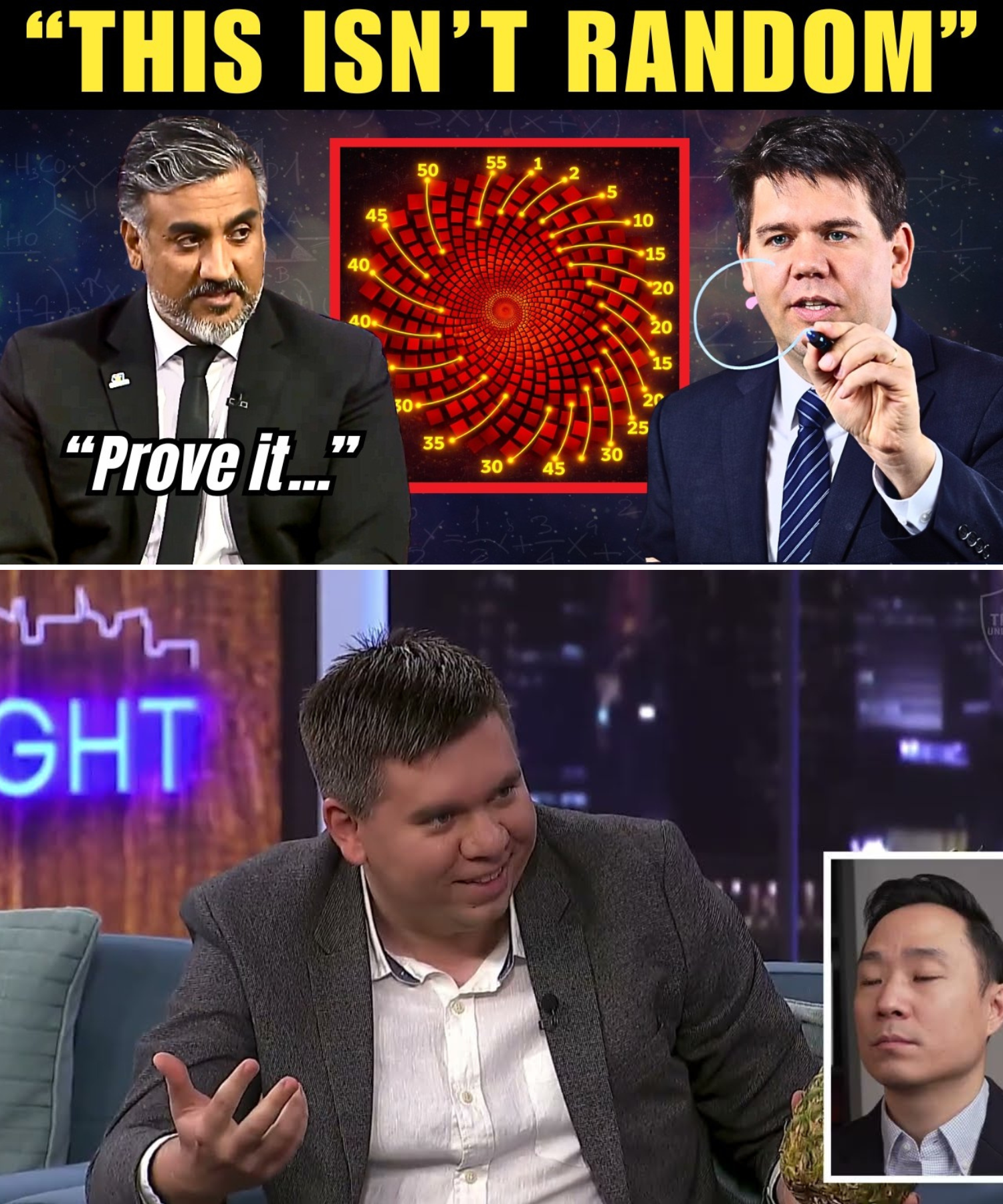
Bosman begins with a pineapple.
At first, it seems almost too ordinary. A pineapple on a table. A fruit most people slice, eat, and forget. But then he counts the spirals across its surface. In one direction, there are eight. In the other direction, there are thirteen. Those are not random numbers. They belong to the Fibonacci sequence, a famous mathematical pattern where each number is the sum of the two before it.
One, one, two, three, five, eight, thirteen.
Then the same pattern appears again.
Sunflowers. Pine cones. Seashells. Galaxies. Spirals in living things and cosmic structures. Beauty and order repeating in places that seem completely unrelated.
That is where the conversation becomes explosive.
If the universe is merely the product of blind accident, why does mathematical order keep appearing everywhere? Why does the same pattern surface in plants, storms, shells, and galaxies? Why does nature behave as if it is written in a language the human mind can discover, calculate, and use to make predictions?
Bosman points to the famous phrase associated with physicist Eugene Wigner: the “unreasonable effectiveness of mathematics.” The idea is that mathematics works far better than anyone might expect if numbers are merely human inventions. Equations do not only describe what scientists already see. They can predict things no one has seen yet.
That distinction matters.
If math were only a game inside the human mind, it would be impressive. But if mathematics reaches out beyond the mind and accurately describes the hidden architecture of the universe, then something deeper is happening. Math is not simply being imposed on reality. It appears to be revealing reality.
One of the most dramatic examples is the discovery of Neptune.
Isaac Newton developed mathematical laws describing gravity and planetary motion. Later, when Uranus was observed behaving in a way that did not perfectly fit the expected pattern, scientists did not immediately throw away Newton’s mathematics. Instead, they wondered whether another unseen planet was pulling on Uranus. Mathematics suggested something was there before telescopes could confirm it.
Eventually, Neptune was discovered.
That is the kind of moment that makes faith-and-science debates catch fire. An equation pointed into the darkness and told humanity where to look. The universe answered.
To Bosman, this is not proof in the shallow sense of a slogan. It is a signpost. A universe built on rational order makes sense if it came from a rational mind. A world that can be understood through mathematics fits naturally with the Christian belief that creation is not chaos, but the work of an intelligent Creator.
The conversation then moves to one of the most contested questions in modern science and theology: the beginning of the universe.
For much of human history, many thinkers assumed the universe had always existed. But modern cosmology points toward a beginning. The universe is expanding. If that expansion is traced backward, it leads toward an initial beginning point — what many call the Big Bang.
For Christian thinkers, that fact carries enormous significance.
The Bible begins with the words, “In the beginning, God created the heavens and the earth.” The claim is not that God emerged from nature, but that nature itself had a beginning and depends on something beyond itself. Bosman contrasts this with ancient mythologies in which gods often arise from chaos, water, darkness, or some preexisting material. In those stories, nature gives birth to gods. In Genesis, God gives birth to nature.
That reversal is crucial.
If nature had a beginning, then nature cannot explain its own existence. The cause of the universe must be beyond the universe. It must be outside time, space, and matter. That is why Bosman rejects the idea that physical laws themselves created everything. Laws describe how things behave. They do not create the things that behave.
He uses a simple money illustration.
Mathematics can describe how much money is in a wallet. But writing “plus one hundred dollars” on a piece of paper does not make a hundred dollars appear. Math describes. It does not create.
In the same way, laws of physics can describe the universe, but they do not explain why the universe exists in the first place.
Then comes the famous challenge: who created God?
Bosman’s answer is that the question misunderstands the Christian claim. Christians do not believe in a God who began to exist. They believe in an eternal God, without beginning and without end. The universe requires an explanation because it had a beginning. God, in Christian theology, does not require the same explanation because God is not a created object inside the universe.
This is where the conversation becomes more personal.
Bosman uses grains of sugar to illustrate large numbers and eternity. A bag of sugar may contain around a million grains. Counting to a million one number per second would take nearly two weeks. Counting to a billion would take more than three decades. But even those numbers are nothing compared with eternity.
For many viewers, that moment shifts the debate from science to the soul.
If eternity is real, then life cannot be reduced to careers, possessions, weekend plans, and temporary pleasures. The present moment matters, but it is not all there is. Human beings were made for something larger than time.
The discussion then lands on the Christian doctrine of the Trinity.
Before creation, Bosman says, God was not lonely. God was not lacking. God existed eternally as Father, Son, and Holy Spirit in perfect love. Jesus’ prayer in John 17 becomes central: the Father loved the Son before the foundation of the world.
That means love is not an invention inside the universe. Love existed before galaxies, stars, planets, mathematics, pineapples, sunflowers, or human beings.
For Christians, that is the final piece.
The order of nature points to a Creator. The beginning of the universe points beyond nature. The mathematical structure of reality points to a rational mind. But the gospel goes further. It says this Creator is not only powerful and intelligent. He is loving. And that love is revealed in Jesus Christ.
The viral power of the conversation comes from its ambition. It does not ask people to choose between thinking and believing. It argues that deep thinking may lead directly to belief.
In an America divided between secular skepticism and renewed religious hunger, that message is landing hard.
Math, once feared by students, has become a witness.
The pineapple has become evidence.
The stars have become a sermon.
And the question remains: if the universe is written in mathematics, who wrote it?