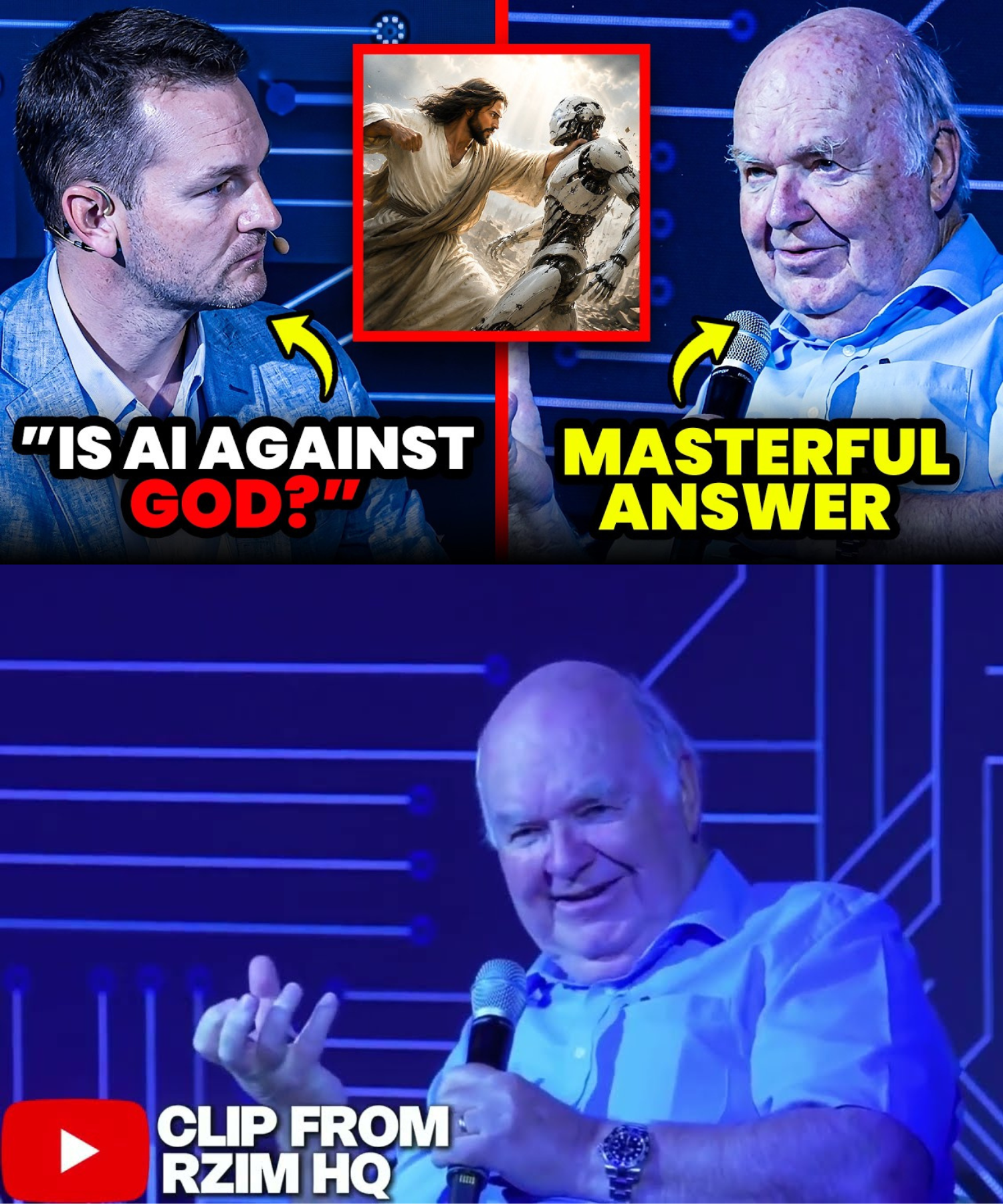
John Lennox Gives the AI Answer Skeptics DON’T Want to Hear
“Should Christians Use AI?” Viral Sermon Ignites Debate Over Technology, Ethics, and Faith in the Digital Age
A widely circulated sermon-style commentary discussing whether Christians should use artificial intelligence has sparked intense debate online after its central message argued that AI is not only permissible for believers, but potentially a tool for advancing the Gospel — provided it is used under ethical and spiritual guidance.
The video, which blends theological reflection, personal testimony, and direct engagement with modern technology culture, has drawn millions of views across platforms, dividing audiences over whether artificial intelligence represents a divine tool for human creativity or a moral danger requiring strict limitation.
At the heart of the discussion lies a pressing question facing modern faith communities:
Should Christians embrace artificial intelligence — or resist it?
“We Shouldn’t Be Afraid of It”: A Pro-AI Theological Argument
The speaker opens the discussion by rejecting fear-based approaches to emerging technology.
He argues that artificial intelligence, particularly in fields such as medicine, can dramatically improve human life by accelerating diagnosis, improving accuracy, and reducing suffering.
From his perspective, technological progress is not inherently opposed to faith, but can be an expression of human creativity.
He frames this creativity as part of being made in the “image of God,” emphasizing that if God is a creator, then human innovation reflects that divine attribute.
Technology as a Moral Arena
A central argument in the message is that technology itself is not morally neutral in practice — because its use always involves ethical decisions.
The speaker emphasizes that nearly every profession involves moral complexity, whether in medicine, business, or communication.
He argues that Christians should not avoid modern tools out of fear, but instead engage with them responsibly and ethically.
In this view, workplaces become environments where believers can actively “seek the kingdom of God” through integrity, decision-making, and moral discernment.
The Ethics Question: Responsibility in Corporate and Digital Systems
The commentary also highlights ethical dilemmas within companies developing powerful technologies.
The speaker raises a hypothetical scenario in which harmful information might be hidden from the public for profit or strategic advantage.
He argues that believers working in such environments face moral responsibility to act with integrity, even when it is difficult or costly.
This introduces a broader ethical tension: whether Christians should participate in building powerful systems like AI while remaining morally accountable within them.
“God Works Through Technology”: A Strongly Pro-AI Position
The most controversial portion of the message comes when the speaker explicitly endorses the use of AI in ministry and communication.
He argues that artificial intelligence is already embedded in daily life — from search engines to social media algorithms — and therefore cannot be realistically avoided.
He claims that refusing to engage with technology entirely would limit the ability to spread religious teachings globally.
In his view, digital platforms allow individuals to reach audiences at a scale previously impossible, enabling what he describes as “leveraging tools for God’s glory.”
Critics: Fear of Dependence and Spiritual Compromise
The video has drawn strong criticism from viewers who argue that integrating AI into spiritual life risks over-reliance on technology.
Some commenters expressed concern that artificial intelligence could replace human discernment in religious decision-making or dilute authentic spiritual practice.
Others raised theological concerns about whether machine-assisted communication could distort messages of faith or introduce unintended biases into religious teaching.
Despite these concerns, the speaker maintains that AI is morally neutral and depends entirely on how it is used.
“We Are All Using It Already”
A key rhetorical point in the message is that AI is already deeply integrated into modern society, even for those who claim to avoid it.
The speaker argues that smartphones, social media platforms, navigation systems, and online content recommendation engines all rely on artificial intelligence in some form.
Therefore, he suggests, the question is not whether Christians should use AI — but how they should use it responsibly.
He frames complete avoidance as unrealistic in a modern digital world.
Divine Guidance vs Human Decision-Making
One of the most theologically charged aspects of the commentary is the claim that believers should seek divine guidance in their technological choices.
The speaker suggests that Christians may be individually led to use or avoid AI depending on personal conviction and perceived spiritual direction.
He emphasizes prayer and discernment over rigid rules, arguing that ethical decisions must be context-sensitive rather than universally fixed.
This introduces a flexible moral framework in which technology use is spiritually individualized.
The Business of Faith and AI Communication
The video also shifts into a promotional segment for a Christian audiobook production company, which claims to use real human narrators rather than AI-generated voices.
This contrast is used to reinforce the speaker’s broader message about ethical choices in technology use — suggesting that human involvement still matters in creative and spiritual communication.
The company is presented as an example of how modern technology can be used without abandoning human authenticity.
A Larger Cultural Debate: AI and Spiritual Authority
Beyond the immediate message, the video has become part of a wider cultural debate about artificial intelligence and religion.
Some religious thinkers argue that AI could become a powerful tool for spreading religious teachings globally, translating texts, and producing accessible content.
Others warn that over-reliance on AI in spiritual contexts could weaken human interpretation, pastoral care, and doctrinal integrity.
The discussion reflects a growing tension between technological acceleration and traditional religious authority structures.
Reactions Online: Praise, Concern, and Polarization
Audience reactions have been sharply divided.
Supporters praised the message for encouraging Christians to engage with modern technology rather than retreat from it.
They argue that rejecting AI entirely would isolate religious communities from major technological developments shaping the world.
Critics, however, expressed discomfort with the blending of ministry, business, and artificial intelligence, warning of potential long-term consequences.
The video has become a focal point for broader anxieties about technology’s role in spiritual life.
Conclusion: Faith in the Age of Artificial Intelligence
The debate sparked by the video reflects a larger question facing religious communities in the 21st century:
How should faith adapt to rapidly evolving technology without losing its core identity?
For the speaker, the answer is clear: artificial intelligence is a tool that, when used ethically and prayerfully, can serve human flourishing and spiritual mission.
For critics, the risks are more complex, involving questions of dependence, authenticity, and moral responsibility.
What remains unresolved is not whether AI will be used in religious life — but how deeply it will become integrated into it.
And as this viral discussion shows, that question is only just beginning to be answered.