John Lennox Answers the HARDEST Question About God and Suffering
“If Christ Rose From the Dead, Everything Changes”: Viral CEO Debate Ignites Global Clash Over God, Suffering, and Human Meaning
A widely circulated podcast-style conversation between a tech CEO and a Christian thinker has triggered a global wave of debate after it shifted from a discussion on skepticism and evidence into a sweeping defense of Christianity centered on suffering, resurrection, and the meaning of human existence.
The exchange, originally framed as a philosophical inquiry into how belief in God can be justified, quickly expanded into one of the most discussed religious debates online this week.
At its core is a question that has haunted philosophers for centuries:
If God is all-powerful and all-good, why does suffering exist?
The Question of Suffering That Started It All
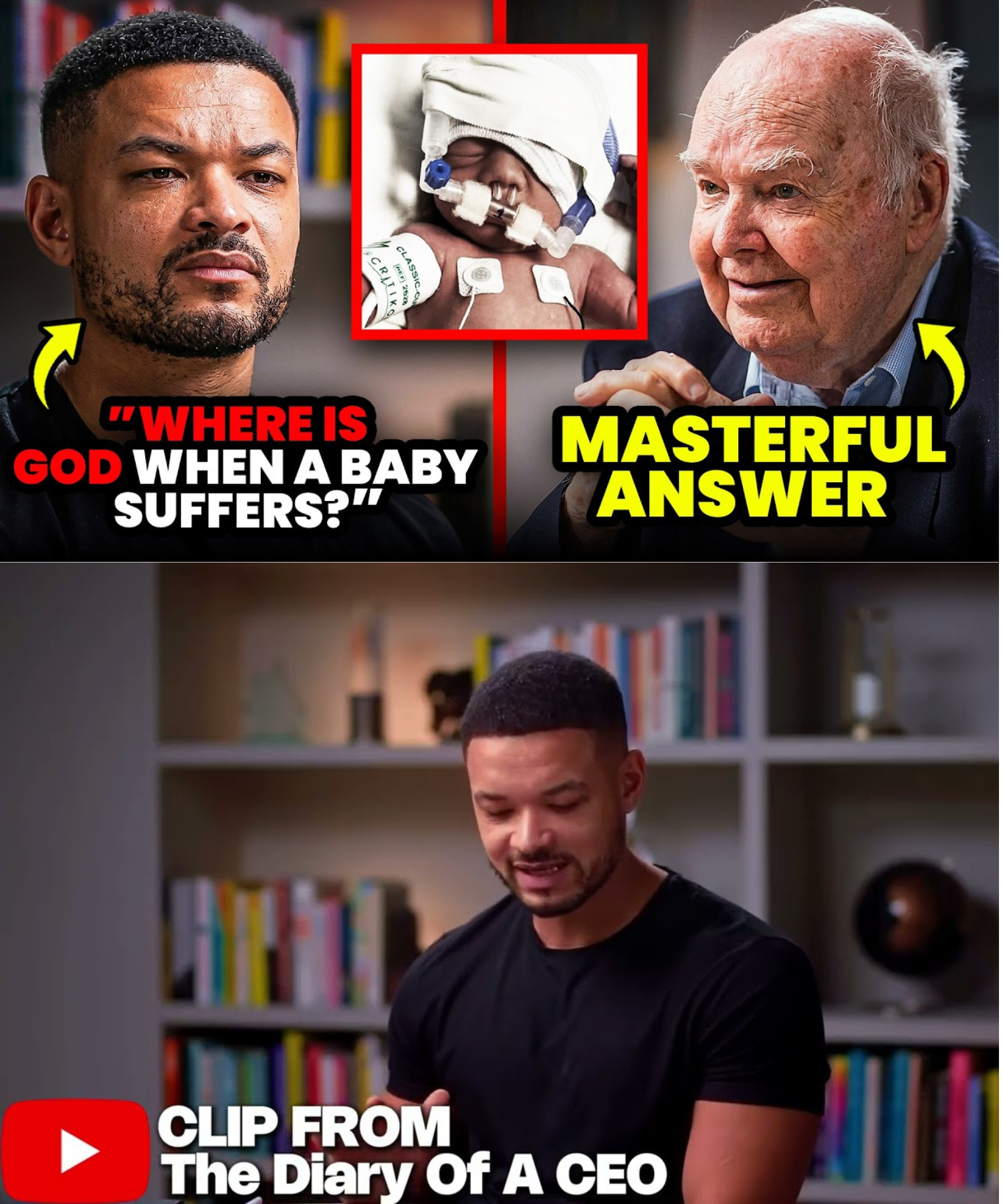
The CEO opens the discussion with a moral challenge often used in philosophy of religion: the problem of suffering.
He references extreme cases of human pain — including innocent children born into suffering or disease — and asks how such realities can be reconciled with the idea of an all-knowing, all-powerful, and all-loving God.
The question is not theoretical for him. He emphasizes the emotional weight of imagining preventable suffering occurring in the world under divine awareness.
This becomes the entry point for a broader discussion about whether belief in God can be intellectually sustained.
The Christian Response: “God Did Not Remain Distant”
In response, the Christian thinker does not offer a simple philosophical explanation.
Instead, he reframes the entire question through the Christian doctrine of the crucifixion.
He argues that Christianity does not claim God is distant from suffering, but rather that God entered into suffering directly through the life and death of Jesus Christ.
According to this view, the cross is not merely a historical or symbolic event, but the central evidence that God does not remain detached from human pain.
The argument shifts the focus from explanation to participation.
Resurrection as the Turning Point of History
The discussion escalates when the topic turns to the resurrection of Jesus.
The Christian speaker argues that if the resurrection is true, it fundamentally alters how reality must be understood.
He claims that while philosophical arguments about God can remain abstract, the resurrection introduces a concrete historical claim: that death was reversed in a specific event.
He suggests that skepticism often dismisses the resurrection as trivial, while believers see it as the most significant event in human history.
For him, everything depends on this claim.
A Clash With Transhumanist Ideals
The conversation then shifts toward transhumanism — the idea that technology will eventually solve death, suffering, and human limitation.
The Christian thinker contrasts this with the Christian narrative, arguing that transhumanism represents humanity attempting to “become gods” through technological advancement.
Christianity, he says, presents the opposite movement: God becoming human.
In this framework, salvation is not achieved through human progress, but through divine intervention.
This contrast becomes one of the most debated parts of the discussion.
The “Sin Problem” and Human Moral Failure
A central theological argument introduced is what the speaker calls the “sin problem” — the idea that humanity’s deepest issue is not technological limitation, but moral failure.
He argues that modern solutions often attempt to eliminate suffering without addressing the underlying causes of human harm: selfishness, violence, and moral brokenness.
In this view, systems built on progress alone fail to resolve the ethical condition of humanity.
Christianity, he claims, uniquely addresses this through forgiveness, redemption, and moral transformation.
The CEO’s Objection: Evidence vs Belief
Throughout the exchange, the CEO repeatedly returns to the question of evidence.
He challenges whether emotional conviction or personal peace can be considered valid proof of truth.
He expresses concern that belief systems often rely on internal experience rather than external verification.
This creates a tension between two frameworks:
One based on empirical validation
One based on relational and experiential truth
Neither side fully abandons its position, and the disagreement deepens rather than resolves.
“God Is Not a Philosophy, But a Person”
A key turning point in the conversation comes when the Christian thinker argues that God should not be treated as an abstract philosophical concept.
Instead, he claims, God is a personal being who can be known relationally rather than merely analyzed intellectually.
He compares this to human relationships, suggesting that distance alone cannot produce understanding.
This shift reframes belief as encounter rather than argument.
Personal Testimony: Peace Through Faith
As the debate continues, the conversation moves from theory into personal experience.
The Christian speaker describes his faith as something that has given him lasting peace over decades of life challenges.
He emphasizes that this peace is not dependent on intellectual certainty, but on trust in Christ’s death and resurrection.
He contrasts this with attempts to find meaning through technology, philosophy, or material progress.
In his view, none of these approaches address the deeper human need for forgiveness and reconciliation.
A Turning Point: “We Will Know One Day”
The discussion also touches on the unresolved nature of suffering in the present world.
The Christian speaker suggests that many unanswered questions — particularly about innocent suffering — may only be understood in a future reality beyond this life.
He argues that if resurrection is real, then death is not the end of the story, and human understanding is incomplete.
This introduces a long-standing theological idea: that ultimate justice and clarity lie beyond present experience.
Emotional Weight in the Debate
At several points, the conversation shifts away from abstraction into emotional reflection.
The speaker references personal experiences of illness, survival, and witnessing natural disasters, using them to illustrate how suffering becomes more meaningful when viewed through the lens of divine suffering and resurrection hope.
He suggests that people who have experienced loss often respond more strongly to this framework than purely philosophical arguments.
This emotional dimension becomes central to the video’s viral spread.
Online Reaction: Deep Polarization
Following its release, the clip has generated intense reactions across social media platforms.
Supporters argue that the conversation presents one of the most coherent modern defenses of Christianity, especially its focus on resurrection and moral meaning.
Critics argue that it relies heavily on theological assumptions that cannot be independently verified.
Philosophers have noted that the debate reflects an ancient tension between faith-based reasoning and empirical skepticism.
The discussion continues to circulate widely, with millions of views across platforms.
Conclusion: A Debate Without Final Resolution
The exchange ends without agreement, but not without impact.
At its center remains a question that neither participant fully resolves:
Is meaning found in evidence alone, or in something beyond it?
For the Christian thinker, the answer lies in the resurrection of Christ — the claim that death itself was broken.
For the CEO, the demand remains grounded in proof, clarity, and rational justification.
Between them lies a gap that has defined philosophical debate for centuries — and continues to define it today.
And as the clip continues to spread online, one thing becomes clear:
This is not just a conversation about belief.
It is a collision between two different ways of understanding reality itself.