Luton Street Clash Video Goes Viral as Debate Over Islam Criticism, Free Speech, and Racism Explodes Online
Luton Street Clash Video Goes Viral as Debate Over Islam Criticism, Free Speech, and Racism Explodes Online
New York — A controversial street video involving British activist Tommy Robinson has gone viral across social media, reigniting a heated debate over free speech, religious criticism, and accusations of racism in public demonstrations.
The footage, filmed in Luton town center, shows a tense and chaotic public confrontation in which Robinson and his group are surrounded by members of the public, with shouting, accusations, and escalating hostility captured on camera.
The video has since become a flashpoint in a broader international debate about whether criticism of Islam is being unfairly labeled as racism, or whether such rhetoric contributes to community tensions.
“So Peaceful?” — Street Confrontation Sparks Online Firestorm
The viral clip shows Robinson and his associates walking through a busy public area when they are confronted by members of the public. Verbal insults are exchanged, and tensions quickly rise.
At one point, voices off-camera can be heard shouting insults, while Robinson reacts by questioning whether criticism of Islam leads to violent or aggressive responses in public spaces.
The narrator of the video frames the encounter as evidence that critics of Islam face hostility that does not typically occur when other religions are criticized, arguing that this creates an uneven standard in public discourse.
Critics of this framing argue that the video selectively highlights moments of conflict while ignoring broader context, including what led to the confrontation or whether any prior provocation occurred.
Police Response and Claims of Assault
In the footage, Robinson states that he has been attacked in Luton town center and appears to seek police assistance. Officers are seen or referenced responding to the situation and taking statements.
The video suggests a chaotic environment in which multiple bystanders are involved, with conflicting accounts of what occurred.
However, no official police report confirming the details of the incident has been publicly released alongside the viral footage.
“You Can’t Criticize Islam” — Central Claim in Debate
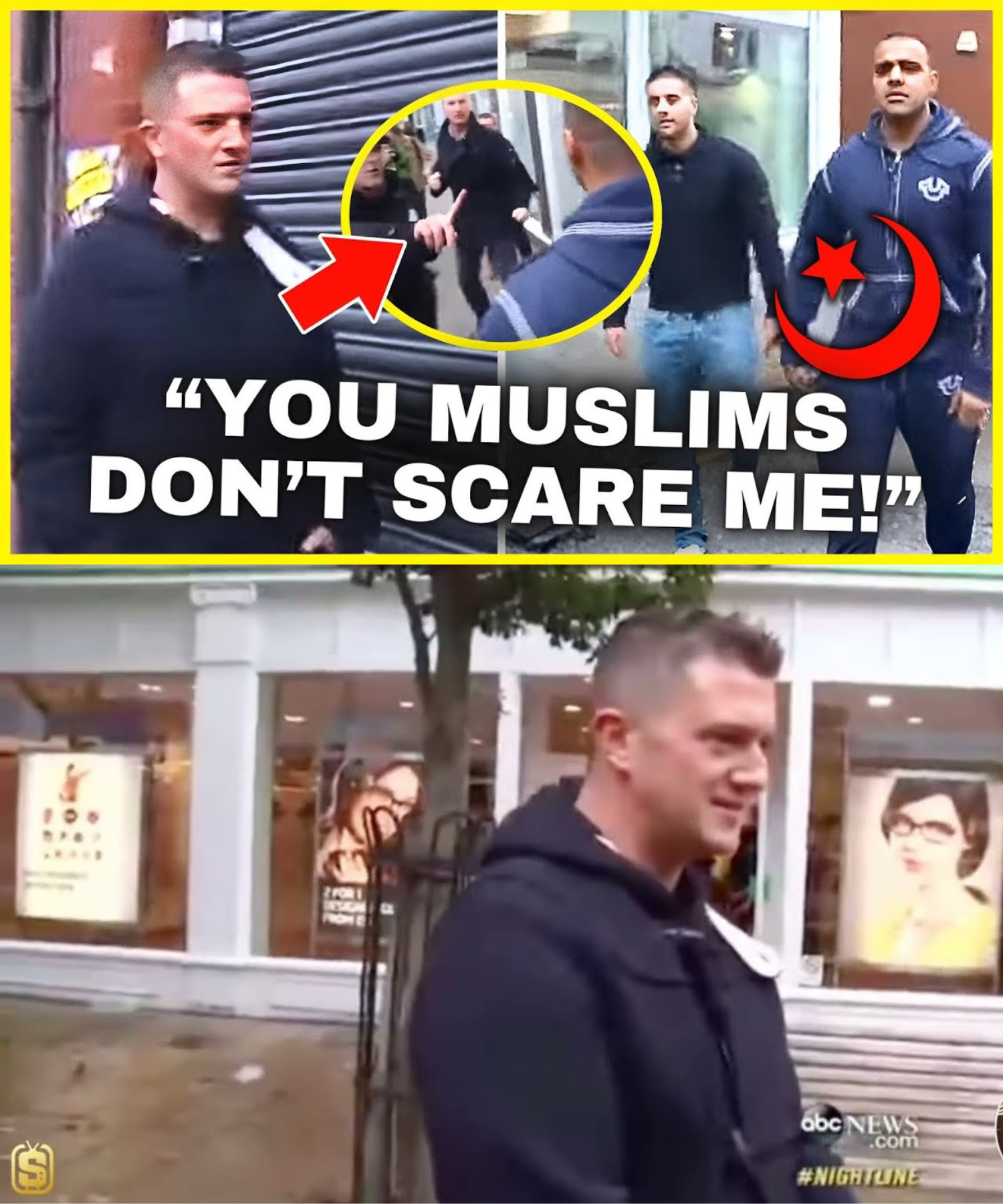
The most controversial portion of the video comes in the commentary surrounding the incident.
The narrator argues that criticism of Islam is treated differently from criticism of Christianity or Judaism, claiming that individuals who criticize Islam are more likely to be labeled racist or Islamophobic.
This claim has become a central talking point in the viral reaction to the video.
Supporters argue that there is a chilling effect on free speech when criticism of a religion is conflated with racism, particularly in cases involving public debate over immigration, integration, and cultural identity.
Critics, however, argue that Islam is not being singled out unfairly, but rather that inflammatory rhetoric about any religious or ethnic group can lead to heightened tensions and public disorder.
Crowd Dynamics and Rising Tensions
The footage also shows a large group forming around the confrontation, with multiple voices shouting and responding to the situation in real time.
The narrator describes the crowd as hostile and suggests that Robinson is being targeted unfairly for expressing his views.
However, others in the video argue that Robinson himself is provoking reactions by filming and engaging directly with members of the public in a confrontational manner.
This tension between “documentation” and “provocation” has become a recurring theme in street-level political content across the UK and increasingly in the United States.
Accusations of Racism and Political Framing
The video repeatedly references accusations that Robinson is racist or far-right, claims that his supporters strongly reject.
The narrator argues that critics are unable to provide clear examples of racist statements, suggesting that the labeling is politically motivated rather than evidence-based.
However, critics argue that racism is not defined solely by individual quotes, but also by broader patterns of messaging, associations, and public impact.
This disagreement reflects a larger cultural divide over how racism should be defined in modern political discourse — whether through strict definitions or broader contextual interpretation.
Free Speech vs Social Responsibility
The viral footage has reignited one of the most contested debates in Western democracies: the balance between free speech and social responsibility.
Supporters of Robinson argue that individuals should be able to criticize religion without fear of being labeled racist or facing public backlash.
Opponents argue that speech does not exist in isolation and that certain forms of public commentary can contribute to real-world tension, particularly in diverse urban environments.
Legal experts note that while free speech is protected in both the UK and the United States, it does not protect individuals from social consequences or public disagreement.
Media Narratives and Competing Interpretations
The video has also fueled debate over media framing and narrative bias.
Supporters of Robinson argue that mainstream media often portrays him unfairly, focusing on controversy rather than context.
Critics argue that independent street footage can also be selectively edited or framed to reinforce a particular ideological viewpoint.
This has created a situation where the same video is interpreted in radically different ways depending on the viewer’s political perspective.
A Symbol of Broader Cultural Conflict
Beyond the immediate incident, the Luton video has become a symbol of broader cultural tensions across Europe and the United States.
Issues of immigration, integration, religious identity, and public order are increasingly intertwined with debates over free speech and political correctness.
In cities with diverse populations, these tensions are often amplified in public spaces where political expression and community identity collide.
No Clear Resolution
As the video continues to circulate online, no official conclusion has been reached regarding the exact sequence of events in Luton town center.
What remains clear is that the footage has become part of a much larger and ongoing debate over how modern societies navigate disagreement in increasingly diverse public spaces.
For some, the video is evidence of suppressed speech and unequal treatment of religious criticism.
For others, it is a reminder that public confrontation rarely has a single, simple explanation.
And for most observers, it highlights a deeper question that remains unresolved:
How can free societies protect both open expression and community harmony when the boundaries between the two are constantly being tested?