Jerusalem’s Ancient Stones Spark Fierce Debate in America as Archaeologists Unearth Layers of Biblical History
Jerusalem’s Ancient Stones Spark Fierce Debate in America as Archaeologists Unearth Layers of Biblical History
A new wave of archaeological storytelling from Jerusalem is reigniting one of the most emotionally charged debates in America’s religious and political world: what do the stones beneath Israel actually say?
For millions of Christians and Jews in the United States, the land of Israel is not simply a location on a map. It is the setting of Scripture, prophecy, exile, return, war, worship, destruction, and longing. For critics, archaeology should not be turned into political proof. But for believers watching the latest footage from Jerusalem’s underground excavations, the message feels overwhelming: beneath the modern city, layer after layer appears to testify that the Bible is not floating in myth — it is rooted in soil, stone, fire, coins, streets, and shattered walls.
The documentary-style exploration begins with a dramatic claim: wherever archaeologists dig in Jerusalem, they encounter another period, another city, another wall, another palace, another physical trace of the past. The land is described as a place where history does not merely survive in books. It survives underground.
That idea has struck a nerve with American audiences.
In a time when debates over Israel are often reduced to slogans, social media arguments, campus protests, and cable-news shouting, archaeology offers something different. It does not shout. It waits. It lies beneath plazas, under streets, below modern buildings, sealed inside destruction layers and collapsed rooms until someone carefully uncovers it.
The most powerful scenes come from below the Western Wall Plaza, where archaeologists describe Jerusalem not as one city, but as many Jerusalems stacked on top of one another. Beneath the surface are remains stretching back thousands of years, including evidence from the First Temple period, Roman destruction, Byzantine construction, medieval layers, earthquakes, and modern rebuilding.
The visual image is striking: Jerusalem as a layered cake of civilization.
One archaeologist compares the process to cutting into a chocolate cake, where each layer reveals another period of human life. People built homes, lost them, rebuilt over them, and watched new generations rise on top of older stones. Over centuries, that process created a physical archive of human habitation.
For American Christians who grew up reading the Bible, the emotional power is obvious. The names of prophets, kings, temples, conquests, exile, and Jerusalem are not distant abstractions. They are part of Sunday sermons, Bible studies, family devotionals, and theological imagination. To see archaeologists standing in places connected to those eras can feel like watching the biblical world become touchable.
One of the most dramatic claims in the footage is that remains beneath the Western Wall Plaza go back roughly 2,700 years, to the time associated with the First Temple period. The archaeologist explains that people living in Jerusalem during that era would have known the world of Judean kings and prophets. For believers, that statement is electric. It compresses thousands of years into one sentence: this is not just history — this is the ground of the Bible.
The documentary also emphasizes how destruction can become archaeology’s grim ally.
When a city is conquered, burned, or shaken by earthquake, daily life can be frozen in place. Pots remain where families left them. Stones collapse where walls once stood. Streets are buried. Fires preserve moments of panic and loss. What was tragedy for ancient people becomes evidence for modern researchers.
That theme appears vividly in the discussion of the Roman destruction of Jerusalem in 70 CE. The city was devastated, and the Second Temple was destroyed. For Jewish memory, that event remains one of the great national and spiritual wounds. For archaeologists, the destruction layer can preserve a precise historical moment. Objects abandoned in fire and collapse become witnesses to the final days of a world that vanished.
The discovery of a mosaic floor over older remains adds another layer to the story. Archaeologists describe how a 1,300-year-old floor was built above remains dating back around 2,000 years, creating a dramatic jump through time within the same physical space. The result is almost cinematic: one period rests directly on another, with centuries compressed into meters of earth.
Then the story moves deeper, to an administrative structure dated to the First Temple period. The footage describes weights connected to the shekel system and artifacts that help illuminate how taxation, administration, and daily life functioned in ancient Jerusalem. This is where archaeology and text begin to meet. The Bible gives the broader narrative. The objects give texture: coins, weights, vessels, seals, and buildings used by real people.
That is the argument now captivating many American viewers.
Archaeology does not always “prove” faith in the way believers might want or skeptics might demand. It does not answer every theological question. It does not settle every modern political dispute. But it can show that the world described in ancient texts had real cities, real systems, real conflicts, real rulers, and real people.
The documentary then turns to Robinson’s Arch, named after Edward Robinson, an American biblical scholar from New York who traveled to the Holy Land in the 19th century searching for biblical locations. His connection gives the story a direct American link. Long before modern tourism and livestreamed excavations, American scholars were already drawn to Jerusalem’s stones.
Under the area associated with Robinson’s Arch, archaeologists describe digging through medieval, Islamic, Byzantine, Roman, and Herodian layers until they reached evidence from the final Jewish fight against Rome. Among the most striking finds were hundreds of coins bearing inscriptions linked to years of revolt and liberation. For the archaeologist interviewed, those coins are not only historical artifacts. They are hard evidence of Jewish national life, rebellion, and independence in the land.
That part of the story is intensely emotional.
The archaeologist recalls guiding paratroopers connected to the 1967 battle for Jerusalem and telling them that the excavation revealed the last moments of Jewish independence before centuries of foreign rule, dispersion, persecution, and eventually the modern return. In that telling, archaeology becomes more than science. It becomes memory, identity, and national continuity.
That is also why the subject becomes controversial.
For many supporters of Israel, these finds strengthen the Jewish historical claim to Jerusalem and the land. For critics, using archaeology as a political deed risks oversimplifying a land shared, conquered, inhabited, loved, and contested by many peoples across thousands of years. The stones can speak, but people still argue over what they mean.
The documentary’s final major stop is Tel es-Safi, identified with ancient Gath, one of the great Philistine cities known from the Bible. There, archaeologists describe a massive multi-period site, a classic mound built by generations of settlement, abandonment, destruction, and rebuilding.
At Gath, the biblical text and archaeology intersect in another dramatic way. The Bible mentions Hazael, king of Aram-Damascus, fighting against Gath. Excavations at the site have revealed a massive destruction layer dated to the period associated with Hazael’s campaign, along with what is described as one of the earliest known siege systems in the world. Burnt mud bricks, broken pottery, collapsed pillars, and ruined houses show the violent end of a powerful city.
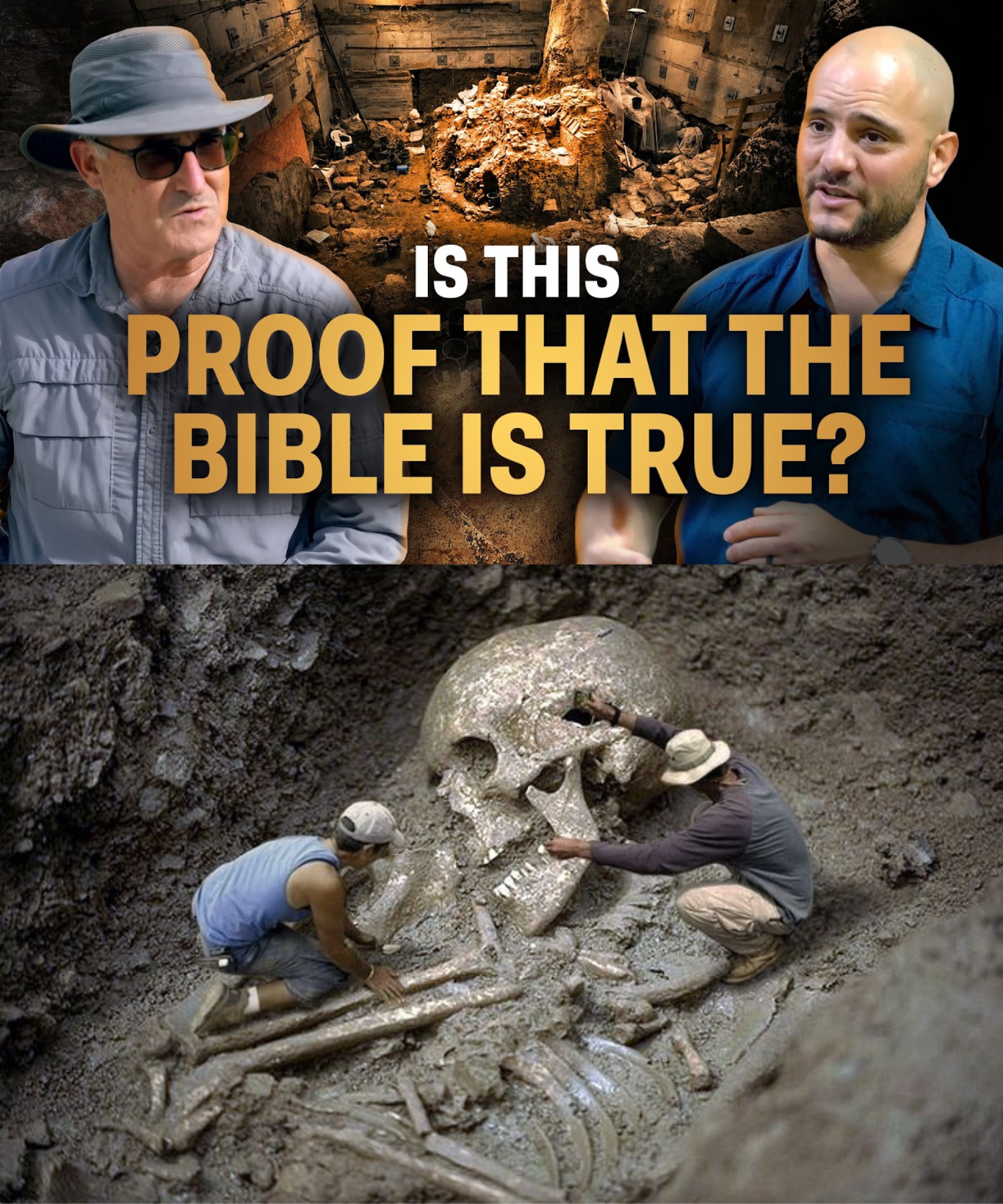
The story of Goliath also appears, though with scholarly caution. Archaeologists do not claim to have found giant skeletons. Instead, they explain that Goliath may represent the image of Gath as a powerful and feared Philistine city. That honesty matters. It gives the article its strongest balance: archaeology can illuminate the Bible without turning every story into a simplistic headline.
For American readers, the bigger picture is clear.
The battle over Israel is not fought only in parliaments, newsrooms, campuses, or social media feeds. It is also fought underground — in pottery shards, coins, walls, streets, earthquake layers, and burned houses.
Jerusalem’s stones cannot end the political conflict.
But they can force the world to confront a truth too often buried beneath modern rage: this land carries memory deeper than any slogan.
And every time archaeologists dig, the past rises again.