Israeli Hostage’s Stunning UN Confrontation Sparks Firestorm Across America Over Hamas, Silence, and Women’s Rights
Israeli Hostage’s Stunning UN Confrontation Sparks Firestorm Across America Over Hamas, Silence, and Women’s Rights
A dramatic confrontation inside the United Nations has erupted into a political firestorm across the United States after a former Israeli hostage directly challenged a senior UN expert over what she described as silence, denial, and moral failure surrounding Hamas’s crimes against Israeli women.
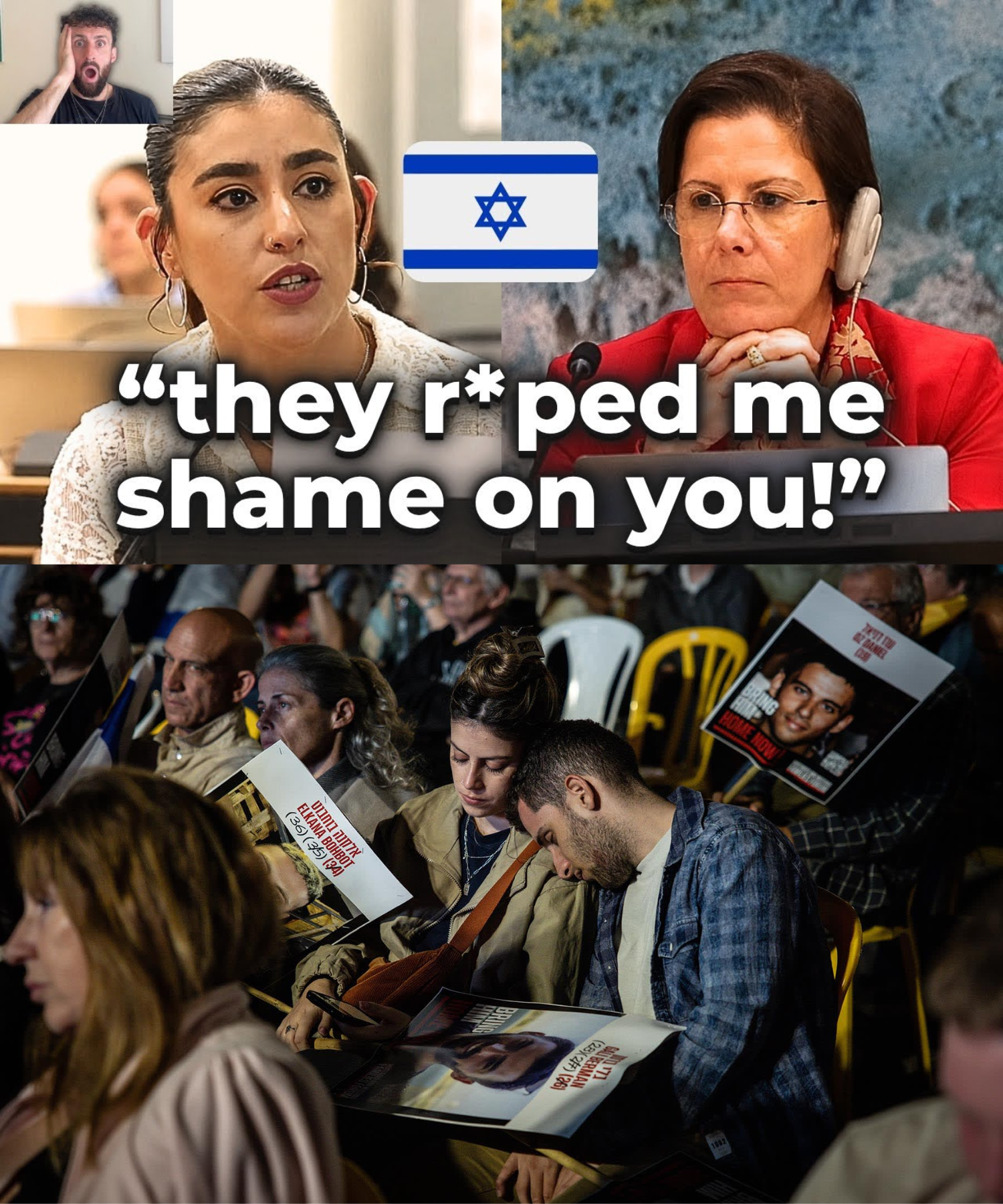
The moment, now spreading rapidly across American social media, shows former hostage Ilana Gritzewsky standing before the UN Human Rights Council and addressing Reem Alsalem, the UN Special Rapporteur on violence against women and girls. The scene was not loud in the usual way. There were no street chants, no protest signs, no collapsing police barricades.
Instead, there was something far more uncomfortable: a survivor asking an international official to look at her.
“Look at me,” she demanded, according to reports of the exchange.
That line has now become the emotional center of the controversy.
For supporters of Israel, the video captured years of frustration with international institutions they believe have repeatedly failed Israeli victims. For critics of the UN, it was a devastating image: a woman who survived Hamas captivity standing in front of a global body dedicated to human rights, pleading to be seen by an official whose mandate is to protect women and girls from violence.
The confrontation centered on one question: why had Hamas not been named clearly in a report about violence against women?
Gritzewsky’s testimony was deeply personal. She described the trauma of October 7, the horror of being taken captive, and the lasting pain carried by women who survived violence, humiliation, and terror. Her message was not abstract. It was not about ideology or geopolitics. It was about bodies, memory, captivity, fear, and the demand that victims not be erased because their suffering is politically inconvenient.
That is why the clip hit so hard in America.
Since the October 7 massacre and the war in Gaza that followed, the United States has been consumed by a bitter argument over moral attention. Jewish Americans and supporters of Israel say Hamas’s crimes were too quickly minimized, excused, contextualized, or buried beneath later political narratives. Palestinian advocates say Gaza’s civilian suffering has been ignored or justified by those focused only on Israeli trauma. Both sides accuse the other of selective compassion.
But the UN confrontation narrowed the debate to a single, brutal question: can an institution claim to defend women while hesitating to name the attackers when the victims are Israeli?
For many American viewers, the answer was obvious.
Conservative commentators quickly framed the moment as a collapse of global human rights credibility. They argued that if Israeli women must fight to have their experiences acknowledged at the UN, then the system is not neutral. It is political. They accused international bodies of speaking loudly when the accused are Western, Israeli, or aligned with the West, but moving cautiously when the perpetrators are Hamas or anti-Israel actors.
Pro-Israel activists went further, saying the encounter exposed a pattern they have warned about for years: Jewish pain is investigated, debated, qualified, and delayed, while other suffering is accepted immediately as morally urgent.
The phrase “believe women” also returned with force.
In America, that slogan became a defining part of public conversations about sexual violence, power, and accountability. But critics now ask whether that standard applies equally when the women are Israeli, Jewish, or victims of a terrorist organization many activists treat as part of a broader “resistance” movement.
That question has unsettled many liberal spaces.
For years, women’s rights groups in the United States have argued that survivors should not have to prove their humanity before being heard. Yet after October 7, many Jewish women and Israeli survivors say they felt abandoned by the very movements that claim to defend victims of sexual violence. Some women’s organizations waited weeks before issuing strong statements. Others focused their language on broader conflict dynamics rather than the specific crimes committed against Israeli women.
The UN moment reopened that wound.
Gritzewsky’s confrontation was powerful because it stripped away the safety of institutional language. Reports, mandates, frameworks, legal terminology, and diplomatic caution all met the face of a survivor. A woman who had lived through horror was no longer willing to be filed under “complexity.”
She wanted acknowledgment.
The reaction from Alsalem, according to those sharing the clip, became part of the viral narrative. Supporters of Gritzewsky said the UN official appeared uncomfortable and avoided the direct moral force of the testimony. Critics of that interpretation caution that short videos can be edited, framed, and weaponized. They argue that UN officials operate within strict evidentiary and procedural standards and that international law requires care with allegations.
But for many viewers, procedural caution sounded like another excuse.
The broader political context is impossible to ignore. The UN has long been accused by Israel and its allies of bias, especially in bodies where Israel is frequently condemned while authoritarian governments escape comparable scrutiny. Defenders of the UN say the organization reflects global politics and that Israel, like every state, must be subject to international law. But critics argue that when a former hostage has to confront a women’s rights official to ask why Hamas is missing from the conversation, something in the system has gone badly wrong.
The controversy has also sharpened the American divide over the war itself.
On college campuses, pro-Palestinian activists often frame the conflict primarily through occupation, civilian casualties, blockade, and Israeli military power. Pro-Israel students and Jewish organizations argue that any conversation that begins after Israel’s response but skips the atrocities of October 7 is already morally distorted. The UN confrontation has now become a symbol in that campus war: one side sees a survivor demanding truth; the other worries that her testimony will be used to justify continued war in Gaza.
But Gritzewsky’s supporters argue that those concerns miss the point.
Acknowledging Hamas’s crimes against women does not erase Palestinian suffering. Naming Israeli victims does not require ignoring Gaza’s civilians. A human rights system worthy of the name must be able to hold more than one truth at once. It must condemn rape, kidnapping, mutilation, and hostage-taking without asking whether the victim belongs to the politically favored side.
That is the standard many Americans now believe the UN failed to meet.
The video has become so explosive because it exposes a crisis deeper than one report or one official. It raises a terrifying possibility: that even suffering can become partisan. That even sexual violence can be filtered through ideology. That even a hostage can be asked, silently or openly, to prove that her pain fits the right narrative.
For survivors, that is a second wound.
For the UN, it is a credibility problem.
For America, it is another flashpoint in the battle over Israel, antisemitism, feminism, terrorism, and truth.
The final image is what stays with people: a former hostage, standing in a global chamber, asking to be looked at.
Not debated.
Not dismissed.
Not buried in diplomatic language.
Seen.
And until the world can do that for every victim, regardless of nationality, religion, or politics, the promise of human rights will keep sounding hollow.