“Is Islam Inherently Violent?” Debate Sparks Fierce Free Speech Firestorm Across Western Academia
“Is Islam Inherently Violent?” Debate Sparks Fierce Free Speech Firestorm Across Western Academia
New York — A controversial academic-style debate arguing that Islam is “more associated with violence than other Abrahamic religions” has gone viral, reigniting one of the most sensitive and divisive discussions in Western political and religious discourse.
The speech, delivered during a formal debate setting, has drawn intense reactions online after the speaker claimed that Islam, despite its historical contributions to art, literature, and culture, appears in modern contexts to be disproportionately associated with acts of violence compared to other major religions.
The remarks immediately triggered backlash, with critics accusing the speaker of generalizing a global faith based on selective interpretations of historical and contemporary events.
“A Religion of Peace?” Questioned in Heated Opening Statement
The speaker opened by acknowledging Islam’s cultural and intellectual contributions, referencing art and literature of “exquisite beauty” and suggesting that it has provided spiritual meaning for many individuals.
However, he quickly shifted focus, arguing that in practice, Islam appears more frequently associated with violence than other Abrahamic traditions.
He cited terrorism incidents attributed to Islamic extremists as evidence, stating that most high-profile terrorist cases discussed in Western media involve individuals claiming Islamic motivation.
This claim became the central point of contention in the debate.
Terrorism, Attribution, and Selective Framing
Critics of the argument immediately challenged the methodology behind linking terrorism disproportionately to any single religion.
They argued that terrorism is a political and social phenomenon that appears across ideological and religious backgrounds, including far-right extremism, nationalist violence, and historical conflicts involving multiple faith traditions.
Supporters of the speaker, however, argued that ignoring patterns of extremist violence linked to Islamist ideology risks avoiding uncomfortable truths about ideological motivation in global terrorism cases.
This divide reflects a broader ongoing debate in Western societies over how to define terrorism, how to classify ideological violence, and whether religious labels clarify or distort analysis.
The Moral Philosophy Argument: “Good vs Evil”
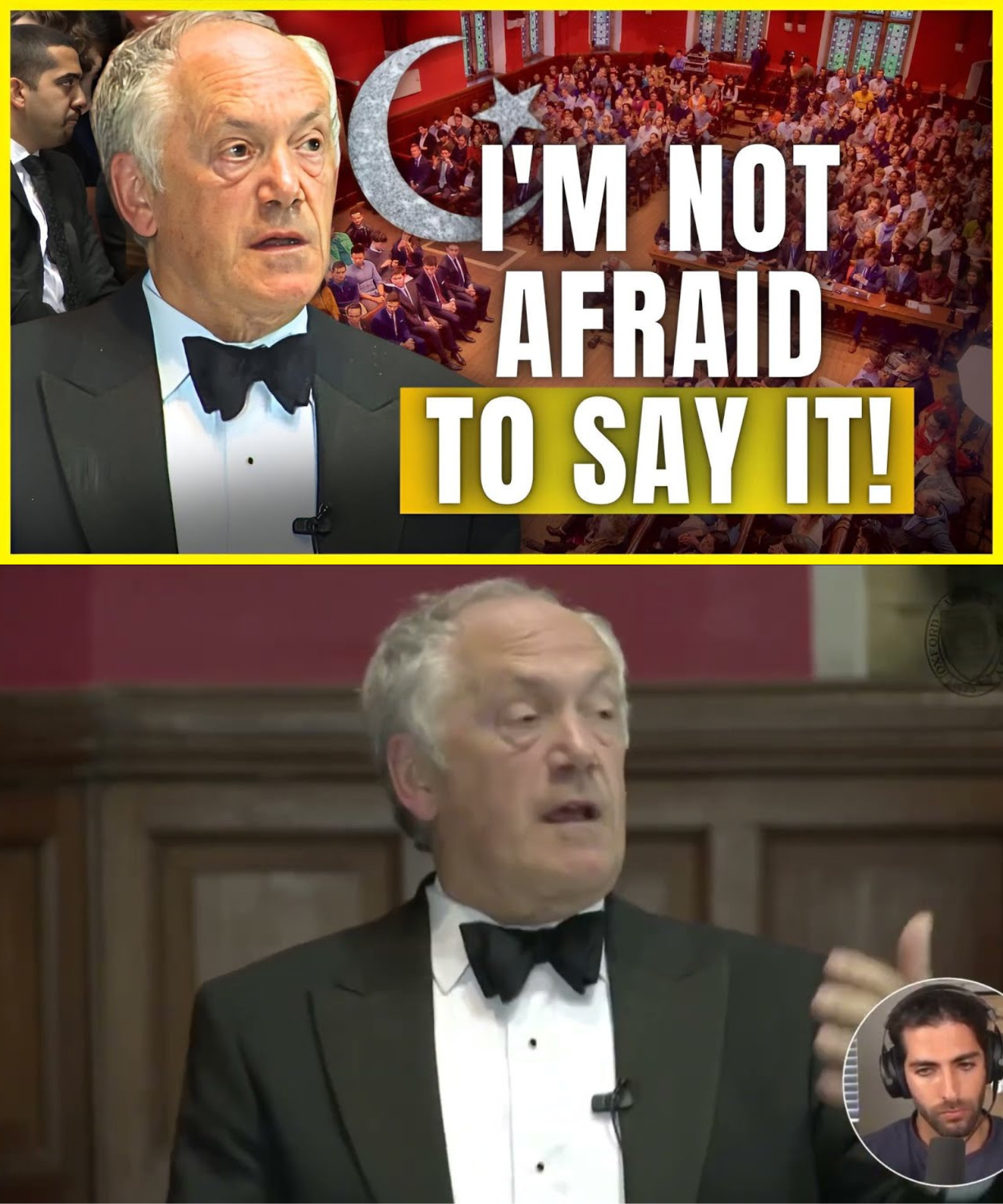
The debate intensified when the speaker shifted from empirical claims to moral philosophy, arguing that acts of violence inspired by religious or ideological belief cannot be offset by acts of charity or peaceful behavior.
He suggested that in moral evaluation, “one evil outweighs many goods,” particularly when human life is lost, and that charitable or peaceful contributions cannot erase acts of violence.
This framing sparked immediate pushback from audience members, some of whom challenged the binary distinction between “good and evil” in complex geopolitical and religious conflicts.
At one point, audience reactions became audible and confrontational, reflecting the emotional intensity of the discussion.
“Religion and Violence” Across Abrahamic Faiths
The speaker also argued that Islam, compared to other Abrahamic religions, appears more frequently associated with violence in contemporary global discourse.
He acknowledged that Judaism, Christianity, and Islam all contain historical episodes involving violence, conquest, and war, but suggested that modern patterns of violence linked to Islamist extremism are more visible in current global events.
Critics responded that selective emphasis on contemporary incidents can create distorted perceptions, especially when historical context across all religions is not equally considered.
They argued that all major religions have complex histories and that modern interpretations vary widely across communities and nations.
Academic and Public Backlash
Following the release of the debate, scholars and commentators sharply divided over its implications.
Some praised the speaker for addressing what they see as under-discussed patterns of ideological violence and for challenging politically sensitive assumptions in Western discourse.
Others condemned the framing as reductive and potentially harmful, arguing that it risks reinforcing stereotypes about Muslims as a whole rather than distinguishing between extremist ideology and mainstream religious practice.
Religious scholars emphasized that Islam, like Christianity and Judaism, contains multiple interpretive traditions and that linking violence to theology alone ignores political, historical, and socioeconomic factors.
Free Speech vs. Social Responsibility
The viral nature of the debate has also reignited discussions about free speech in academic and public forums.
Supporters argue that controversial ideas must be discussed openly, even when offensive or uncomfortable, in order to preserve intellectual honesty and prevent censorship.
Critics counter that public platforms carry responsibility, and that framing entire religions in ways that emphasize violence can contribute to social polarization and discrimination.
This tension between open debate and social impact remains a central challenge in Western democracies.
Audience Reaction and Emotional Division
The audience response during the debate reflected the broader societal divide.
Some participants applauded the speaker’s willingness to make controversial claims in an academic setting, while others challenged him directly, questioning both his evidence and his conclusions.
At several points, the discussion became heated, with interruptions and visible disagreement over whether the argument was analytical or inflammatory.
A Debate With No Easy Resolution
By the end of the exchange, no consensus was reached.
Instead, the debate crystallized into two opposing frameworks:
One side views patterns of violence linked to Islamist extremism as a legitimate subject of analysis that must be addressed openly.
The other side views such framing as dangerous generalization that risks stigmatizing an entire global religion practiced by over a billion people.
A Reflection of a Larger Western Divide
The viral spread of the debate reflects a broader cultural struggle in the United States and Europe over how to discuss religion, violence, and identity in a pluralistic society.
As global conflicts, migration, and political polarization continue to intensify, questions about how to balance honest analysis with social cohesion are becoming increasingly difficult to resolve.
What is clear from the reaction is that the underlying issue is not only about Islam — but about how modern societies define truth, responsibility, and the limits of acceptable speech.
And for now, like many debates in this space, the argument remains unresolved — but far from over.