Explosive LA Studio Debate Over Islam, Immigration, and the Future of the West Triggers Cameraman Meltdown
Explosive LA Studio Debate Over Islam, Immigration, and the Future of the West Triggers Cameraman Meltdown
A fiery Los Angeles studio interview has erupted across American political media after a discussion about Islam, immigration, Western Europe, and national survival spiraled into one of the most explosive culture-war confrontations of the year — ending with a cameraman stepping into the debate after hearing a brutal proposal for stopping illegal border crossings.
The exchange began as a long-form conversation between street epistemologist Peter Boghossian and a controversial Christian commentator known for his harsh criticism of Islam’s growing influence in Western societies. The stated topic was broad and dangerous: is Islam truly a religion of peace, what happens when Islamic law enters secular societies, and are Western nations already too weak to defend themselves?
But the conversation quickly became more than theology.
It became a referendum on whether Western civilization, especially Europe, still has the will to survive.
The guest opened by challenging the popular phrase “Islam means peace.” He argued that the word is more accurately connected to submission, saying that peace in Islamic tradition comes only after surrender to Allah’s law. From there, he moved to Sharia, jihad, and the historical status of Christians and Jews under Islamic rule. He described the jizya tax not as benign protection money, but as a form of subjugation that left non-Muslims living as second-class subjects under Muslim political control.
For supporters watching in America, this was the kind of direct talk they believe mainstream outlets avoid. For critics, it was sweeping, inflammatory, and painted Islamic history in the darkest possible terms.
The interview then turned toward Europe.
The guest argued that Western Europe is facing a demographic and civilizational crisis because it has imported large Muslim populations while losing confidence in Christianity, national identity, masculinity, and borders. He said countries like Britain, France, Germany, and Sweden have been weakened by guilt, liberal idealism, and political elites who refuse to tell the truth about integration, crime, and religious conflict.
Boghossian pushed the argument even further by asking whether Europe’s decline was now so inevitable that surrender might be more realistic than resistance. The question was partly provocative, partly philosophical: if a civilization refuses to reproduce, refuses to defend its borders, and refuses to fight for its own culture, does it deserve to continue?
The guest did not offer much comfort.
He said he was deeply pessimistic about Western Europe, describing it as a society in “hospice.” He argued that many European men had been pacified and emasculated, while their leaders continued lying about the scale of the crisis. According to him, Europeans still believe elections will save them, but he insisted the real problem is cultural rot, not just bad politicians.
Then came the moment that detonated the room.
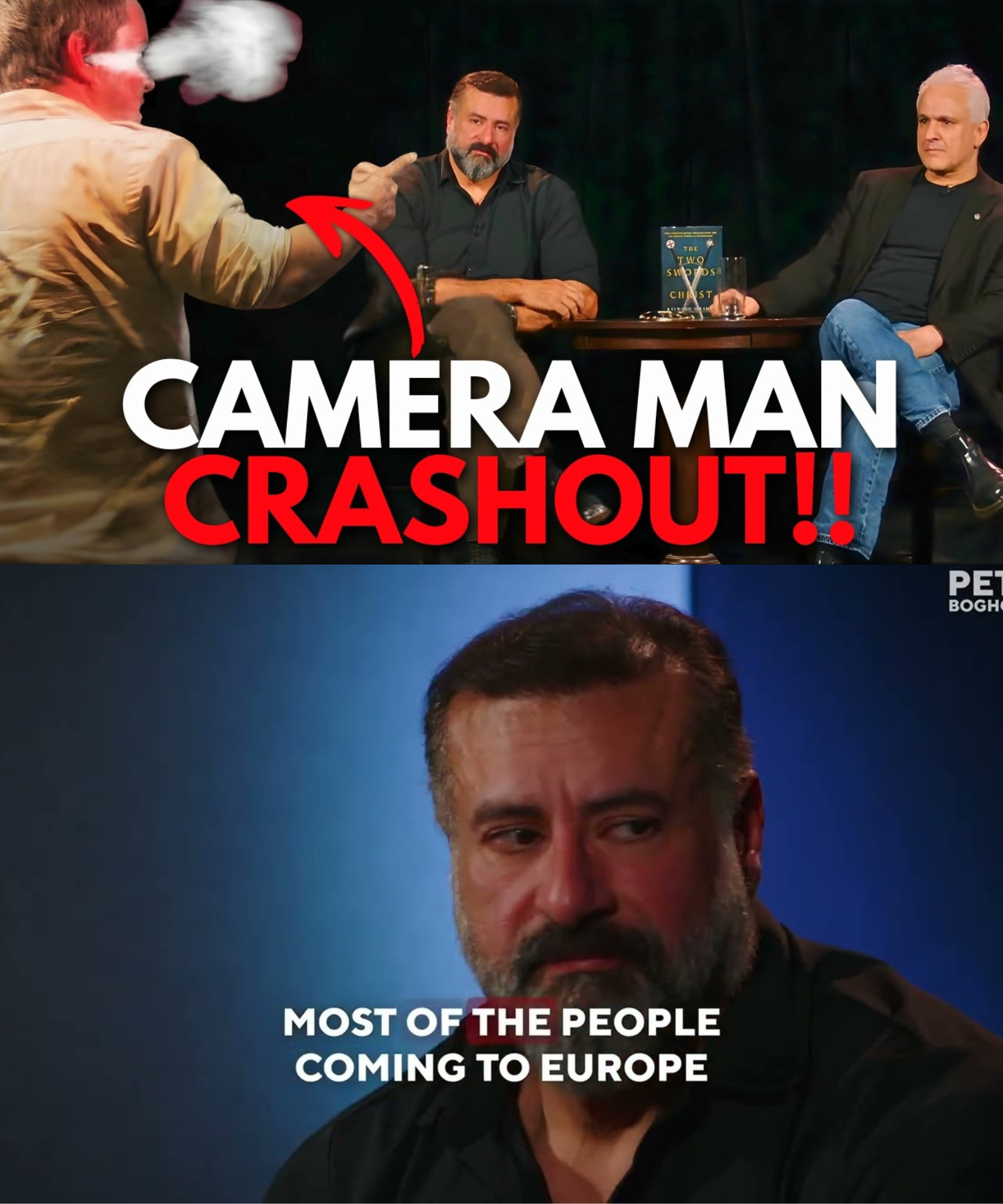
Asked what Europe would need to do to survive, Boghossian said the first step would be a complete moratorium on immigration. Then he made the remark that changed the entire atmosphere: he said, in blunt language, that people would “lose their minds,” but that border enforcement would ultimately require lethal force against those attempting to cross illegally if no other method worked.
The statement immediately shifted the tone from theoretical debate to moral crisis.
One cameraman reportedly left the room. Another later stepped into the conversation and challenged the claim directly. He said he found it impossible to denounce political violence, such as assassination, while also discussing lethal force against refugees or undocumented migrants trying to flee war and build better lives.
That confrontation became the emotional center of the interview.
The cameraman argued that immigration is a human right and that borders are often used to protect privilege rather than justice. He said undocumented immigrants commit fewer crimes than citizens in many contexts and accused the speakers of building fear around Muslims and migrants without evidence strong enough to justify such extreme rhetoric.
Boghossian pushed back by asking a simple policy question: what should a country do when people enter illegally?
The cameraman rejected the premise. He said the term “illegal immigration” can become a trap when there is no realistic legal path for desperate people to enter. To him, the issue was not lawlessness but exclusion. If legal migration is made nearly impossible, he argued, then calling people “illegal” becomes a political weapon.
That answer exposed the deepest divide in the room.
Boghossian and his guest saw borders as the foundation of civilization. The cameraman saw borders as arbitrary lines that can be used to deny human beings safety and dignity. The speakers asked whether a nation has the right to preserve its culture, people, and sovereignty. The cameraman compared such thinking to racial segregation, arguing that exclusion based on identity echoes the moral failures of the Jim Crow era.
The confrontation became even sharper when the speakers pressed him on whether a country has the right to say, “We do not want immigrants.” The cameraman said no. He argued that migration is part of human life and that no nation should be able to close itself off entirely from people fleeing violence or poverty.
That answer stunned the room.
To the speakers, it meant he did not believe in meaningful national sovereignty. To the cameraman, it meant he believed in universal human freedom. Both sides realized they were not arguing about one border policy. They were arguing about the nature of nationhood itself.
The debate then veered into accusations of racism and Islamophobia. The cameraman said the criticism of Muslim immigration expressed during the interview was fundamentally racist because, in his view, it was rooted in fear of Muslims rather than reality. The guest and Boghossian rejected that framing, arguing that Islam is a religion and political system, not a race, and that criticisms of Islamic doctrine or immigration policy cannot simply be dismissed as racism.
The cameraman responded that race is a social construct and that Islam, ethnicity, and immigrant identity often overlap in real-world prejudice. To him, saying “Islam is not a race” did not erase the way anti-Muslim rhetoric can target brown, Arab, South Asian, African, or immigrant communities.
For American viewers, this was the familiar collision of two languages.
One side speaks in terms of sovereignty, crime, civilizational survival, and cultural continuity. The other speaks in terms of human rights, refugees, racism, and historical injustice. Each side believes the other is morally blind.
The interview also covered attacks on churches in Europe, persecution of Christians in Nigeria and Africa, the role of Sharia, Quranic abrogation, Muslim demographics, assimilation, the decline of Christianity, and whether traditional Christianity could serve as a bulwark against Islam. The guest argued that modern Western Christians have become too passive and materialistic, while Muslims still possess strong metaphysical conviction, communal identity, and civilizational confidence.
That, he suggested, is why Islam advances while the West apologizes.
Yet the final confrontation with the cameraman revealed the most unsettling truth of the entire exchange: the West is not merely divided over Islam. It is divided over whether borders, nations, and civilizations should exist in the form they once did.
One side fears surrender.
The other fears cruelty.
And in that Los Angeles studio, under hot lights and rolling cameras, America watched the argument move from abstract theory to raw emotion.
No one left with a clean victory.
But everyone left knowing the same thing: the debate over Islam, immigration, and the future of the West is no longer coming.
It is already here.