Europeans Walk Into Walmart for the First Time — and America Suddenly Looks Bigger Than They Ever Imagined
Europeans Walk Into Walmart for the First Time — and America Suddenly Looks Bigger Than They Ever Imagined
A wave of European visitors arriving in the United States for the first time has turned an ordinary American shopping trip into a viral cultural event, and the place at the center of the shock is not the Statue of Liberty, the Grand Canyon, or Times Square.
It is Walmart.
Across social media, clips of British, Australian, French, and other foreign travelers walking into Walmart for the first time are spreading fast, capturing the exact moment when America stops being an idea from television and becomes something physical, oversized, fluorescent-lit, and almost impossible to explain to anyone back home.
The reactions are part comedy, part disbelief, and part genuine wonder.
One visitor walks through the entrance and immediately notices a fast-food restaurant inside the store. Another stares at massive Halloween pumpkins in October and declares that America has a serious pumpkin obsession. Someone else finds giant bags of candy, cereal sold in sacks, one-gallon tubs of ice cream, frozen desserts in endless flavors, entire aisles of chips, enormous bottles of juice, and snacks they had only seen in movies.
Then comes the line that keeps repeating in different ways: “How is this place real?”
For Americans, Walmart is normal. It is where people buy groceries, socks, shampoo, phone chargers, school supplies, towels, bikes, televisions, Christmas decorations, medicine, garden tools, laundry baskets, and sometimes lunch — all under one roof. For many Europeans, that exact combination feels almost absurd.
One shopper compared it to several stores from back home fused together: supermarket, discount shop, electronics store, home goods store, hardware store, toy shop, beauty shop, office supply store, and fast-food stop all inside one building. Another visitor joked that the store was so large it seemed to have its own zip code. Someone else saw computers near bicycles, automotive supplies within a few steps of personal hygiene products, and groceries stretching into cleaning supplies, then simply gave up trying to categorize what Walmart actually was.
That confusion is the story.
Walmart is not merely a store. To foreign visitors, it becomes a living symbol of American scale.
The United States is built differently. Distances are wider. Suburbs are larger. Families often drive instead of walk. People may shop once a week, twice a month, or even stock up for long periods. Houses often have more storage space. Refrigerators and freezers are bigger. Cars can carry bulk items. In that environment, giant boxes of snacks, massive paper towel packs, and family-size everything are not strange. They are efficient.
But to someone from a smaller country, or from a city where people buy groceries in smaller quantities and carry them home by foot, the American system can feel like walking into another civilization.
That is why the videos hit so hard.
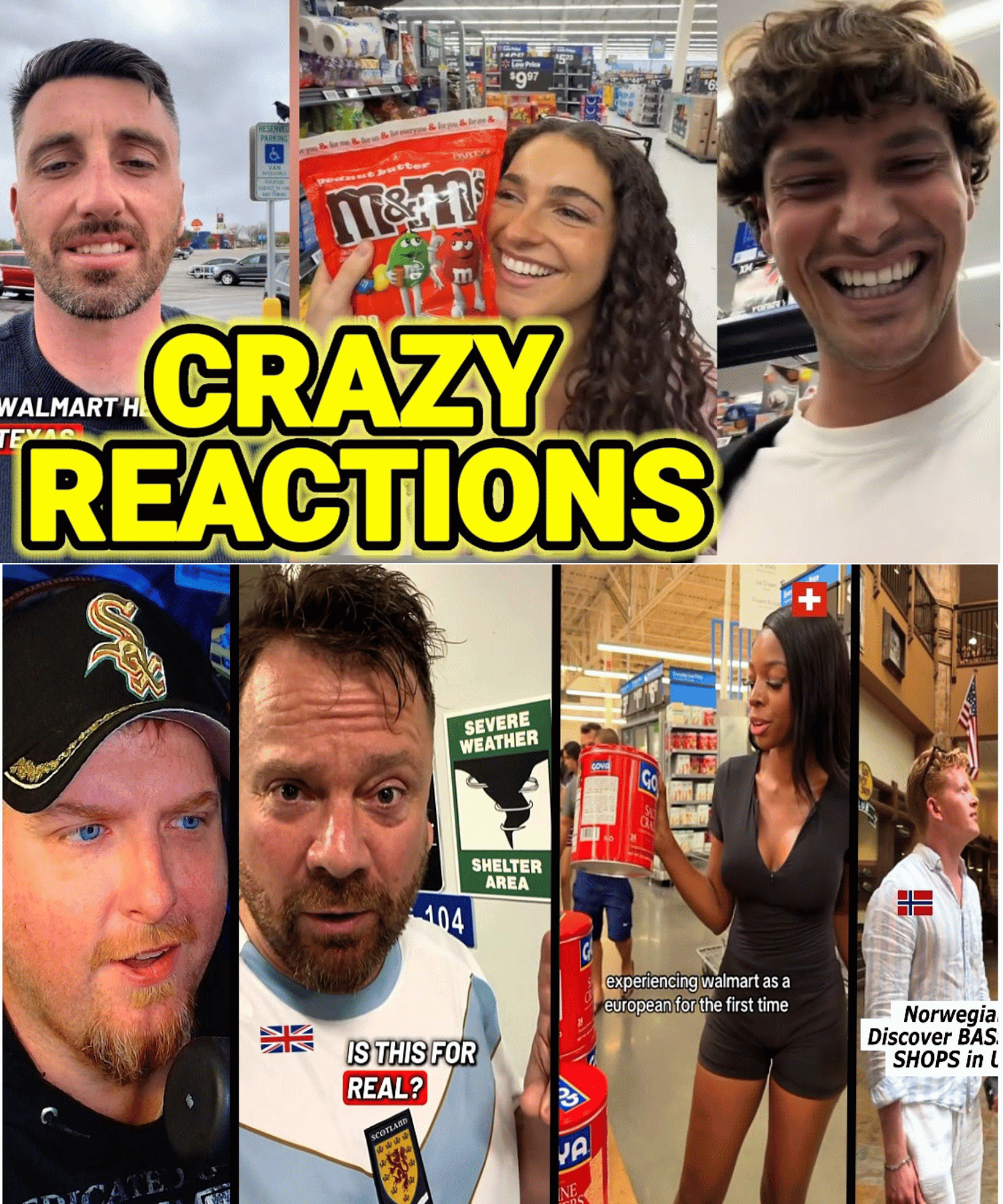
The tourists are not simply laughing at large cereal bags. They are discovering the logic of a country designed around space, convenience, cars, choice, and abundance.
The food section delivers the first shock. Aisles of cereal look endless. Candy bags are heavy enough to feel like luggage. There are flavors visitors did not know existed: coffee-flavored energy drinks, peanut butter M&M’s, Mexican street corn chips, ranch Pringles, chocolate chip cookie dough tubs, Starburst gelatin, Pop-Tarts, cosmic brownies, Twinkies, sour candy, freezer pops, and snacks that feel less like groceries and more like souvenirs from American childhood.
For many foreign tourists, these brands are mythical. They grew up seeing them in movies, sitcoms, YouTube videos, and TikToks. They knew Walmart existed. They knew yellow school buses existed. They knew Route 66, Texas flags, New York streets, and American football stadiums existed. But those things belonged to a version of America that felt distant — real, but not reachable.
Then they stand in a Walmart parking lot, see a school bus outside, walk through automatic doors, and suddenly the television version of America becomes real.
One traveler described the feeling almost emotionally. Walmart was not beautiful in the way ancient ruins are beautiful. It was not historic like the Colosseum. But it carried a strange power because it had been part of the imagination for years. To finally enter it was to step into a cultural landmark of everyday America.
That may sound ridiculous to Americans.
But that is exactly why it matters.
Americans often forget that ordinary things here can feel extraordinary to outsiders. A drive-through pharmacy. A gas station with hot food, merchandise, and massive drink cups. A supermarket that sells tires. A store with a subway sandwich shop inside. A holiday aisle appearing months early. A map kiosk showing where to find melatonin. A one-gallon tub of ice cream. A bin full of patriotic soccer balls. An entire section of Fourth of July decorations so loud and red-white-and-blue that tourists wonder whether they have accidentally entered a national celebration cult.
To Americans, it is Tuesday.
To visitors, it is anthropology.
The timing makes the reaction even more powerful. With the World Cup bringing more foreign fans into American cities, millions of visitors are encountering the United States not through politics or news headlines, but through real streets, stores, food, service counters, parking lots, and local habits. And what many are finding is not the collapsed, joyless, hostile country they were sometimes told to expect.
They are finding a place that is strange, excessive, friendly, overwhelming, and unforgettable.
There is also a deeper reversal happening.
For years, America has been mocked abroad for being too big, too loud, too commercial, too sugary, too consumer-driven, too obsessed with convenience. Some of that criticism is fair. Walmart culture can be excessive. American portions can be huge. The endless choice can feel wasteful. The bright aisles and bulk packaging can overwhelm the senses.
But the same things that make outsiders laugh also fascinate them.
They may joke about the size of the snacks, but they keep filming. They may question why anyone needs so many chips, but they still want to try the flavors. They may call the store ridiculous, then admit they love it. One visitor says Walmart is “absolute paradise.” Another arrives sleep-deprived after a long flight and still lights up at the sight of Lucky Charms, Pop-Tarts, and giant candy boxes.
That is the magic of the moment.
Walmart becomes both critique and attraction.
It is excessive, but useful.
Chaotic, but organized.
Commercial, but entertaining.
Ordinary, but iconic.
The real shock is not that America has big stores. The shock is that the system works so naturally for the people who live inside it. Americans do not walk around Walmart thinking they are inside a cultural monument. They are comparing prices, buying dog food, grabbing detergent, checking the clearance aisle, and wondering whether they forgot milk.
But through foreign eyes, the everyday becomes dramatic.
A shopping cart becomes a vehicle for cultural discovery. A cereal aisle becomes a museum of American childhood. A snack section becomes proof that the country has turned abundance into architecture. A Walmart entrance becomes a border crossing between what foreigners thought America was and what it actually feels like.
That is why these videos are spreading.
They are funny, but they are also revealing. They show how much of America cannot be understood from a distance. News headlines show conflict. Movies show fantasy. Memes show exaggeration. But a tourist standing in Walmart with wide eyes sees something more immediate: the scale, the convenience, the weirdness, the friendliness, the absurdity, and the strange charm of a country that refuses to do anything small.
America is not perfect.
Walmart is not paradise.
But for a growing wave of visitors, one trip through those endless aisles is enough to prove that the United States is far bigger, stranger, and more fascinating than the version they were handed from afar.
And somewhere between the giant cereal bags, the fast-food counter, the holiday decorations, and the one-gallon ice cream tub, America becomes real.