Europe Is Burning — and America Just Got Its Clearest Warning Yet
Europe Is Burning — and America Just Got Its Clearest Warning Yet
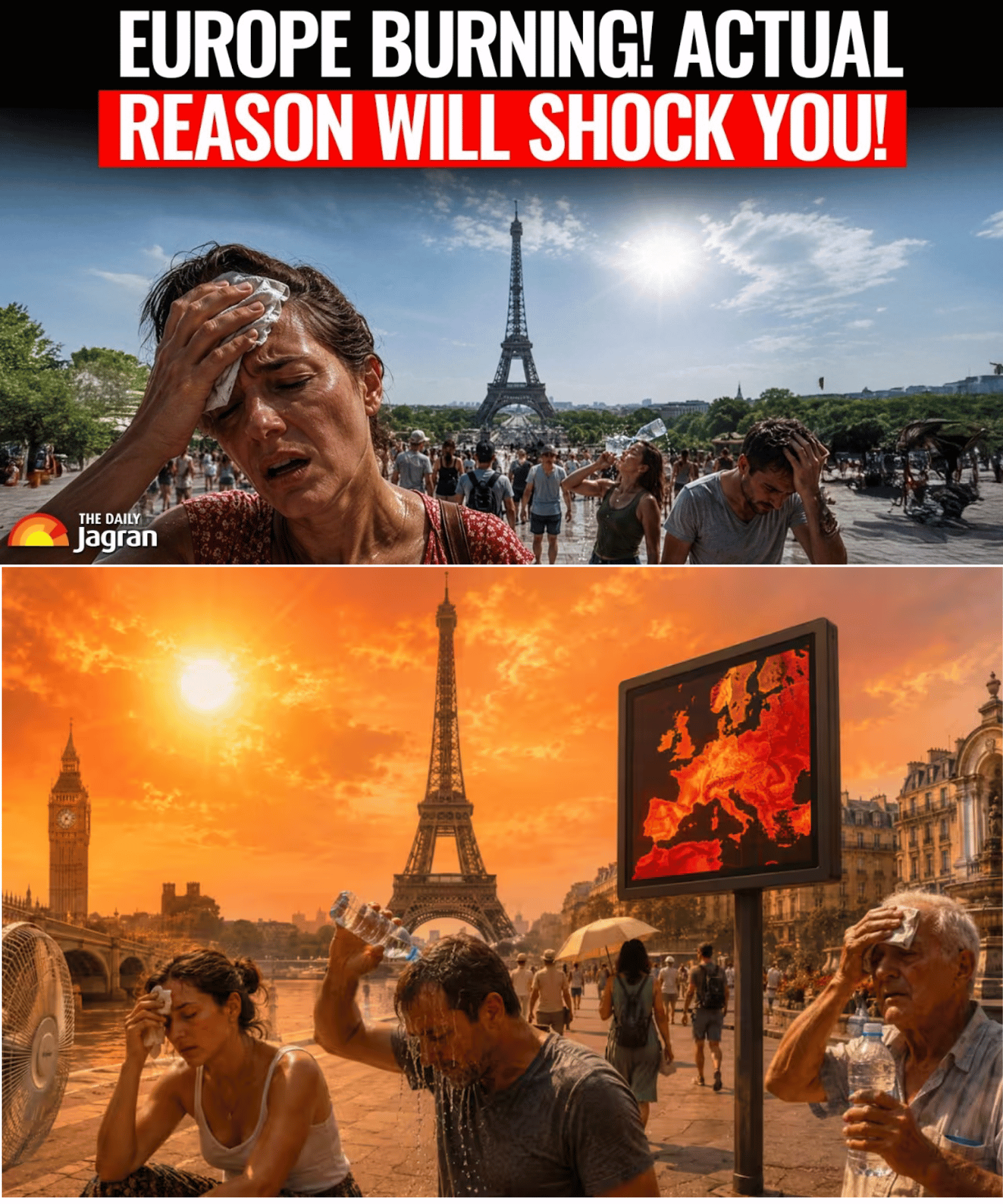
Europe is sweltering under a heatwave so fierce that it no longer feels like weather. It feels like a preview.
Across the continent, cities are breaking records, governments are issuing red alerts, emergency services are stretched, and ordinary people are discovering that heat can become a silent disaster faster than almost any storm. Spain has pushed into the brutal mid-40s Celsius. France has recorded historic national heat levels. Britain, Germany, Switzerland, Luxembourg, Italy, and other countries have faced dangerous conditions that once sounded exceptional but now appear with terrifying regularity.
For Americans watching from thousands of miles away, the temptation is to treat this as Europe’s problem.
That would be a mistake.
What is happening in Europe is not a freak accident. It is a warning from the future — and the United States is already standing in the same line of fire.
The immediate cause of the European heatwave is a weather pattern known as an omega block. On a map, the atmosphere bends into the shape of the Greek letter omega. A huge dome of high pressure becomes trapped between low-pressure systems on either side. Instead of moving along, the heat stays in place. The skies clear. Winds weaken. Sunshine pounds the ground day after day. Hot air builds under the pressure dome like steam trapped under a lid.
It is not just hot.
It is stuck.
That is what makes this pattern so dangerous. A normal hot day can be endured. A normal heat spell can be managed. But when the atmosphere locks in place for days or weeks, the danger multiplies. Roads soften. Rail lines warp. Hospitals fill. Power demand surges. Rivers warm. Crops wilt. Older people suffer. Children trapped in cars die in minutes. People rush to rivers and beaches to cool down, and drownings rise.
This is the part America must understand: heat is not dramatic until it kills.
Unlike a hurricane, it does not roar ashore on radar. Unlike a wildfire, it does not turn the sky orange immediately. Unlike a tornado, it does not arrive with sirens and debris. Heat creeps into apartments, nursing homes, buses, subway platforms, farms, warehouses, and construction sites. It punishes anyone without shade, water, air conditioning, or money.
That is why Europe’s crisis should hit American cities like an alarm bell.
Phoenix already knows what extreme heat can do. Las Vegas knows. Dallas knows. Houston knows. Miami knows. Southern California knows. But the danger is spreading beyond the places Americans traditionally think of as hot. New York, Chicago, Philadelphia, Boston, Minneapolis, and Washington can all face deadly heat when humidity, concrete, poor housing, and weak infrastructure combine.
Europe is proving that the old map of climate comfort is obsolete.
The deeper reason this heatwave matters is that the baseline has changed. Weather patterns like omega blocks have always existed, but now they are forming over a warmer planet. That means when the atmosphere stalls, it is trapping hotter air than it would have trapped decades ago. Climate change does not need to create every weather event from scratch. It loads the dice. It raises the floor. It turns what used to be rare into something more frequent, more intense, and more deadly.
That is exactly what scientists have been warning about for years.
Europe is warming faster than the global average for several reasons. Much of it is land, and land heats faster than ocean. The continent sits near the Arctic, where warming has accelerated dramatically as snow and ice melt away, exposing darker surfaces that absorb more sunlight. Europe has also cleaned up much of its air pollution since the 1980s, a public health victory that removed particles that once reflected some sunlight back into space.
The result is a cruel paradox: Europe became cleaner, but the warming signal became clearer.
Now the continent is trapped in a new reality. Heatwaves are arriving earlier. They are lasting longer. They are hitting before July, traditionally the peak of summer. They are no longer limited to Mediterranean countries. Northern Europe, once seen as a refuge from extreme heat, is increasingly part of the story.
That should make America nervous.
The United States is larger, more air-conditioned, and more accustomed to heat in many regions. But that does not mean it is safe. America’s strength may also be its vulnerability. The country relies heavily on electric cooling, long-distance power grids, car-based suburbs, massive logistics networks, outdoor labor, and aging urban infrastructure. When heat intensifies, those systems are tested all at once.
A heatwave is not just a public health event. It is an economic event. It is an infrastructure event. It is an inequality event. It is a political event.
If the grid fails during extreme heat, homes become ovens. If farmworkers cannot safely harvest, food supply chains suffer. If rivers warm too much, power plants face limits. If asphalt and rail lines buckle, transportation slows. If hospitals lose capacity, the vulnerable pay first. If schools are not prepared, children suffer. If cities lack trees and cooling centers, poor neighborhoods become heat traps.
This is not theory.
This is the new governing test of the 21st century.
For years, American politics has treated climate change as an argument between parties, slogans, and cable-news tribes. Europe’s heatwave cuts through that noise. The thermometer does not care whether voters are liberal or conservative. A 110-degree day does not ask whether a mayor believes in climate policy. A heat dome does not negotiate with Congress.
The heat simply arrives.
And when it arrives, the question becomes brutally practical: who is ready?
Do cities have cooling centers? Do they have emergency text alerts in multiple languages? Do apartment buildings have safe indoor temperatures? Are nursing homes protected? Are outdoor workers guaranteed water and rest breaks? Can the power grid handle sustained demand? Are urban neighborhoods being redesigned with shade, trees, reflective roofs, and cooler pavement? Are public officials planning for the climate that exists now, or the climate they remember from childhood?
Europe is being forced to answer those questions in real time.
America will be next.
The most dangerous phrase in this crisis is “new normal,” because it makes the abnormal sound manageable. There is nothing normal about record heat arriving before peak summer. There is nothing normal about children dying in hot cars, cities banning alcohol at public events, tourists collapsing, rivers warming, and governments issuing red alerts across entire regions.
This is not a seasonal inconvenience.
It is a warning about the stability of modern life.
The current European heatwave will eventually break. Cooler Atlantic air will move in. Headlines will shift. Politicians will move on. Tourists will return to cafes. The panic will fade.
But the physics will remain.
Greenhouse gases will remain. Warmer oceans will remain. Hotter land surfaces will remain. Melting ice will remain. Expanding heat risk will remain. And every summer will carry the same question: is this the year the system fails?
That is why Americans should not watch Europe with distance or superiority.
They should watch with recognition.
Because the same future is already visible in Arizona sidewalks, Texas power alerts, California wildfire smoke, Florida humidity, Midwestern crop stress, and New York subway platforms that feel like furnaces.
Europe is not burning alone.
It is showing America what the next climate emergency looks like when the sky stops moving and the heat has nowhere to go.
The warning has arrived.
The only question now is whether America will prepare before its own summer turns into a national emergency.