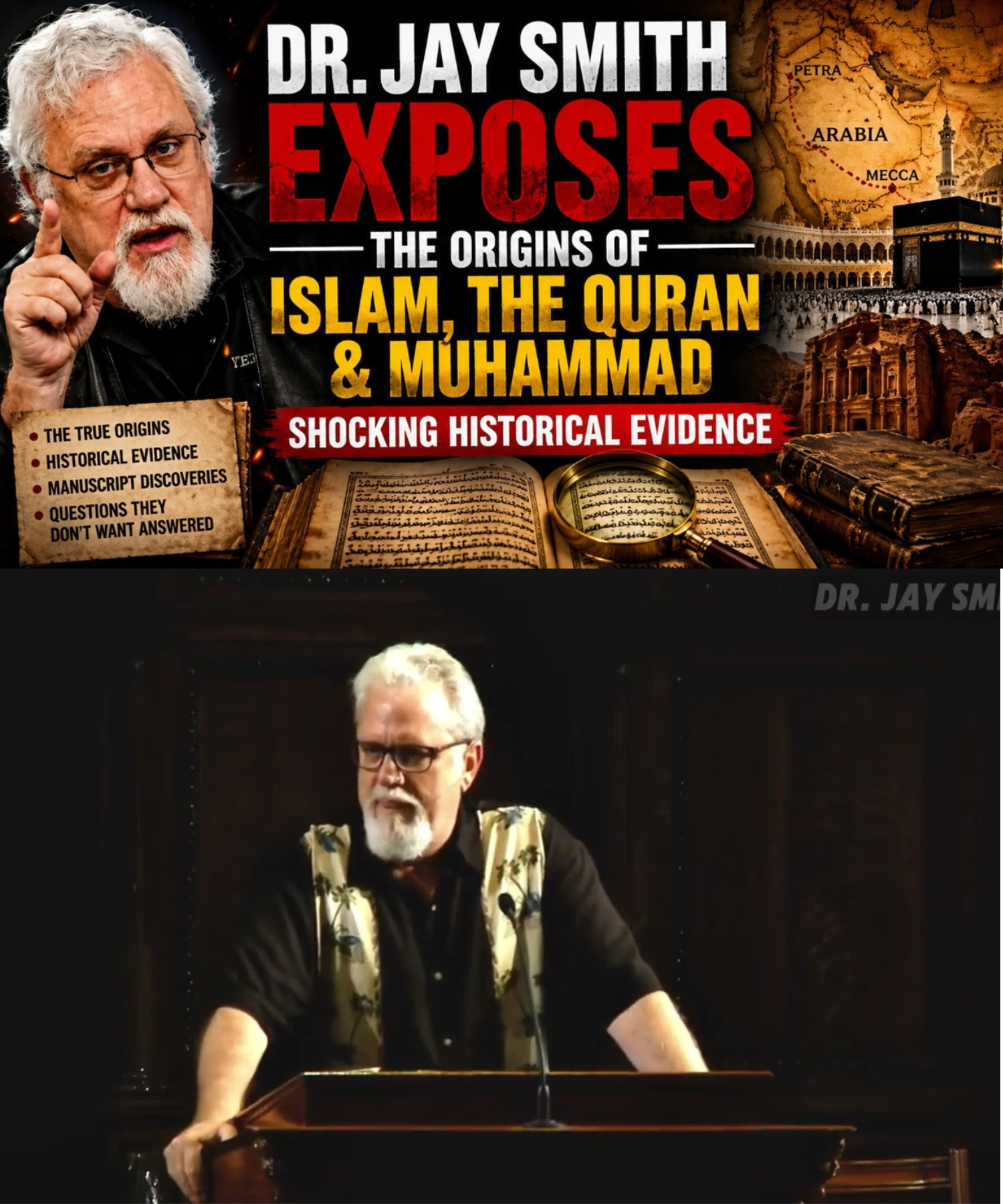
Dr. Jay Smith EXPOSES the Origins of Islam, the Quran & Muhammad | Shocking Historical Evidence
“A Religion Without Early Records?” Dr. Jay Smith’s London Lectures Ignite Fierce Debate Over Islamic Origins
A controversial lecture series delivered by Dr. Jay Smith, a long-time Christian apologist and Islamic studies researcher, has gone viral after he presented claims challenging the historical origins of Islam, the Quran, and early Islamic manuscripts — reigniting a decades-old academic and theological dispute in a modern digital setting.
The lectures, recorded during public speaking events in London and circulated widely online, focus on textual criticism, early Islamic manuscripts, and historical reconstruction of religious narratives. Smith argues that modern academic tools used to critique biblical texts should also be applied to Islamic sources — a claim that has drawn strong reactions from both Muslim and Christian scholars.
While supporters describe his work as rigorous historical analysis, critics accuse him of selective interpretation and misrepresentation of Islamic tradition.
A Career Built in London’s Religious Debate Scene
Dr. Jay Smith begins his testimony by describing his decades-long work engaging with Muslim communities in London, particularly at Speakers’ Corner in Hyde Park — a well-known public forum for religious and political debate.
He recounts his arrival in the early 1990s, when he began attending university Islamic society meetings across London institutions such as King’s College, Imperial College, and the London School of Economics.
According to his account, these early encounters were small and informal, but he quickly became aware of growing ideological movements among some student groups discussing Islam in increasingly political terms.
His involvement deepened after meeting speakers who emphasized strict textual interpretations of Islamic scripture in public debates.
Speakers’ Corner: A Battleground of Ideas
A central theme in Smith’s narrative is his experience at Speakers’ Corner, where public debates between Christians, Muslims, atheists, and activists take place every Sunday.
He describes the environment as intellectually intense and often confrontational, where arguments are presented without academic structure, relying instead on memorization, rhetorical skill, and scriptural references.
Smith says he initially struggled in these debates, facing strong opposition from Muslim speakers who were well-versed in Quranic citations and traditional arguments.
Over time, he claims to have refined his approach by focusing on historical criticism and manuscript evidence rather than theological debate alone.
The Manuscript Question: A Central Controversy
The core of Smith’s argument revolves around Islamic manuscript history and textual transmission.
He references academic work from European and Middle Eastern scholars examining early Quranic manuscripts, including fragments from:
The Sana’a manuscripts (Yemen)
The Topkapi manuscript (Istanbul)
The Birmingham manuscript (UK)
The Samarkand codex
Paris Bibliothèque Nationale fragments
Cairo collections
Smith argues that these manuscripts show variation in text, structure, and completeness, and suggests that none fully align with the standardized Quranic text used today.
He also claims that most surviving manuscripts are dated decades or centuries after the life of Muhammad, raising questions about transmission history.
These claims remain highly disputed among Islamic scholars, many of whom argue that manuscript variation is consistent with known preservation methods in early Arabic writing traditions.
The Mecca Question and Early Islamic Geography
One of the most controversial sections of Smith’s lecture focuses on early Islamic geography, particularly the historical existence and location of Mecca.
He references academic debates suggesting that early references to Mecca in historical records are sparse compared to later Islamic tradition.
Smith further argues that archaeological and textual evidence for early Mecca is limited, and raises questions about trade route descriptions in early Islamic sources.
These claims align with a minority academic theory sometimes referred to as the “revisionist school” of early Islamic history, though most mainstream historians reject its conclusions.
Muslim scholars argue that Mecca’s historical existence is well supported through traditional Islamic sources, early inscriptions, and archaeological interpretations.
Radical Movements and Historical Lineage Claims
Smith’s lecture also outlines a historical narrative linking modern extremist movements — including Al-Qaeda, ISIS, the Muslim Brotherhood, and the Taliban — to ideological developments in Islamic reform movements over several centuries.
He argues that these groups share intellectual roots in textual literalism and revivalist interpretations of Islamic law.
According to his presentation, figures such as Ibn Taymiyyah, Muhammad ibn Abd al-Wahhab, Hassan al-Banna, Sayyid Qutb, and later militant leaders contributed to ideological frameworks that influenced modern extremist movements.
This historical linkage is strongly contested by Islamic scholars and political analysts, who emphasize the diversity of Islamic thought and reject monolithic explanations of radicalization.
The “Book and the Man” Framework
A recurring theme in Smith’s argument is what he calls the “book and the man” paradigm — the idea that religious authority in both Islam and Christianity is structured around sacred texts and foundational figures.
He compares this to Protestant Reformation principles, suggesting parallels between Christian and Islamic interpretive traditions.
Smith argues that both religions have undergone internal reform movements centered on returning to original texts and figures, though critics say this comparison oversimplifies complex theological differences.
Manuscript Criticism and Academic Debate
Smith claims that modern textual criticism — originally developed in biblical studies — can be applied to Islamic texts in the same way.
He argues that applying source criticism, redaction criticism, and historical analysis reveals inconsistencies in transmission history.
However, many academics caution that methodologies used for biblical texts do not always translate directly to Islamic manuscript traditions due to differences in preservation, oral transmission, and codification timelines.
The academic community remains divided, with mainstream Islamic studies generally affirming the stability of the Quranic text from early Islamic periods, while acknowledging minor orthographic variations.
Claims of Missing Early Evidence
One of Smith’s most disputed assertions is that early historical records outside Islamic tradition contain limited references to Muhammad, Islam, and early Islamic practices until later centuries.
He suggests that early external sources do not align chronologically with traditional Islamic narratives.
Historians counter that while early documentation is limited — as with many ancient figures — available inscriptions, coins, and textual references do exist and are subject to interpretation.
The debate remains ongoing in academic circles and is far from settled.
Public Reaction and Online Polarization
The viral spread of Smith’s lectures has led to sharply divided reactions online.
Supporters praise his willingness to question established narratives and argue that historical criticism should be applied equally across all religions.
Critics accuse him of selective sourcing and of presenting contested theories as established fact.
The controversy has also reignited broader debates about religious criticism, academic freedom, and interfaith sensitivity in public discourse.
Conclusion: A Debate That Refuses to Settle
Dr. Jay Smith’s lectures represent one of the most contentious intersections of religion, history, and public debate in recent years.
While his arguments draw heavily on academic methods of textual analysis, their application to Islamic origins remains highly disputed among scholars.
At the center of the controversy lies a larger question:
How should modern societies interpret ancient religious texts when historical evidence is incomplete, contested, or evolving?
For supporters, Smith is asking necessary questions about history and evidence.
For critics, his conclusions risk oversimplifying centuries of complex religious development.
And for the broader public, the debate highlights a growing tension between faith, scholarship, and the digital age — where ancient histories are now being re-examined in real time, before global audiences.
The discussion is far from over.
In fact, it has only just begun.