Barrie Schwortz: “The Latest DNA Results on the Shroud of Turin Defy Explanation”
“It Defies Every Explanation”: Shroud of Turin Returns to the Center of Scientific Controversy After New DNA Findings
A centuries-old linen cloth believed by millions to be the burial shroud of Jesus Christ is once again at the center of global scientific debate after new genetic analysis and forensic studies reignited controversy over its origin — and challenged one of the most widely accepted conclusions in modern religious archaeology.
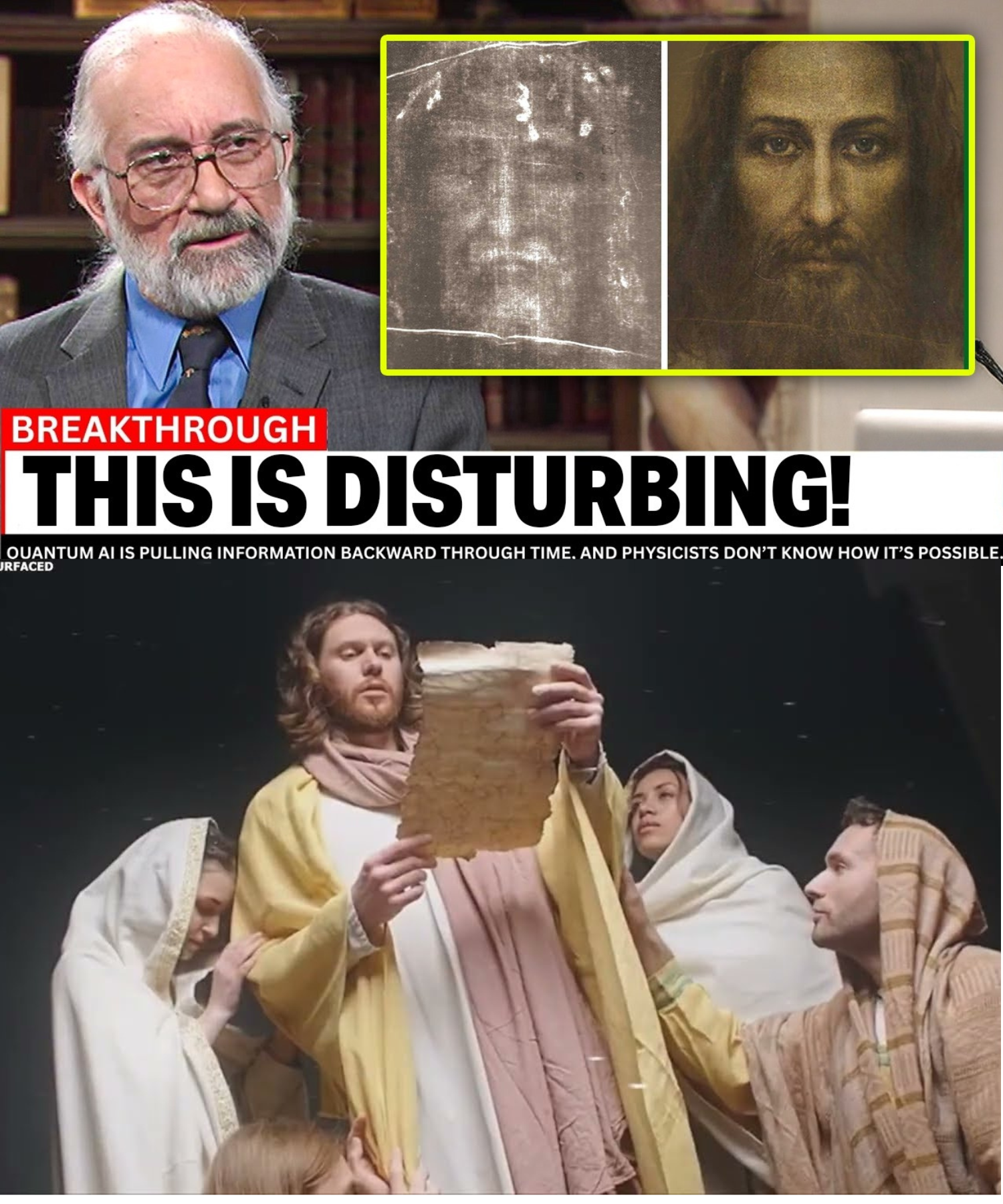
The Shroud of Turin, a 14-foot-long linen cloth preserved in a climate-controlled case inside the Cathedral of St. John the Baptist in Turin, Italy, bears the faint front-and-back image of a crucified man. For decades, it has been studied by scientists, skeptics, forensic experts, and theologians — yet no consensus explanation has ever fully satisfied all evidence simultaneously.
Now, new discussions around DNA analysis, pollen studies, and imaging technology are reopening one of the most complex scientific mysteries in the world.
A Cloth That Continues to Resist Explanation
The Shroud depicts a bearded man in his early 30s with injuries consistent with Roman crucifixion methods.
Forensic interpretations of the image include:
Nail wounds consistent with wrist penetration rather than palms
Extensive scourge marks across the back and legs
A side wound consistent with a spear thrust
Scalp punctures consistent with a crown-like object
The image itself is faint, sepia-toned, and appears to exist only on the very outermost fibers of the cloth — not deeply embedded like paint or dye.
Scientists involved in the Shroud of Turin Research Project (STURP) concluded decades ago that the image is not created by any known artistic technique.
They described it as a superficial oxidation or dehydration of the linen fibers — but were unable to identify a known physical mechanism that could produce it.
The Carbon Dating That Seemed to End the Debate
In 1988, laboratories at Oxford University, the University of Arizona, and the University of Zurich conducted radiocarbon dating on a sample of the cloth.
All three independent results converged on a medieval date range between 1260 and 1390 CE.
The scientific conclusion at the time appeared definitive: the cloth was approximately 700 years old and therefore a medieval artifact rather than a first-century relic.
For many researchers, the case seemed closed.
But others immediately questioned whether the tested sample truly represented the original cloth.
The DNA Study That Reopened the Mystery
In 2015, a team led by researchers at the University of Padua published genetic findings based on microscopic material extracted from the Shroud using non-invasive adhesive tape and vacuum sampling techniques.
The analysis revealed both plant and human DNA fragments embedded in the cloth fibers.
What drew attention was not the presence of DNA itself — expected after centuries of handling — but its surprising geographic diversity.
Plant DNA included species associated with:
The Mediterranean region
The Middle East
Europe
And even regions of the Americas
Human mitochondrial DNA revealed haplogroups linked to multiple populations across North Africa, the Middle East, East Asia, South Asia, and Europe.
Researchers suggested this could reflect centuries of contact across trade routes and pilgrimages — but acknowledged that some patterns were difficult to fully explain within a single historical context.
The Pollen Evidence From the Holy Land
One of the most debated lines of evidence comes from pollen analysis conducted in earlier decades by forensic palynologist Max Frei.
Frei identified pollen grains from dozens of plant species embedded in the cloth fibers.
Significantly, a large portion of the identified species are native to the region around Jerusalem and the Dead Sea — and do not naturally grow in medieval Europe.
This suggests possible physical contact with the Middle East at some point in the cloth’s history.
Supporters of authenticity argue this supports an ancient origin, while skeptics caution that centuries of movement and handling could introduce contamination.
NASA Imaging and the 3D Revelation
One of the most unusual findings comes from imaging analysis using the VP8 system — a NASA-associated technology designed to interpret brightness data as spatial depth.
When a normal photograph is processed through the system, it produces distortion.
However, when the Shroud image was analyzed, it produced a coherent three-dimensional body map — something not typical of painted or photographic images.
Researchers involved in the testing concluded that the image encodes spatial information consistent with a body-shaped source, rather than a flat artistic rendering.
No widely accepted explanation has been established for how such information could naturally or artificially be encoded into linen fibers.
The Blood Evidence That Raises Forensic Questions
Forensic chemist Dr. Alan Adler analyzed stains on the cloth and confirmed the presence of human blood components including hemoglobin and bilirubin.
The blood type was identified as AB, which is relatively rare globally but more common in certain Middle Eastern populations.
One particularly striking detail is the elevated bilirubin levels — a compound associated with extreme physiological stress and trauma.
Such levels are typically found in individuals who experienced severe physical suffering prior to death.
Additionally, serum halos around blood stains suggest natural clotting and separation processes consistent with real biological wounds rather than painted pigment.
The 3D Image Problem and Failed Replications
Despite decades of research, no laboratory has successfully reproduced all characteristics of the Shroud image simultaneously.
Attempts have replicated certain features — such as superficial coloration or image negative effects — but not the full combination of:
3D encoding
No pigment presence
Fiber-level surface-only oxidation
Anatomically precise blood flow patterns
This has led some researchers to conclude that the formation mechanism remains unknown.
Others argue that future discoveries in medieval artistic techniques or chemical processes may eventually provide an explanation.
The Controversy Over the Carbon Sample
A major point of contention remains the 1988 radiocarbon sample itself.
Some researchers argue the tested corner of the cloth may have been contaminated or repaired in the medieval period using newer materials.
The “invisible reweave” hypothesis suggests that restoration techniques may have altered the composition of the sample, skewing results toward a younger date.
Chemist Raymond Rogers later argued that chemical analysis of adjacent fibers indicated the presence of cotton and coating materials consistent with repair work rather than original linen.
If correct, this would mean the carbon-dated sample may not represent the original cloth.
A Scientific Debate Without Closure
Despite competing interpretations, no single explanation has resolved all evidence.
Skeptics emphasize the strength of radiocarbon dating and the lack of definitive proof linking the cloth to the first century.
Supporters point to the accumulation of anomalies — DNA diversity, pollen evidence, forensic blood chemistry, and imaging data — as evidence that the cloth cannot be easily classified as a simple medieval artifact.
Both sides acknowledge one key reality: no laboratory has fully replicated or explained every observed characteristic of the Shroud.
Conclusion: A Mystery That Refuses to End
More than 600 years after its first documented appearance in medieval France, the Shroud of Turin continues to resist classification.
It is either:
A remarkably sophisticated medieval artifact that defies replication
or
An ancient relic with origins that science has not yet fully understood
For researchers like Barry Schwartz, the debate is not about belief but about unresolved data — patterns that persist across decades of analysis without a final answer.
What remains undisputed is that the Shroud continues to generate scientific, theological, and cultural fascination at the highest level.
And despite centuries of study, one fact remains unchanged:
The cloth is still there.
And the questions it raises are still unanswered.