American University Debate Erupts as Professor Dismantles Student’s Claim That “Palestine Existed 3,000 Years Ago”
American University Debate Erupts as Professor Dismantles Student’s Claim That “Palestine Existed 3,000 Years Ago”
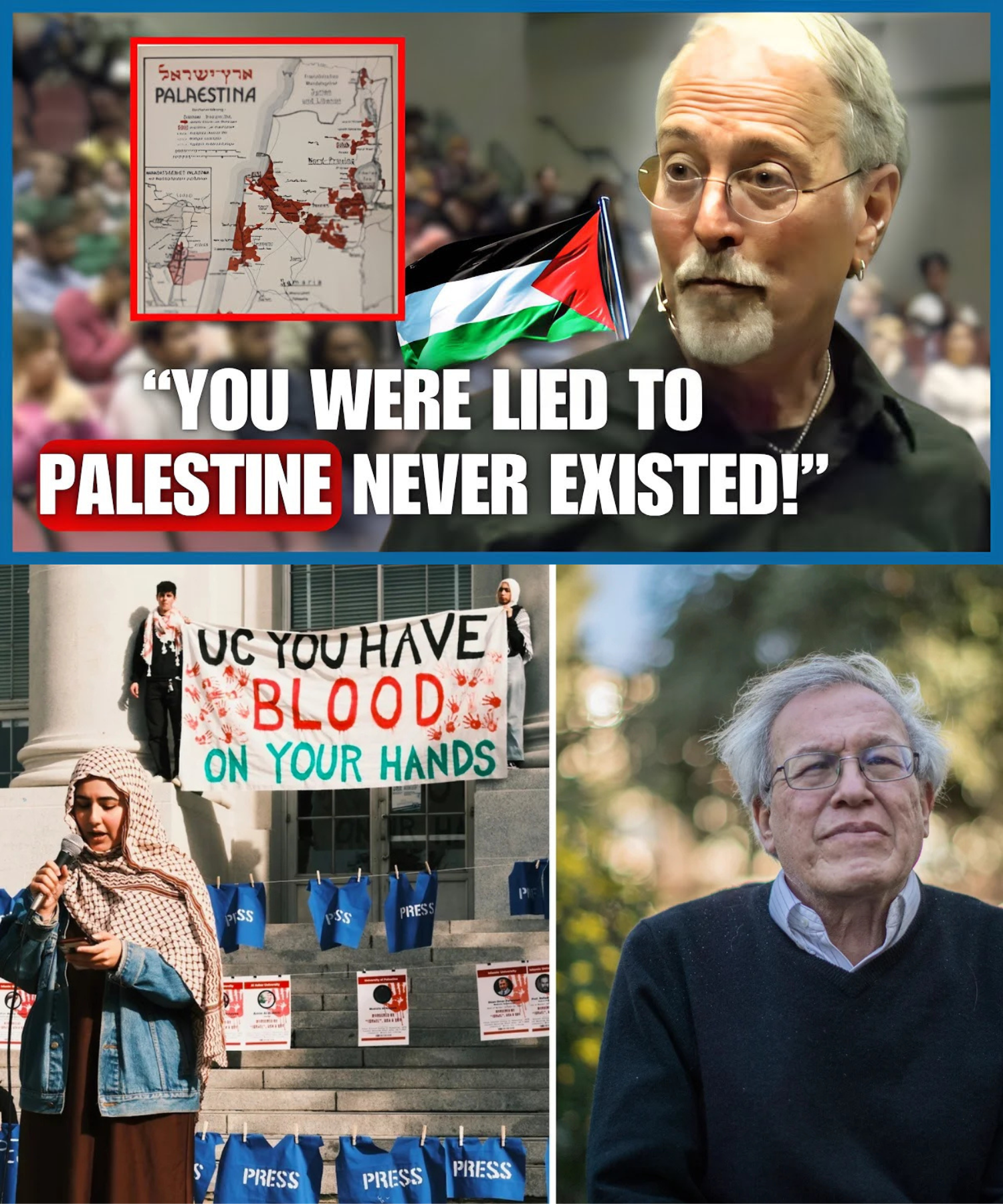
A tense classroom exchange over Israel, Palestine, and the history of the Holy Land has exploded across American political media, after a professor challenged a student’s claim that Palestine has existed for more than 3,000 years and would remain so “until the day of judgment.”
The clip, now circulating widely online, has become another flashpoint in the furious debate over what American students are being taught, what campus activists believe, and whether slogans about the Middle East are replacing serious historical knowledge.
The confrontation began when a student insisted that the land would still be called Palestine and suggested the name stretched back thousands of years. The professor did not shout. He did not remove the student from the room. He did something far more devastating in today’s campus climate: he asked for historical precision.
“No, listen, man,” he said in effect. Palestine as a name, he argued, does not go back 3,000 years in the way the student was using it. He urged the student to study the region’s history, the changing names of the land, the empires that ruled it, and the peoples who came and went across centuries.
Then came the line that lit up the internet: Jews never left.
For supporters of Israel, that moment was a long-overdue correction to a narrative they believe has taken over American universities. In their view, too many students speak about the region as if Jewish connection to the land began in the 20th century, or as if Jews were foreign colonizers with no ancient presence there. The professor pushed back by reminding the room that Jewish communities remained connected to the land through Roman, Byzantine, Islamic, Crusader, Ottoman, British, and modern eras.
For pro-Palestinian activists, however, the clip triggered a different reaction. They argue that challenging simplistic claims about names and timelines should not be used to erase Palestinian identity, suffering, or political rights. The historical name “Palestine,” the modern Palestinian national movement, Arab presence in the land, and the unresolved question of statehood are not the same issue — but in America’s overheated debate, they are often collapsed into one emotional argument.
That is what made the video so explosive.
It exposed the dangerous weakness of slogan politics.
On campuses across the United States, students chant phrases, carry signs, occupy buildings, and accuse institutions of complicity in oppression. But when pressed on maps, dates, legal history, the Ottoman period, the British Mandate, the 1947 partition plan, the 1948 war, the 1967 war, Gaza, the West Bank, Jerusalem, settlements, Hamas, and the Palestinian Authority, many cannot explain the complexity behind the slogans.
The professor’s point was not simply that the student was wrong about a name. His larger point was that the region has never been a frozen picture. It has been a crossroads of empires, religions, armies, languages, identities, and competing memories. The map has changed repeatedly, just as Europe’s map changed constantly over centuries of war, conquest, collapse, and state formation.
That comparison mattered.
The professor pointed to Europe around the year 1000 to show how absurd it would be to treat today’s borders as eternal. Europe was once a shifting puzzle of kingdoms, duchies, empires, tribal lands, and religious authorities. No serious person would say those lines never changed. Yet when the conversation turns to Israel and Palestine, many activists suddenly speak as if one slogan can explain thousands of years of political, ethnic, and religious transformation.
The conversation then turned to the two-state solution.
The student asked whether the professor supported something like the old partition framework, the Oslo Accords, or perhaps a one-state solution. The professor responded by drawing out the geography: the Mediterranean, Egypt, Gaza, the West Bank, Jerusalem, and Israel proper. He explained that Gaza and the West Bank are not connected territories, that Jerusalem has had a uniquely contested status, and that Israel itself includes Arab citizens — Muslims and Christians — who live inside the state.
That part of the discussion cut against both extremes.
The professor acknowledged that Arab citizens of Israel can face forms of unequal treatment and second-class conditions in some areas. That admission made his argument more credible. He was not presenting a cartoon version of Israel where everything is perfect. He was saying the truth is complicated: Israel is a real country with real problems, real Jewish history, real Arab citizens, real Palestinian grievances, and real security fears.
His answer on one state versus two states was equally blunt.
Either could theoretically lead to peace, he suggested, if the people making decisions genuinely believed it was the best path forward and had the courage to pursue it. The structure matters, but leadership, trust, security, and public will matter more.
That is where the debate moved from history into human reality.
The professor warned that a very small group of people can change the course of history. He compared it to airport security after the shoe bomber: one individual’s attempted attack altered travel procedures for billions of people around the world. In the same way, a small number of extremists can derail peace, harden borders, empower hardliners, and poison public trust for generations.
That warning speaks directly to the Israel–Palestine conflict.
Millions of ordinary Israelis and Palestinians do not live inside the simplified slogans Americans shout at protests. They live inside neighborhoods, families, checkpoints, fears, memories, security walls, rocket sirens, grief, work permits, elections, religious holidays, and personal relationships that outsiders often never see.
The professor said he has friends and colleagues in Israeli communities, including settlements, who have meaningful relationships with Arab neighbors. His point was not that settlements are uncontroversial. His point was that real life on the ground is more complicated than the moral fantasies projected by people thousands of miles away.
That line is what hit American audiences hardest.
Many Americans now speak about Gaza, the West Bank, Jerusalem, settlers, Hamas, Zionism, occupation, resistance, apartheid, colonization, and genocide with absolute certainty — while having never spoken to a Palestinian in Gaza, an Israeli in Sderot, an Arab citizen of Israel, a Jewish resident of the West Bank, or a family that lost someone in the conflict.
The professor’s message was simple: slogans are not knowledge.
And ignorance, when repeated loudly enough, becomes dangerous.
The most disturbing part of the clip is not that a student got a historical detail wrong. Students are supposed to learn. The disturbing part is that entire movements can now be built around claims that many participants have never seriously investigated. In the professor’s words, some people repeat blatant falsehoods, and masses follow them.
That accusation cuts deep into American higher education.
Universities once advertised themselves as places where difficult truths could be tested, debated, challenged, and refined. But in recent years, many critics say campuses have become ideological factories where certain claims are protected from scrutiny if they serve the right political narrative.
The Israel–Palestine debate has exposed that crisis more than almost any other issue.
When students cannot distinguish ancient history from modern nationalism, criticism of Israel from denial of Jewish history, or support for Palestinian rights from romanticizing militant movements, the result is not justice. It is confusion dressed up as moral clarity.
The professor’s final warning was aimed not only at the student but at American liberalism itself.
Liberalism, he argued, does not mean accepting lies. It also does not mean shutting down people simply because they think differently. Real liberal education requires debate, evidence, intellectual humility, and the willingness to admit when a beloved narrative is incomplete.
That is why the clip went viral.
It was not merely a professor correcting a student.
It was a collision between history and ideology.
And in a country where campus protests increasingly shape national politics, that collision may only be beginning.