1945 Palestine Documentary Sparks New Firestorm in America Over Immigration, History, and the Roots of the Israel Debate
1945 Palestine Documentary Sparks New Firestorm in America Over Immigration, History, and the Roots of the Israel Debate
A decades-old black-and-white documentary has suddenly returned to the center of America’s most heated political argument, after a viral commentary video used the 1945 footage to challenge one of the most sensitive narratives in the Israeli-Palestinian conflict.
The video, now spreading across U.S. social media platforms, revisits an MGM news-style documentary filmed before the establishment of the State of Israel. The original footage describes postwar Jewish refugees, British control of Palestine, Arab opposition to mass Jewish immigration, and the economic transformation taking place in Jewish-built towns, farms, hospitals, and industries.
But what turned the clip into political dynamite was not only the archival footage. It was the modern commentary layered over it.
The host pauses the documentary repeatedly, reacting with visible disbelief as the narrator claims that Arabs had been coming into Palestine in increasing numbers because Jewish-owned farms and plantations offered higher wages. To the commentator, that line undermines the modern argument that the region’s Arab population was entirely fixed and unchanged before Zionist immigration.
“Wait, what?” the host says, before arguing that the footage complicates today’s popular slogans about land, indigeneity, and displacement.
Within hours, the video had become part of a larger American debate over history, memory, and propaganda. Supporters of Israel shared the clip as evidence that many assumptions about pre-1948 Palestine are incomplete or misleading. Critics pushed back, warning that old newsreels often reflected the political bias of their time and should not be treated as neutral historical proof.
Still, the footage struck a nerve.
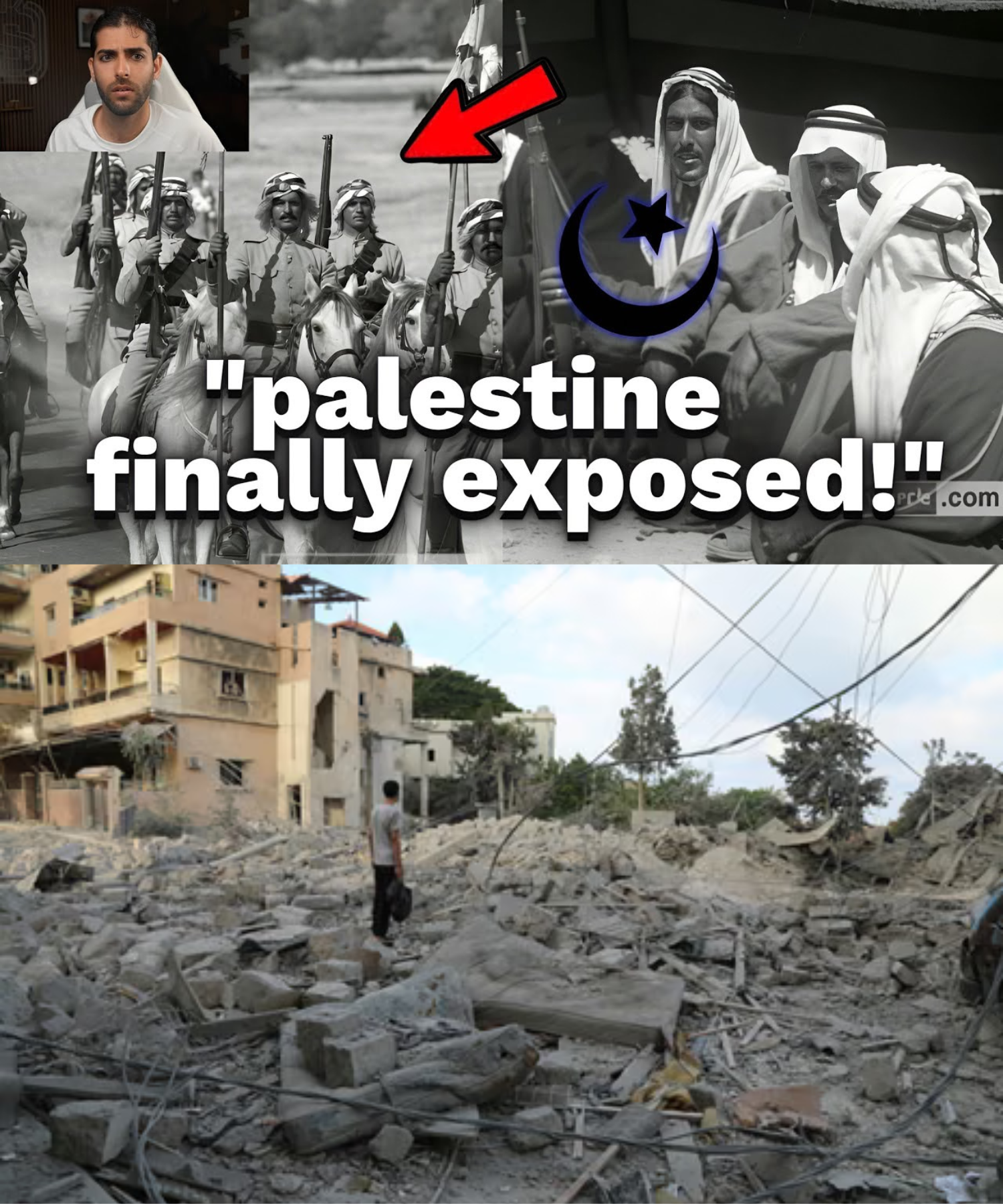
The documentary begins in the shadow of World War II, describing the desperate condition of surviving European Jews after the Holocaust. According to the narration, millions had been murdered, and the remaining Jewish refugees faced hunger, cold, homelessness, and closed borders. Palestine, the film says, represented hope — but British immigration restrictions made that hope nearly impossible for many to reach.
That point became one of the emotional anchors of the viral video.
The host argues that Britain’s 1939 White Paper, which restricted Jewish immigration into Palestine, trapped many Jews in Europe at the very moment they most needed escape. The video frames the policy as a catastrophic betrayal, suggesting that Arab pressure and British strategic interests helped limit Jewish refuge during one of the darkest chapters in modern history.
In the American context, that argument landed with particular force. The United States has long wrestled with its own record on Jewish refugees during the Holocaust, including the refusal to open doors widely to those fleeing Nazi persecution. For many viewers, the documentary revived the painful question of what happens when humanitarian crises collide with immigration politics.
The film also highlights the 1917 Balfour Declaration, British control of the Mandate, and the League of Nations framework that supported the idea of a Jewish national home. It presents Jewish immigration not simply as a political project, but as a rescue mission for a shattered people seeking safety, dignity, and self-rule.
But the most explosive section comes when the documentary describes economic development in Palestine.
The narration praises Tel Aviv’s growth from sand dunes into a modern city, points to Jewish hospitals and laboratories improving public health, and describes hydroelectric plants, diamond cutting, shipbuilding, agriculture, irrigation, and research centers. It claims that Jewish immigrants helped turn swamps and deserts into productive land, while also raising health standards for both Jews and Arabs.
To the modern commentator, this was a crucial counterpoint to the accusation that Jewish immigration only brought destruction.
He argues that the footage shows Jewish settlers building institutions, farms, industries, and medical systems that benefited the entire region. He reacts sharply when the documentary says Arab workers gained prosperity from high wages on Jewish-owned farms and plantations.
For pro-Israel viewers in America, that line became the centerpiece. They saw it as proof that Jewish immigration brought economic opportunity and that some Arabs moved into the area because of that opportunity.
For pro-Palestinian critics, however, the argument was far too simple. They said economic development does not erase political dispossession, land conflict, or the fear Arab communities felt as the Zionist project grew. They also warned that colonial-era films often used language that reduced Arab society to stereotypes while romanticizing European-led modernization.
That tension is exactly why the clip has become so combustible.
It does not merely ask what happened in 1945. It asks who gets to define what happened.
The documentary repeatedly refers to the local Arab population as “Arabs,” while the commentator emphasizes that the word “Palestinians” is not used in the way it is used today. He argues that this absence proves that modern Palestinian identity was politically constructed later.
That claim has become one of the most controversial parts of the video. Supporters call it a powerful historical observation. Opponents argue that national identities often develop over time and that older terminology does not invalidate a people’s later political identity or connection to land.
In America, where debates over identity are already intense, that argument quickly moved beyond Middle Eastern history. It became part of a broader cultural fight over language, nationhood, victimhood, and legitimacy.
The documentary’s final section raises the stakes further. It describes Arab opposition to further Jewish immigration and warns of armed men ready to fight what the film calls a “holy war” that could set the Near East aflame. The modern commentator seizes on that phrase, arguing that the conflict has always had a deep religious dimension.
That framing drew both support and condemnation. Some viewers agreed, saying the conflict cannot be understood without acknowledging religious claims, holy sites, and centuries-old rivalries. Others accused the video of unfairly painting Arabs and Muslims as motivated only by religious hostility, ignoring nationalism, land ownership, British policy, and anti-colonial resistance.
What cannot be denied is that the footage feels eerily relevant nearly 80 years later.
The same arguments still dominate American cable news, campus protests, congressional hearings, church debates, and social media wars: Was Zionism a liberation movement or a colonial project? Were Jewish refugees seeking survival or building a state at another people’s expense? Were Arab fears justified, or were they rooted in rejection of Jewish sovereignty? Did Britain create the crisis, fail to solve it, or both?
The viral video offers one forceful answer. But the fury surrounding it shows that America is still nowhere near agreement.
For some, the 1945 documentary is a forgotten piece of evidence that exposes what they see as decades of distortion. For others, it is a politically loaded artifact being used to flatten a complex and painful history into a one-sided narrative.
And that is why the clip has exploded.
It is not just about old footage. It is about the battle to control the past.
In a divided America, history has become a weapon. Every archive, every phrase, every map, and every forgotten newsreel can be pulled into the present and used as ammunition. This documentary, once a wartime-era explanation of Palestine’s crisis, has now become another spark in the modern fight over Israel, Palestine, immigration, identity, and moral responsibility.
Nearly eight decades after the camera rolled, the questions remain unresolved.
Who built the land? Who belonged to it? Who was fleeing for survival? Who was being pushed aside? And who has the right to tell the story now?
The old film does not end the argument.
It reignites it.