The Most IMPOSSIBLE Sculpture EVER Created
The Most IMPOSSIBLE Sculpture EVER Created
The autumn wind off the Bay of Naples was thick with the scent of roasted chestnuts, diesel exhaust, and the ancient, damp salt of the Mediterranean. It was October 2026. For Julian Vance, a thirty-six-year-old American materials scientist and forensic investigator from Boston, the city felt less like a cradle of culture and more like a labyrinth of unverified anomalies. He was a man who lived by the strict geometry of data—by x-ray diffraction, electron microscopy, and the unyielding laws of physical mass.
Beside him stood Dr. Francesca Rossi, an art historian whose family had lived within a stones throw of the Piazza del Plebiscito for three generations. She walked with the casual, loose-limbed confidence of someone who viewed the baroque excesses of Naples not as mythology, but as local history.
“You are looking for a trick, Julian,” Francesca said, her voice cutting through the ambient roar of a passing Vespa. “Every American engineer who comes to the Sansevero Chapel wants to find a seams line. They want to find a chemical formula on a scrap of parchment. They cannot accept that a human being simply picked up a hammer and became a god for six months.”
“I accept data, Francesca,” Julian replied, adjusting his rimless glasses as they turned into the narrow, shadow-drenched alley of Via Francesco de Sanctis. “When a piece of stone violates the structural limitations of its own medium, it’s not an insult to the artist to ask how it was done. It’s an act of respect. Marble has a specific tensile strength. It shears under certain pressures. If you carve it too thin, it shatters. That’s not art history; that’s geology.”
They stopped before the unassuming entrance of the Cappella Sansevero. From the outside, the building looked like a forgotten private vault, its gray stone facade weathered by centuries of Neapolitan humidity. But Julian knew that the interior was a psychological funhouse, designed by one of the most eccentric and terrifying minds of the eighteenth century.
They stepped through the heavy wooden doors, and the noise of the modern city died instantly, replaced by a dense, cool silence that smelled of beeswax, damp tufa rock, and old incense.
In the exact center of the nave, bathed in a soft, dramatic vertical light from the high clerestory windows, lay the masterpiece.
The Veiled Christ.
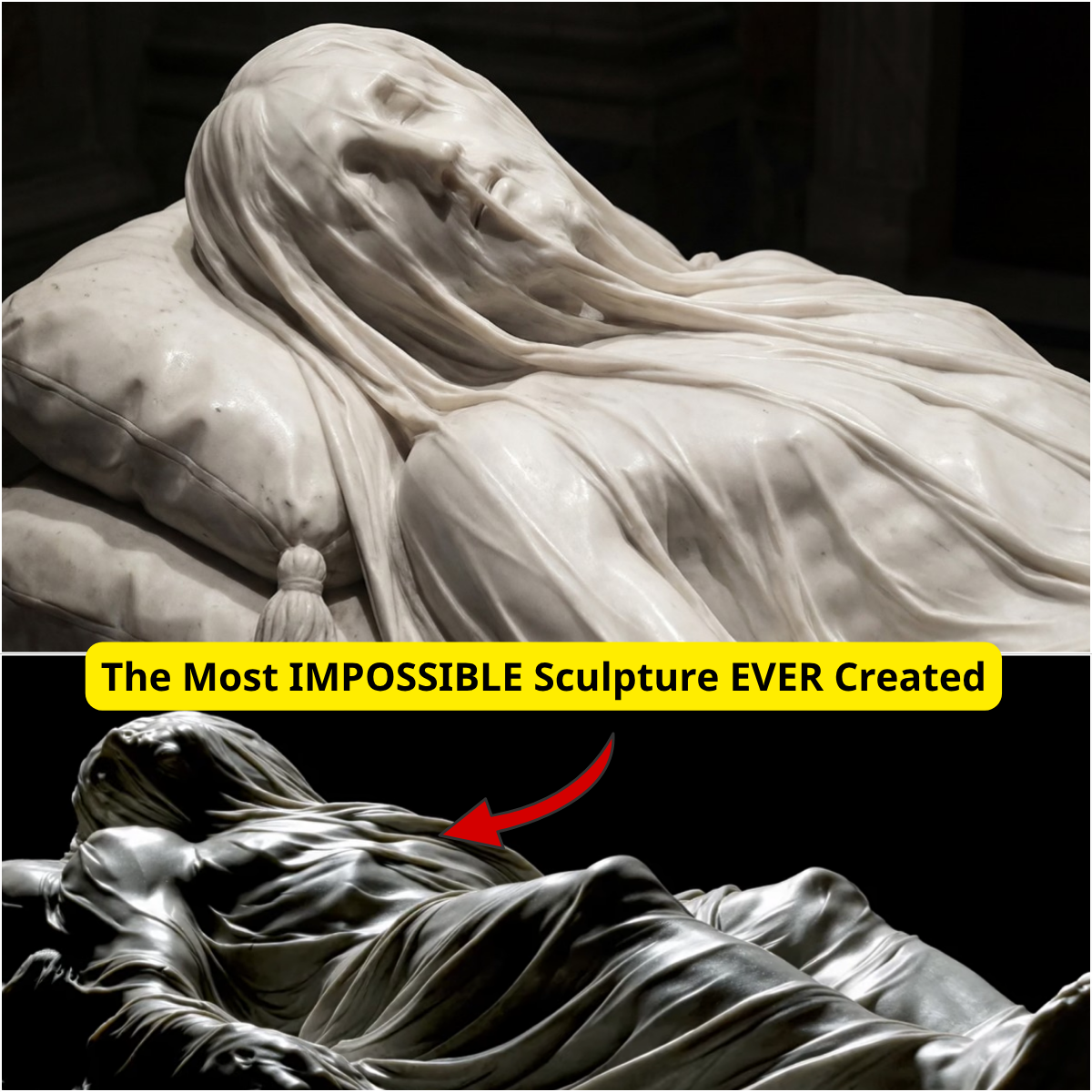
Julian approached the marble balustrade, his breath catching in his throat despite his analytical training. Resting on a low marble platform was the life-size figure of Christ immediately after his descent from the cross. He lay on a deeply creased stone mattress, two plush, heavy pillows cradling his head. His body was entirely covered by a continuous burial shroud—a veil so impossibly thin, so fluidly draped, that it seemed to cling to the wet contour of the skin beneath.
“He was thirty-two when he finished it,” Francesca whispered, her eyes tracking the movement of Julian’s face. “Giuseppe San Martino. A local boy. Before this, he was nobody—just a craftsman making terracotta figures for church mangers. Then he walks into this chapel in 1753, takes a single block of Carrara marble, and does… this.”
Julian leaned over the rail, his eyes widening. His brain was misfiring. The visual information his eyes were receiving flatly contradicted everything his baseline knowledge of materials science dictated.
The shroud did not hover over the body like a rigid shell of stone. It clung with a desperate, heavy dampness. It tracked the precise hollow of the throat where the final breath had escaped. It settled into the deep, rhythmic valleys between the ribs. It gathered in tiny, realistic bunches within the spaces between the long, cold fingers.
The optical illusion was so absolute that Julian’s mind registered three distinct physical substances: the dense, porous weight of the pillows; the cold, dead elasticity of human flesh; and the gossamer, translucent weave of linen. Yet every square millimeter of it was the exact same piece of calcium carbonate.
“Look at the shortcut,” Julian murmured, recalling a classic study he had read in Scientific American regarding a much later, nineteenth-century veiled sculpture by Giovanni Strazza. “The traditional technique for this kind of illusion isn’t actually to carve a transparent layer over a face. The sculptor renders the anatomical features as if the cloth isn’t there at all, but they leave narrow, raised ridges along the bone lines and subtle texture shifts in the stone. The human brain, seeking continuity, fills in the blanks. It creates the transparency that isn’t physically present.”
“Perhaps,” Francesca said, her voice dropping to a low, melodic register. “But run your eyes down to the forehead, Julian. Look through the veil.”
Julian adjusted his gaze, focusing on the left temple of the Christ. There, visible beneath the alleged linen, was a single, swollen vein—raised, intricate, and perfectly mapped according to human anatomy. It didn’t look like a stylized representation of stone; it looked, as the chapel’s own historic guidebook claimed, as though it were still pulsating with the residual pressure of a violent death.
To achieve that, San Martino couldn’t use a simple perceptual shortcut. He had to carve the minute, rounded structure of a vein, and then, without breaking the stone, carve a micro-thin layer of ripples directly on top of it from the very same master block. It was a mathematical and manual impossibility—a feat that required a precision of force measured in fractions of a millimeter, executed with a iron chisel and a wooden mallet.
The Alchemist’s Shadow
“It’s not possible,” Julian said, his voice tight as he stepped back from the rail. “Not with mid-eighteenth-century tools. The vibration alone would have snapped the stone at that thickness.”
“And that is exactly why the legend was born,” a new voice remarked from the shadows of the nave.
An elderly docent, dressed in a faded black suit that matched the dark marble monuments along the walls, stepped forward. He smiled, his eyes twinkling with the institutional pride of a man who had watched thousands of rationalists break their minds against the same sculpture.
“You are thinking like a modern technician, signore,” the old man said, pointing toward a small door that led down into the chapel’s basement crypt. “But you must remember who held the purse strings for this room. Raimondo di Sangro, the Prince of Sansevero.”
Julian knew the name. In the annals of the European Enlightenment, the Prince was a figure of deep, unresolved terror. He was the Grandmaster of the Neapolitan Masonic Lodge—a practicing alchemist, a military engineer, and an inventor whose creations bordered on macabre performance art.
The Prince was a man who lived to challenge the boundaries of nature. He had constructed an amphibious carriage with cork horses that traveled across the waves of the Bay of Naples on concealed paddle wheels. He had developed synthetic silks, waterproof fabrics, and fireworks that detonated with the precise, acoustic pitch of nightingales and thrushes.
But it was his work beneath the chapel that had cemented his reputation as a sorcerer.
“Come,” Francesca said, gesturing toward the basement stairs. “Before you decide on San Martino, you must see the Prince’s true signature.”
They descended a narrow, spiral staircase of cold limestone, the air turning rapidly damp and smelling of underground earth. At the bottom, inside a vaulted, circular brick crypt, stood two tall glass cases. Inside those cases were the Anatomical Machines—the real, skeletal remains of a man and a pregnant woman, completely encased in an intact, vibrant red-and-blue network of blood vessels.
For nearly three centuries, the local population of Naples had believed a terrifying rumor: that the Prince, desiring a perfect map of human circulation, had injected his living servants with an alchemical compound that metallized their blood while their hearts were still beating, preserving the arterial system before the flesh could rot.
Julian approached the glass, his professional instincts kicking in. He examined the incredibly dense web of capillaries wrapping around the skull, the long, delicate strands of the femoral arteries, the intricate cage of the lungs.
“A 2008 analysis by researchers at University College London ruined the ghost story,” Julian said, his voice echoing slightly in the brick vault. “They proved that the circulatory systems aren’t real human tissue. It’s an incredibly sophisticated assembly of iron wire, colored silk threads, and liquid beeswax, molded over genuine human bones. It’s an engineering marvel of modeling, but it’s artificial.”
“Yes,” Francesca agreed, looking up at the crimson web. “But look at what that means. For two hundred and fifty years, the work was so perfect that people preferred to believe in a monstrous act of murder-alchemy rather than accept that a human hand could model wire and wax with that level of fidelity. The skill was so extreme that it became a crime.”
They walked back up the stairs, returning to the light of the upper chapel.
“The same thing happened to the Veiled Christ,” the docent said, waiting for them near the base of the statue. “Because the Prince was an alchemist, the city decided that he had invented a chemical solution—a liquid that, when poured over real linen drapery resting on a standard marble sculpture, would calcify the fabric, turning it into stone through a secret crystalline process. For decades, travelers swore that the veil was real cloth trapped in a mineral state.”
“The archival record kills that theory too,” Julian noted, pulling up his data files on his tablet. “On December 16th, 1752, a payment receipt was logged in the historical archives of the Bank of Naples. It explicitly records fifty ducats paid to Giuseppe San Martino for a statue of Our Lord Christ, covered by a veil also of marble. The Prince’s own letters confirm it was a single block of Carrara stone. There is no chemistry here. There is only a man with a piece of metal.”
“And yet,” Francesca said, leaning against a nearby pillar, “the legend survives. Why? Because the alternative is harder for our modern egos to accept. We want to believe in a trick, Julian, because if there is a trick, then the artist is just an engineer with a secret. But if there is no trick, then he is something we can never duplicate with all our software and all our lasers.”
The Instruments of the Passion
Julian returned to the foot of the sculpture, dropping to one knee to examine the details that most visitors passed over in favor of the face.
Resting at the feet of Christ, half-buried under the heavy folds of the stone shroud, were the instruments of the crucifixion: a pair of iron pliers, heavy shackles, and the twisted, chaotic knot of the crown of thorns.
As a materials scientist, this was where Julian found the truest brilliance of the work. The surface texture of the pliers was completely different from the texture of the veil. The metal looked matte, hard, and unforgiving—its surface bearing the simulated pits and imperfections of hand-forged iron. The thorns looked dry, brittle, and sharp enough to draw blood, completely distinct from the smooth, cold transparency of the flesh just inches away.
“He is forcing the medium to lie,” Julian whispered, his fingers hovering an inch above the stone. “Marble is uniform. It has a single refractive index. It reflects light in one specific way. But San Martino has altered the microscopic texture of the stone’s surface through varying degrees of polishing and abrasive scratching. He’s controlling how the light scatters, forcing our retinas to perceive iron, fabric, and bone simultaneously. It’s an intuitive mastery of optical physics.”
“And that is why the critics hated it,” Francesca said, walking over to join him. “Rudolf Wittkower, the great patriarch of art history, dismissed this sculpture in his Pelican History of Art. He called it a ‘hypertrophic effort.’ He thought it was pure technical showmanship—virtuosity for its own sake, a parlor trick designed to make tourists gasp rather than to elevate the soul.”
“Is that what you see?” Julian asked, looking up at her.
“No,” she said softly, her eyes reflecting the amber glow of the chapel lights. “I look at Ruth Lockheart’s work at University College Dublin. She read the veil through the lens of Christian iconography. In the ancient world, the veil is never just a decoration. It is the velum—the boundary between the human and the divine, the visible and the invisible, presence and absence. When Christ died on the cross, the veil of the temple was rent in two. The boundary collapsed.”
She stepped closer to the head of the figure. “By that reading, San Martino is not playing a game with us. The veil is a theological threshold. It is the exact point where our physical, material reality meets the mystery of the sacred. It forces you into a choice about what you are actually witnessing.”
The Unsettling Reveal
Julian stood up, his analytical distance beginning to erode under the sheer emotional gravity of the space. He looked at the way the stone fabric pooled around the wounds in the hands and feet.
“Look at what the veil actually does, Francesca,” he said, his voice dropping. “If this were a standard burial shroud, its purpose would be mercy. It would be an act of compassion—covering the absolute horror of a ruined, tortured body, hiding the gashes from the public eye to preserve the dignity of the dead.”
He moved along the balustrade, changing his angle of view until the light caught the contours of the abdomen.
“But it does the exact opposite,” Julian continued, the realization striking him with the force of a physical impact. “The veil doesn’t conceal anything. Because it clings so tightly, because it tracks every indentation and every bruise, it actually makes the suffering more legible. The hollow of the stomach is deeper through the cloth. The puncture wound in his side is more defined, its edges sharper under the marble drapery than if the skin were bare. The covering reveals more than nakedness ever could.”
The old docent nodded slowly from the corner of the room, his hands folded over his chest. “Ah, signore. Now you see the true labyrinth of San Severo.”
“So what is it?” Julian asked, turning back to the sculpture. “Is the veil an act of concealment, or an act of exposure? If you see concealment, you see a traditional message of comfort and protection. But if you see exposure, you see something far more unsettling. You see a shroud that strips away a man’s final privacy, turning his agony into a permanent, transparent exhibition.”
The Veiled Christ remained completely motionless in the center of the room, an eternal, silent enigma carved from a single block of Carrara stone. It seemed to look back at the two modern observers through its blind, marble eyes, offering no answers, no compromise, and no chemical formulas.
Julian looked down at his digital tablet, with its clean, verified records of the 1752 bank transactions, its precise measurements of mineral densities, and its historical receipts signed by long-dead princes. Then he looked back at the swollen, pulsating vein on the forehead of the stone man, the wet cling of the fabric, and the sharp, iron texture of the pliers resting at the bed’s edge.
“Well, engineer?” Francesca asked, her hand resting lightly on his arm as they turned to leave the chapel. “What do you trust now? Do you trust the documents in your hand, or do you trust the skin in front of your eyes?”
Julian did not answer. He turned off the screen of his tablet, slipped it into his leather bag, and walked out into the bright, chaotic noise of the Neapolitan afternoon, knowing that he would never truly cross back over the threshold of the stone.