Another Proof That Caravaggio Was a Genius
Another Proof That Caravaggio Was a Genius
The Roman summer of 1601 did not breathe; it suffocated. In the cramped, high-ceilinged studio off the Via della Lupa, the air was a thick soup of turpentine, crushed linseed oil, and the sharp, metallic tang of unwashed human sweat. Outside, the eternal city swarmed with pilgrims, beggars, and mercenaries, all churning the dust of the streets into a golden haze. Inside, Michelangelo Merisi da Caravaggio moved like a predator in a cage.
He was thirty years old, possessing a wild mane of dark curls and eyes that looked as though they had never known a full night’s sleep. He did not paint like the elegant masters of the High Renaissance. He did not sketch pristine outlines or spend months calculating geometric harmonies on paper. Instead, he attacked the canvas directly with his brush, cutting deep, dark gashes of earth-toned pigment onto the coarse fabric, guided only by the stark, unforgiving light that sliced through a single, shuttered window high above.
“Hold the arm, Mario,” Caravaggio growled, his voice gravelly from a night spent drinking cheap wine at the Osteria del Moro. “If you drop your hand again, I’ll paint you with a broken wrist.”
In the center of the room, arranged around a rough wooden table, three men froze. Mario Minniti, a young Sicilian artist and Caravaggio’s frequent model, was thrusting his arms outward, his face locked in an expression of theatrical shock. His right arm stretched toward the canvas, his left extended back into the shadows, his body mimicking the raw, geometric expanse of a crucifix.
Opposite him, an old Roman laborer with a deeply lined forehead and calloused hands sat perched on the absolute edge of a rickety straw-bottomed chair. His elbows poked through the tattered, split seams of his jacket—a detail Caravaggio had specifically ordered him not to fix.
This was not an assembly of idealized saints or ethereal beings worthy of a Vatican fresco. These were the men of the Roman taverns, the people who slept on stone steps and earned their bread by the strain of their backs. To the aristocratic patrons who commissioned art in the holy city, these models were the dregs of society. To Caravaggio, they were the only vessels capable of holding the divine.
“The priests want us to believe that Christ walked three inches above the dirt,” Caravaggio muttered, mixing a dollop of lead white with yellow ochre on his palette. “They want him in robes of silk that never saw a speck of dust. But the Gospel doesn’t say he broke bread with princes. He broke it with fools who couldn’t even recognize his face after walking with him for three leagues.”
He was painting The Supper at Emmaus, a crucial scene from the Gospel of Luke. The narrative was simple yet psychologically devastating: two disciples, shattered by the crucifixion of their master three days prior, walk along the road to Emmaus with a stranger. They converse for hours, sharing their grief and confusion. It is only when they sit down for dinner at a nondescript inn, and the stranger takes the bread, blesses it, and breaks it, that the scales fall from their eyes.
Caravaggio did not want to paint the abstract theology of the resurrection. He wanted to freeze the exact microsecond of human realization—the terrifying, beautiful ignition of the human mind when it recognizes what has been sitting in front of it all along.
The Canvas of Flesh
For weeks, Caravaggio labored in the darkness, refusing to let natural daylight touch the composition. He had painted the background of the canvas a deep, impenetrable black—a void so absolute that it seemed to absorb the very walls of his studio.
A contemporary writer and critic, Giovanni Pietro Bellori, would later note with a mixture of awe and disapproval that Caravaggio never brought his figures out into the open day. Instead, he kept them locked in the gloom of a windowless room, using a single, vertical beam of light that descended like a blade over the principal parts of the bodies. The technique—chiaroscuro taken to its absolute, violent extreme—left the rest of the scene in total shadow, creating an immense, muscular force through the sheer contrast of light and dark.
“It forces them to look,” Caravaggio said to Mario during a brief respite, as he wiped his stained fingers on a dirty rag. “In a world drowning in gold leaf and pretty colors, the dark makes you look at what matters. It strips away the lies.”
He stepped back to examine the central figure. Christ sat presiding over the table, but he was unlike any depiction Rome had ever seen. Caravaggio had painted him without the traditional, flowing beard. He was young, his cheeks smooth and slightly flushed, his hair falling in soft curls around a face that remained completely serene amidst the surrounding explosion of human shock.
This youthfulness was a deliberate, radical choice—a direct theological reference to the “transformed form” described in the post-resurrection appearances. Christ’s body was no longer the broken, scourged vessel that had hung on the hill of Golgotha three days before; it was something altered, something so fundamentally changed that his closest companions could look directly at him for hours and see only a traveler.
To Christ’s right, the old laborer—playing the disciple Cleophas—was thrusting himself upward from his chair, his hands gripping the wooden armrests as if a physical jolt of electricity had passed through his spine. To his left, Mario’s extended arms seemed to burst through the spatial boundaries of the painting, his left hand reaching out toward the viewer in a gesture that practically demanded entry into our world.
Behind them stood the innkeeper, a heavy-set man with a receding hairline and a dull, uncomprehending gaze. He stood under the exact same vertical beam of light. He heard the exact same blessing. He breathed the same air. And yet, his face remained a blank slate of domestic indifference. He was a man wondering if the bill would be paid, entirely blind to the cosmic hinge swinging open in his own dining room.
“Look at him,” Caravaggio whispered, pointing his brush at the innkeeper’s painted face. “The tragedy of the world isn’t that God hides himself. It’s that he sits at our table, and we’re too busy counting the pennies to notice.”
But the true genius of the composition lay in its architecture. Caravaggio had left the entire foreground of the table completely open. There was no barrier, no painted bench or decorative shield to separate the sacred space from the secular floor of the viewer. He had engineered a vacuum at the front of the table—leaving a metaphorical fourth seat available, an open invitation for whoever stood before the canvas to step out of their reality and sit down with the risen dead.
The Threat at the Edge
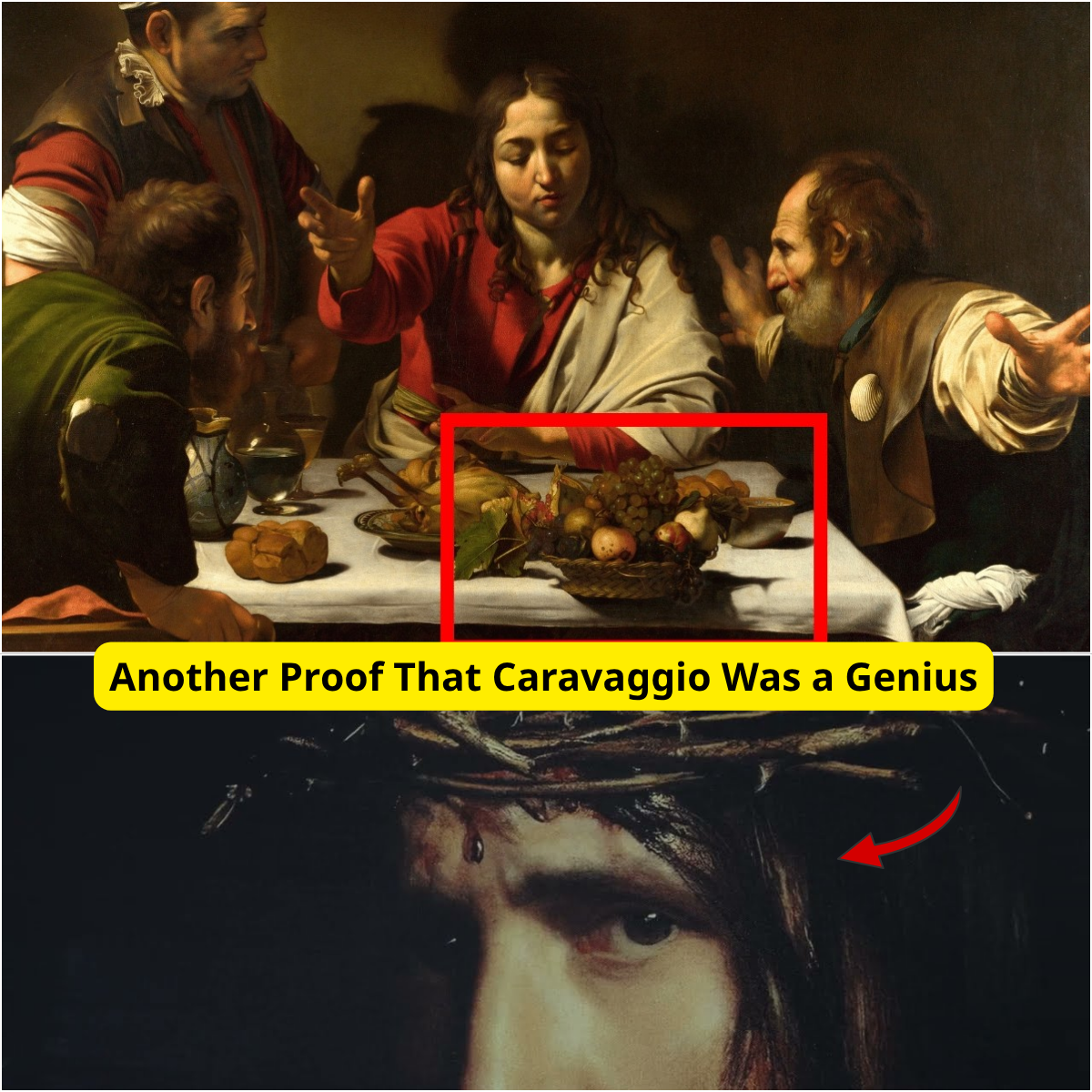
To anchor this illusion, Caravaggio focused his obsessive attention on a single object resting at the very lip of the table, directly in front of the open space: a wicker basket filled to the brim with fruit.
Using a masterful application of trompe l’oeil—the art of tricking the eye—he painted the basket so that it didn’t merely sit upon the white tablecloth; it jutted out over the precipice. More than half the base of the wicker basket hung precariously in the air, defying gravity, extending outward into the physical space of the viewer. It was a visual threat, an illusion so immediate that anyone standing in front of the canvas felt an instinctive urge to reach out their hands to catch it before it spilled its contents onto the floor.
Inside the basket, the fruit was a meticulously rendered catalog of life and decay. Caravaggio had painted a large, prominent apple, but its skin was not flawless; it bore a deep, unsightly brown blemish where rot had begun to take hold—the universal symbol of temptation, original sin, and the fallen nature of mankind. Beside it lay heavy, dark clusters of grapes, their skins dusted with a pale bloom, representing the Eucharistic wine and the sacrificial blood of Christ. There were figs, pomegranates, and quinces, each carrying a heavy weight of traditional biblical iconography that any seventeenth-century Roman viewer would have decoded instantly.
For more than four hundred years, that basket of fruit was analyzed, praised, and copied by generations of artists. It was considered one of the finest still-lifes in western art, a testament to Caravaggio’s uncompromising realism. The painting eventually found its way to the National Gallery in London, where millions of eyes passed over it, cataloging the cracks in the tablecloth, the tears in the sleeves, and the bruises on the apples.
And then, centuries later, an art historian leaned closer to the canvas than anyone had in four hundred years.
The discovery didn’t come from a hidden document or a long-lost diary; it came from looking at the paint itself. In the bottom right corner of the wicker basket, where the dried twigs were woven together to form the lip, Caravaggio’s brush had done something extraordinary.
Among the fraying, loose ends of the wicker pattern, a single twig had broken free from the tight weave, sticking upward in a sharp, elegant arc. Directly beneath it, another strand of dried reed curved in the exact opposite direction, crossing the first at a precise juncture. Together, the two loose twigs formed a perfect, unmistakable silhouette.
It was the Ichthys. The fish.
The ancient, secret monogram used by the earliest Christians during the dark centuries of Roman persecution under the emperors. In those brutal times, when a single word of faith could mean the lions of the Colosseum, a Christian walking a dusty street would use their sandal to draw a single, simple curve in the dirt. They would then wait. If the person approaching them was a fellow believer, they would take their own foot and trace the opposing curve, completing the silhouette of the fish. If they did not, the symbol remained incomplete—a meaningless scratch in the dust to an outsider, but a lifeline to a brother.
Caravaggio had not merely painted a loose piece of wicker; he had built the secret handshake of the underground Church into the very fabric of the Emmaus table. He had illuminated the upper curve of the twig with his sharp, mystery light, while leaving the lower curve cast in the deep shadow of the fruit, mimicking the exact historical reality of the symbol—half hidden in the light, half buried in the dark.
But the secret did not stop at the wicker weave.
If one followed the trajectory of the vertical light as it hit the basket, the shadow cast by the wicker container onto the pristine white tablecloth below took on an even more defined shape. The shadow wasn’t a generic, rounded blur. It stretched across the linen, tapering into a distinct, crescent-shaped tail fin that seemed to swim toward the darkness of the room.
Caravaggio had hidden the fish twice in the same square inch of canvas—once in the physical structure of the basket, and once in the negative space of the shadow it cast. And then, as if to leave no doubt as to his intention, the shadow cast by the separate pile of fruit to the right of the basket mirrored the exact same ichthyic form a third time. Three fish, hidden in plain sight, guarding the edge of the table for over four centuries.
The revelation completely reframed the painting. Caravaggio wasn’t just showing a miracle; he was operating under the same rules as the early Christians. He was telling the viewer that the truth is always hidden in the ordinary things—the broken twigs, the cast shadows, the worn coats of poor men. To find the divine, one had to know how to read the secrets written in the dirt.
The Thickening Dark
Five years after he completed the London masterpiece, Caravaggio found himself standing before another blank canvas, about to paint the exact same scene. But the man who held the brush in 1606 was not the confident, thirty-year-old darling of the Roman art world. He was a fugitive.
In May of 1606, during a chaotic, blood-soaked brawl on a Roman tennis court, Caravaggio had drawn his sword and run it through the groin of a young man named Ranuccio Tomassoni. Tomassoni died on the dirt, and Caravaggio fled the city with a death bounty on his head. He was hunted, paranoid, moving from one safe house to another in the Alban Hills, his mind fracturing under the weight of his guilt and the constant fear of the executioner’s blade.
It was during this desperate exile that he painted his second version of The Supper at Emmaus, a work that now hangs in the Pinacoteca di Brera in Milan.
When you look at the second painting, the change is terrifying. The vibrant, theatrical energy of the first work has been completely extinguished. The colors have been drained, replaced by a muted, monochromatic palette of earthy browns, dull grays, and sallow flesh tones.
The basket of fruit—with its brilliant trompe l’oeil illusion, its rich theological symbols, and its hidden fish—is entirely gone. In its place, the table is barren, holding only a single, flat loaf of bread and a plain ceramic jug. There are no playful tricks to make the basket seem as though it is falling into our world. There is no open invitation, no fourth seat left vacant at the front of the linen. Caravaggio had built a wall of shadow between the table and the viewer, effectively pushing us away from the sacred space.
The figures themselves have aged decades in the span of five years. Christ is no longer the young, rosy-cheeked, serene figure of the London canvas; his face is gaunt, his eyes are heavy with an unbearable sorrow, and his hand blesses the bread with a slow, exhausted movement that feels more like a funeral rite than a resurrection celebration. The disciples do not leap from their chairs in dramatic astonishment; they lean forward with quiet, subdued grief, their faces lined with the grim reality of a world that kills its prophets.
The shadows behind the figures have thickened into an oppressive, suffocating wall of black water. The light no longer cuts the characters out like heroic actors on a stage; it seems to be losing a war against an encroaching, universal night.
In those five turbulent years, the world had broken Caravaggio, and his art bore the scars. Between the first painting and the second, he had ceased to view the canvas as a mystical portal where an ordinary person could step into the light and find their soul through a hidden symbol. The painting had become something else—a mirror reflecting the growing, terrible darkness that was slowly consuming his own spirit.
He would die four years later, in 1610, collapsed on a desolate, fever-ridden beach at Porto Ercole, alone and frantic, chasing a boat that carried his remaining canvases. He left behind a legacy that would revolutionize European art, but his truest testament remained locked in the weave of a wicker basket in London—a tiny, silent declaration made by a young man who still believed that if you looked closely enough at the broken things of the earth, you could find the face of God waiting in the shadows.