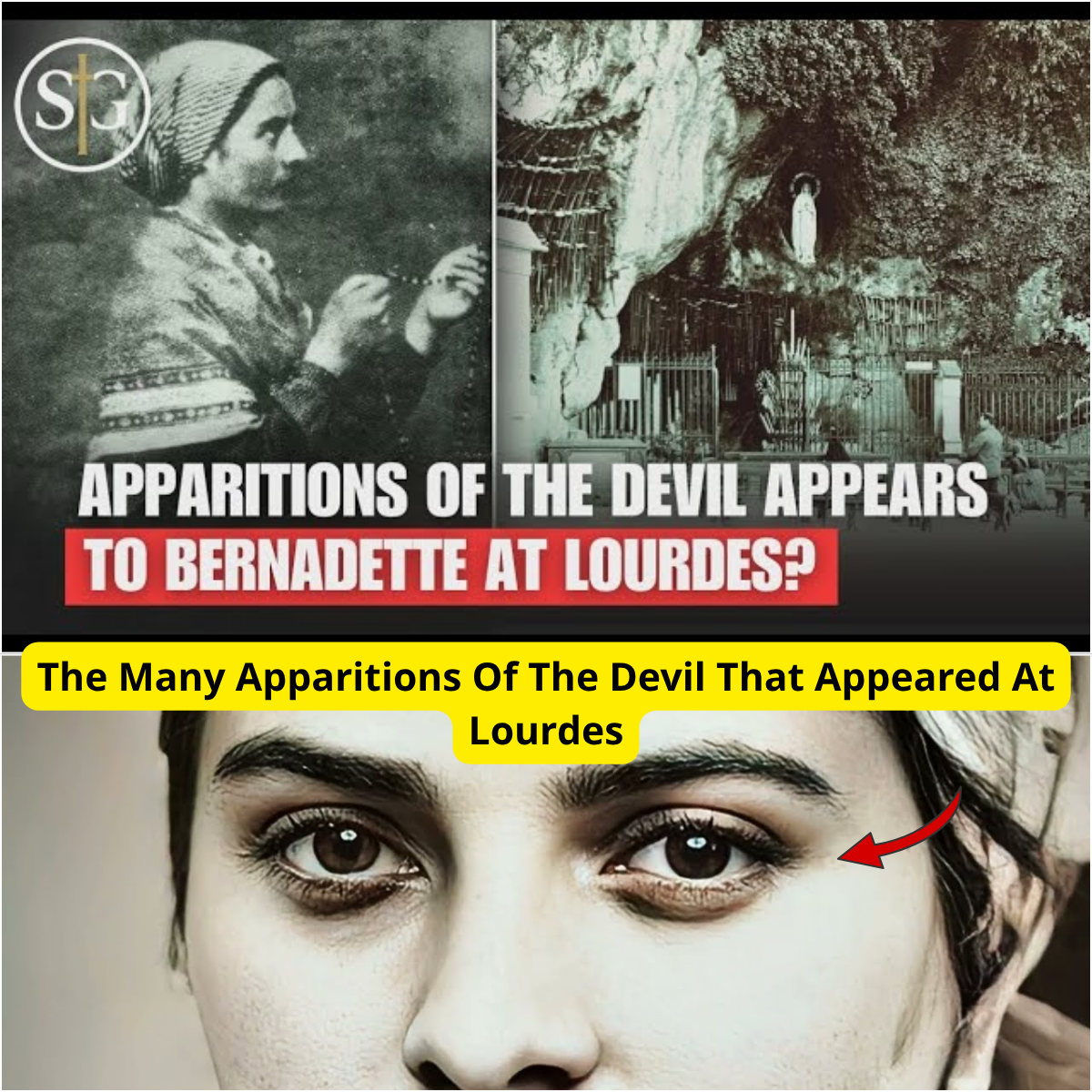
The Many Apparitions Of The Devil That Appeared At Lourdes
The Many Apparitions Of The Devil That Appeared At Lourdes
The cold mud of the Massabielle grotto clung to Bernadette’s wooden clogs like wet mortar, making every step toward the dark alcove feel heavy, deliberate, and fraught with peril. It was February 1858. The Pyrenean wind blowing through the commune of Lourdes carried the bitter, sharp scent of frozen moss and river silt from the Gave de Pau.
Bernadette Soubirous was fourteen, though her stunted growth and chronic asthma made her look like a child of ten. She was a girl of the margins—uneducated, unable to read the catechism, and living with her destitute family in the cachot, a damp, single-room former prison cell that smelled permanently of stagnant wash-water and poverty. She had every reason to avoid the spotlight. Yet, here she stood, at the base of a jagged limestone cliff, staring up at a shallow, natural niche in the rock.
Inside that niche stood the Lady.
To Bernadette, the apparition was a dazzling, luminous point of reference in a gray world. She was young—no older than sixteen—dressed in a snowy white robe with a bright blue sash, her bare feet graced by twin golden roses that seemed to bloom against the cold stone. But Bernadette was not naive. The stories whispered around the hearths of the valley were full of warnings: the mountains were ancient, and the entities that inhabited the limestone caves were not always bound by the laws of heaven.
Her parents, François and Louise, had been horizontal with worry since the first sighting. Her siblings had openly wept, terrified that the white figure was a restless soul trapped in purgatory, seeking a living proxy to pay its spiritual debts, or worse—a subtle, predatory demon wearing the skin of an angel to lead an ignorant peasant girl to damnation.
“If she speaks, you do not listen, Bernadette,” her mother had warned that very morning, her hands shaking as she tied a wool shawl around the girl’s neck. “The devil knows the Latin of the mass better than any priest in Paris. He can weave a trap out of light.”
For her third visit to the grotto, Bernadette did not come unprotected. Her sister, Toinette, and a few neighborhood girls trailed behind her, their pockets weighted down with a heavy, glass vial of holy water obtained from the parish church of Saint-Pierre.
Bernadette knelt on the sharp gravel. The Lady appeared instantly, her presence filling the damp cavern with a soft, golden warmth that seemed to push back the freezing winter mist.
Bernadette felt the familiar, cold flutter of panic in her chest. She reached into her apron, her small fingers wrapping around the glass vial. She uncorked it with trembling teeth, stepped closer to the edge of the rock, and flung the holy water directly at the feet of the vision.
“If you come on the part of God,” Bernadette cried out, her cracked voice competing with the roar of the river, “then advance! Approach us!”
The Lady did not flinch. She did not vanish into a puff of sulfur as the girls behind Bernadette expected. Instead, she inclined her head, bowing several times with an exquisite, maternal grace. She took three steps forward, moving almost to the very lip of the stone precipice.
A radiant, deeply amused smile broke across her beautiful features. It was the smile of a mother watching her small child brandish a wooden sword against the sunset. She looked at the spilled water, she looked at Bernadette’s wide, terrified eyes, and she seemed to take profound delight in the girl’s crude weapons of war and her fierce loyalty to the sacred name of God. Her countenance lighted up like summer dawn over the peaks.
Bernadette took a deep, steadying breath, her fingers still gripping the empty glass. “And if you come on the part of the devil, be gone from this place!”
The Lady remained. She did not speak, but she extended her right hand, which held a heavy rosary of milk-white beads with a golden crucifix. As Bernadette dropped to her knees and began to run her own cheap wooden beads through her fingers, the Lady joined her, slipping the white beads through her fingers in perfect silence, nodding at every Gloria Patri. She did not leave until the last prayer had faded into the stone.
Weeks later, during the sixteenth apparition, Bernadette would finally receive the linguistic seal she required. When she raised her face and asked the Lady for her name in the local Gascon patriot dialect, the beautiful woman folded her hands over her breast, looked up into the sky, and said:
“Que soy era immaculada bounceptiou.”
I am the Immaculate Conception.
It was a theological phrase completely foreign to an illiterate girl from the cachot—a dogma defined by Rome only four years prior. For Bernadette, it was the final, unassailable confirmation. This was not a phantom of the valley or a trick of the dark. The Lady was the Holy Mother herself.
The Cacophony of the Cave
But where heaven plants a garden, the abyss often sows weeds to choke the harvest.
As spring bloomed across the Pyrenees, the genuine nature of Bernadette’s visions became a target for a different kind of spiritual warfare. The devil, realizing he could not terrify the young girl out of her devotion, shifted his strategy. He sought to dilute the truth, to bury the quiet dignity of the Massabielle messages under an avalanche of chaotic, supernatural noise.
By April 1858, the grotto had become a theater of mass hysteria and bizarre manifestations.
On the tenth of April, a group of local women from Lourdes descended upon the cliffside, their minds inflamed by the sensational stories filling the regional newspapers. They climbed past the lower ledge, crawling deep into a small, dark, and damp secondary fissure located behind the main alcove.
Armed with only a handful of tallow candles, their yellow light flickering erratically against the damp walls, the women began to scream.
“I see her!” one woman, a seamstress named Jeanne, shrieked, her body convulsing against the limestone. “She is there, tucked into the crevice! A woman in white, holding a tiny child!”
Behind her, two older women dropped to their knees, their eyes wide with a manic, feverish intensity. “No, it is not a woman! It is a girl—a child of ten! No, she is four years old! Look at the white linen of her dress!”
Had an objective observer stood in that narrow cave with a stable lantern, the truth would have been starkly evident. The “apparition” was nothing more than a large, pale stalactite—a mineral deposit shaped by centuries of dripping water, which, when illuminated by flickering candles and viewed through the lens of intense emotional expectation, looked vaguely like a human form. But imagination is a powerful crucible.
By the fourteenth of April, the contagion had spread. Another woman claimed she had seen dark, shadowy figures moving within the stone, whispering obscenities between prayers.
A few days later, a young schoolgirl had to be physically dragged down from the upper ridge by her father. The child was hyperventilating, her clothes torn by the briars, her face streaked with tears and dirt.
“The Immaculate Conception!” the girl screamed, her fingers clawing at the air. “She was there! She was carrying a baby, but beside her stood a massive man with a long, black beard who glared at me! He told me the valley belonged to him!”
The town of Lourdes split down its ancient seams. The local authorities—the cynical Public Prosecutor Vital Dutour and the harried Police Commissioner Jacomet—used the chaos as political ammunition. They claimed that all talk of visions, including Bernadette’s, was a symptom of rural ignorance, a collective mental illness born of poverty and religious fanaticism.
Some manifestations, however, possessed a malice that could not be easily explained away by psychological hysteria.
A young woman named Marie Bernard came forward to the parish clergy with a narrative that sent a chill through the rectory. She claimed that while she was praying the rosary at the mouth of the grotto, three distinct figures had emerged from the solid rock: an old man with an immense white beard, a beautiful young woman, and a small child.
“The man was holding a heavy iron ring with dozens of keys,” Marie whispered to the assistant curate, her face pale. “He was smiling, twirling his long mustache with his fingers. But then… then they changed. Their faces twisted. They began to make crude, obscene gestures at me. They laughed with the sound of grinding teeth.”
By the early months of 1859, the number of self-proclaimed “visionaries” in the region had skyrocketed into the dozens. Men, women, and dozens of school-children were found wandering the hillsides at night, their eyes rolled back into their heads, claiming to receive conflicting celestial directives.
Twenty years later, when Father Cross, the primary historian of the Lourdes events, conducted his formal investigation into the early history of the shrine, he easily located over thirty of these famous alternative visionaries. Their stories were a chaotic tapestry of spiritual confusion.
In one well-documented instance, a group of schoolboys had gathered at the grotto, watching an eleven-year-old girl who was sobbing and throwing herself against the rocks. She claimed that the Lord Himself was about to appear on the ridge to recite the Holy Rosary. She did not possess the simple theological awareness to realize the logical absurdity of her vision: God does not pray the rosary to His own creature. The deception was sloppy, designed only to provoke mockery from the secular press.
The objective of the dark forces was clear: if you cannot stop the light, you create a thousand false candles until the seeker cannot tell the stars from the fireflies.
The Rules of the Discerning Soul
This methodology of deception was not unique to the hills of France. Decades later, on the other side of the European continent, another soul would wage the same silent war against the mimics of the abyss.
In the Franciscan friary of San Giovanni Rotondo, Francesco Forgione—the capuchin monk who would become known to the world as Saint Padre Pio—sat in his austere cell, his hands covered by heavy wool mittens to conceal the painful, bleeding stigmata that marked his palms.
Pio was a man who lived with his feet on the floor and his eyes in the spiritual realm. For him, the veil between the physical and the supernatural was as thin as a sheet of cigarette paper. The demons did not hide in the shadows of his room; they walked through the door.
Often, the attacks were visceral, designed to break his psychological stamina through raw, animalistic terror. The door of his cell would slam open in the dead of night, and an immense, pitch-black cat with yellow, intelligent eyes would leap onto his chest, its claws digging into his habit as it hissed with human malice. Other times, the room would fill with the stench of rot, and a repugnant, misshapen beast—something intermediate between a hyena and a reptile—tangled itself in his bedsheets, baring its teeth until he used the name of Jesus to banish it.
When terror failed, the enemy altered his currency.
The cell would grow warm, the stone walls dissolving into a luxurious, perfume-scented courtyard. Beautiful, young women—entirely nude, their skin gleaming under an artificial moon—would emerge from the shadows, performing provocative, obscene dances around his low wooden desk, their voices whispering promises of physical relief if he would only renounce his vows of chastity. Pio would press his bleeding palms against his eyes, reciting the Anima Christi until his knuckles turned white.
But Pio always maintained that his greatest peril did not come from the monsters or the dancers. The true danger arrived in the quiet hours, when the room fell silent and a figure would appear wrapped in a soft, ethereal radiance.
The entity would take the form of the Provincial Father, his direct religious superior, speaking in a gentle, holy voice, giving him spiritual directions that sounded remarkably pious. Other times, the figure would appear as Christ Himself, or as the Holy Mother, her hands extended in blessing, her face a mask of serene perfection.
Through years of intense, agonizing spiritual combat, Pio discovered a fundamental rule of thumb—a gold standard of psychological discernment that he would later pass down to his spiritual children in his letters.
“The enemy is a thief,” Pio wrote. “He can copy the uniform, but he cannot copy the peace.”
He noticed a distinct, unvarying pattern in how his soul reacted to these visitations:
The Anatomy of Divine vs. Demonic Visions
Dimension
The Authentic Divine Vision (Holy Mother / Our Lord)
The Demonic Counterfeit (Satan in Sacred Form)
Initial Reaction
A profound sense of timidity, unworthiness, and reverent fear. The soul shrinks back, aware of its own limitations before the divine majesty.
An immediate surge of superficial joy, intense emotional attraction, and pride. The ego feels validated and exalted by the manifestation.
During the Vision
A gradual, deepening sense of quiet strength, clarity, and structural order.
A high-energy state of excitement, emotional turbulence, and sensory intoxication.
Upon Departure
An enduring, unshakeable state of interior peace, deep humility, and love for God. The soul feels anchored and serene.
A sudden, heavy descent into remorse, spiritual dryness, agitation, and a profound sadness. The soul is left hollowed out.
“The devil,” Pio explained, “always begins with a pleasant greeting and leaves you in a state of chaos. God begins with a holy tremor and leaves you in a state of perfect rest.”
The Armor of Humility
The lessons of Lourdes and the cells of San Giovanni Rotondo converge upon a single, timeless truth: the spiritual realm is not a playground for the curious or a laboratory for the sensationalist. It is a field of active engagement where discernment is the only line between sanity and deception.
When Bernadette Soubirous stood before the Lady of Massabielle with her glass vial of holy water, she was not acting out of rural superstition; she was practicing the ancient, mandatory vigilance of the Church. She understood instinctively that the supernatural must always be tested by the light of divine truth and authority. She did not trust her own eyes; she trusted her prayers.
In an age dominated by noise, where every modern illusion can be broadcast to millions at the speed of light, the ancient rules of discernment remain completely unchanged. The human heart, when confronted by the extraordinary, must always lean upon three pillars:
Humility: The recognition that our own emotions, imagination, and desires can easily be manipulated by external forces or internal hysteria.
Vigilance: The refusal to accept every bright light as a celestial sign without testing its fruits and its alignment with divine truth.
Reliance on Holy Guidance: The willingness to submit our private experiences to the objective wisdom, prayerful oversight, and guidance of the Holy Spirit through the Church.
The false visions of Lourdes eventually faded into historical footnotes—their stalactites remaining nothing more than cold stone, their visionaries returning to the obscurity of the valley after their brief, chaotic moments in the sun. But Bernadette’s Lady remains an enduring beacon of grace, her sanctuary visited by millions of seekers every year who find there what the devil can never truly replicate: a profound, miraculous, and unshakeable peace that heals the broken heart.
True spiritual light does not seek to dazzle the senses or provoke the applause of the crowd. It steps quietly into the damp, cold spaces of our lives, bows its head with a maternal smile, and leaves behind a fragrance of humility that the darkness can never understand.