Pro Hamas ISLAMISTS Mess With The WRONG Police in Spain!
Pro Hamas ISLAMISTS Mess With The WRONG Police in Spain!
The Flotilla Effect: Theatre, Double Standards, and the Global Information War Over Gaza
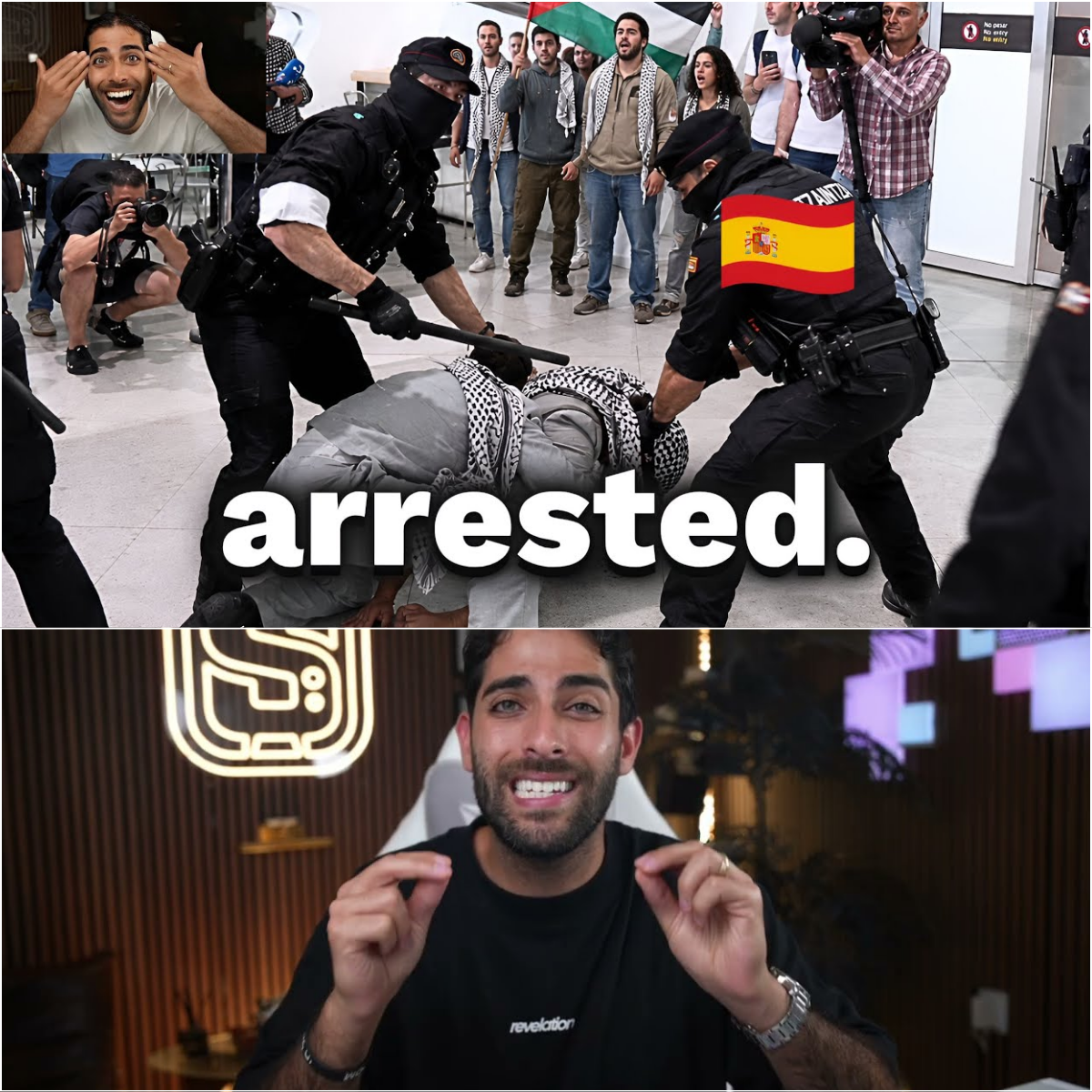
MADRID — The arrivals terminal at Adolfo Suárez Madrid-Barajas Airport was supposed to be a place of quiet reunions, but instead, it became a battleground. Fresh off their deportation from Israel, a group of pro-Palestinian activists from the latest humanitarian Gaza flotilla swarmed the exit gates, deliberately blocking the flow of international passengers to stage an impromptu, high-decibel demonstration. When regular travelers and airport security tried to squeeze past, tempers flared, and within minutes, the “peaceful” humanitarians were actively scuffling, shoving, and trading blows with local Spanish law enforcement. Yet, as baton-wielding European police forcefully dragged away screaming activists, a curious phenomenon occurred: the international press corps, which had spent the preceding forty-eight hours breathlessly broadcasting the activists’ unverified tales of systemic torture in Israeli custody, fell completely silent. The violent clashes in Madrid, alongside identical chaotic airport brawls involving deported activists in Athens, vanished into the digital ether, exposing a glaring geopolitical double standard in how the West consumes, validates, and polices the optics of Middle Eastern political activism.
The dramatic scenes unfolding across European transport hubs offer a vivid window into the mechanics of the modern information war. The Gaza flotilla movement, which began years ago as a high-profile effort to break the maritime blockade of the Gaza Strip, has increasingly transitioned from a traditional aid delivery mission into a highly sophisticated exercise in asymmetric narrative warfare. To its supporters, the flotillas are a heroic manifestation of global civil society, risking life and limb to deliver vital medical supplies to a besieged population. To its critics, they are a deeply cynical form of political theater, engineered from the ground up to provoke an armed response, manufacture viral imagery, and weaponize Western media biases against the state of Israel.
For an American public uniquely inundated with conflicting media narratives regarding the Israeli-Palestinian conflict, the juxtaposition of the activists’ public rhetoric and their physical conduct provides a revealing case study. It exposes a profound disconnect between the carefully curated imagery of peaceful, law-abiding humanitarians presented to Western audiences and the reality of a highly organized, combative political movement that treats international law, local police forces, and human suffering as tactical assets.
By analyzing the stark discrepancies in how European governments handle political agitation, the biological anomalies found within the activists’ claims of physical abuse, and the broader institutional biases that govern international media coverage, we can begin to untangle the intricate architecture of the modern narrative campaign.
The Domestic Clash: Europe’s Unreported Enforcement
The core hypocrisy of the international response to the flotilla phenomenon lies in the distinct asymmetry between how law enforcement actions are judged based entirely on the geography of the intervention. When Israel intercepts an activist vessel violating a legally recognized military blockade, the international community routinely responds with immediate, preemptive condemnation. Global political bodies demand sweeping independent investigations, and foreign ministries issue stern warnings regarding the safety of their citizens.
However, when these same citizens return to their home countries and deploy identical tactics of disruptive civil disobedience against domestic infrastructure, the standard changes entirely. The airport confrontations in Madrid and Athens demonstrated that European democracies maintain zero tolerance for the chaotic disruption of their public spaces, regardless of the righteousness claimed by the agitators.
In Madrid, the activists did not merely hold signs; they constructed a human barricade at a vital international transit chokepoint, effectively trapping hundreds of arriving passengers inside the terminal. Video documentation of the incident shows airport staff and private citizens pleading with the activists to clear a path. When these requests were met with defiance and physical resistance, Spanish national police moved in to clear the area.
The ensuing confrontation was characterized by significant physical aggression from the activists, who linked arms, resisted arrest, and physically struck officers attempting to maintain public order. A nearly identical scene played out at the Athens international airport, where returning Greek flotilla members engaged in a chaotic, physical standoff with riot police, chanting slogans and pushing against defensive lines.
Remarkably, the political leadership of these European nations appeared entirely unbothered by the heavy-handed tactics used by their own police forces. Spanish Prime Minister Pedro Sánchez, who had previously made headlines by issuing sharp public warnings to Jerusalem regarding the treatment of Spanish nationals on the flotilla, offered no public commentary on the fact that his own constabulary was actively arresting those same citizens for rioting in a public airport.
This stark contrast reveals a cynical political truth: for many European leaders, defending the human rights of political activists is an exercise in geopolitical convenience—a stick used to chastise a controversial ally abroad, while remaining entirely comfortable utilizing robust state power to suppress identical disruption at home.
The Anatomy of a Narrative: The Stretcher Phenomenon
Beyond the double standard of law enforcement, the recent flotilla incident has highlighted an even more glaring vulnerability in the activist narrative: the profound contradiction between the physical reality of the participants and the horrific testimonies they deliver to waiting microphones.
In the immediate aftermath of the maritime interception, global media outlets were flooded with terrifying accounts of systemic violence allegedly perpetrated by Israeli security forces. Activists from Australia, Europe, and Turkey spoke of being subjected to prolonged torture chambers, severe physical beatings, and targeted campaigns of degradation. One prominent female activist claimed during an international press conference that she had been subjected to a “relentless and planned campaign of violence” on a prison ship, asserting that five men had repeatedly “bashed her” and “smashed her face” over a period of days.
However, the visual evidence surrounding these testimonies tells a completely different story. When these same individuals appeared on camera to deliver their harrowing accounts, they displayed a remarkable, near-miraculous absence of any physical trauma. The activist who claimed her face had been repeatedly smashed by multiple grown men appeared before reporters with pristine skin, no visible bruising, zero swelling, and an unblemished complexion. Her physical movements demonstrated a complete range of motion, entirely inconsistent with the severe defensive injuries or facial fractures that naturally result from a prolonged physical beating.
This pattern of performative suffering reached a level of near-absurdity during the repatriation of Turkish flotilla members. Photographic and video tracking of the individuals showed them walking entirely unassisted, in high spirits, and exhibiting full physical capability as they boarded their flights out of Israel. Yet, the moment the aircraft touched down on the tarmac in Istanbul, a dramatic transformation occurred.
The very same individuals who had just been walking freely were wheeled out of the aircraft on medical stretchers, wrapped in blankets, and presented to a waiting wall of Turkish television cameras as broken victims of foreign cruelty. The swift transition from healthy travelers to hospitalized martyrs was so instantaneous, and so utterly detached from medical reality, that it exposed the entire sequence as a pre-planned piece of political propaganda.
For an American audience accustomed to rigorous investigative journalism, the willingness of major international news agencies to broadcast these transparently staged performances without a modicum of skepticism is deeply troubling. It suggests that in the rush to satisfy an insatiable appetite for content that confirms a specific geopolitical villain narrative, the most basic principles of journalistic verification—such as checking whether a victim of an alleged face-smashing actually possesses a single bruise—have been completely abandoned.
The Selective Memory of Global Activism
The rhetorical strategies deployed by the flotilla leadership are defined not only by what they choose to amplify, but by what they deliberately choose to omit. The testimonies delivered by American, Australian, and European activists uniformly frame their actions within the high-minded vocabulary of international human rights, global solidarity, and universal human dignity. They frequently evoke the language of anti-apartheid struggles and civil rights movements to legitimize their campaign.
Yet, this universalist framing collapses under the weight of their selective moral outrage. In their lengthy, emotional appeals to the global public, the activists maintain a total, calculated silence regarding the documented atrocities, systemic rocket fire, and ongoing hostage crises perpetrated by the terrorist organizations that govern the territory they are attempting to reach.
During a post-release address, an Australian activist delivered a tearful, impassioned monologue demanding that Western governments completely cut off all economic resources, impose blanket boycotts, and shut down weapons factories supplying Israel. She spoke at length about the alleged psychological trauma of having her friends’ hijabs removed during security screenings and accused her captors of being “monsters who take pleasure in dishing out suffering.”
Conspicuously absent from her lengthy manifesto, however, was any mention of the hundreds of innocent civilians—including women, children, and elderly citizens—who were systematically slaughtered, sexually assaulted, and dragged into subterranean dungeons by Hamas during the October 7th atrocities that ignited the current conflict. She offered no demands for the release of Israeli hostages, no condemnation of the use of Palestinian civilians as human shields, and no acknowledgment of the complex security environment that makes a maritime blockade a recognized necessity under international law.
This total erasure of context is not accidental; it is a structural requirement of the flotilla’s ideological mission. To acknowledge the reality of Palestinian terrorism would be to acknowledge that the maritime blockade is not an act of arbitrary cruelty, but a defensive military measure designed to prevent the unchecked import of advanced weaponry into a hostile enclave. By wiping the historical slate clean and presenting the conflict as a simple, black-and-white morality play between innocent humanitarians and monstrous oppressors, the movement seeks to alienate Israel from its Western allies and erode its foundational right to self-defense.
The Transatlantic Disconnect: Why America Thinks Differently
The dramatic failure of the flotilla narrative to achieve the same level of political leverage in the United States as it does in Europe highlights a profound cultural and legal divergence between the two continents. While European public opinion is highly susceptible to the visual theater of street protest and international agitation, the American political landscape operates on a fundamentally different set of assumptions.
First and foremost, the American public possesses an deeply ingrained skepticism toward state-controlled or state-aligned media narratives. Because the American media ecosystem is highly decentralized and fiercely competitive, performative stunts like the Istanbul “stretcher transformation” are far more likely to be scrutinized, dissected, and exposed by independent commentators, digital journalists, and alternative news networks. The presence of a robust, highly critical conservative media apparatus ensures that anti-Israel propaganda campaigns face immediate, aggressive counter-caricature.
Secondly, the American understanding of national security and state sovereignty is fundamentally incompatible with the open-borders philosophy that animates European activism. Having experienced the transformative trauma of domestic terrorism, the vast majority of the American public retains a deep, intuitive respect for the necessity of secure borders, rigorous maritime interdictions, and the right of a democratic nation to police its perimeters against hostile actors. When an American sees an activist group attempting to forcibly breach a naval blockade, their natural institutional sympathy rarely lies with the agitators; instead, it rests with the uniform-wearing personnel charged with maintaining operational security.
Finally, the American political tradition is deeply rooted in the concept of personal accountability. In the United States, if an individual makes a conscious choice to travel to a volatile combat zone, ignore the explicit travel warnings of their own State Department, and deliberately place themselves in physical opposition to a foreign military, the prevailing public consensus is that they must bear the full consequences of that choice.
The expectation that the home country should expend significant diplomatic capital or launch international incidents to rescue an activist from a self-inflicted legal predicament is widely viewed by working-class Americans not as a duty of citizenship, but as an expression of immense, coddled privilege.
The Financial Incentives of Professional Martyrdom
To fully comprehend the durability of the flotilla movement despite its repeated exposure as a vehicle for misinformation, one must analyze the complex economic incentives that sustain the broader ecosystem of professional activism. The individuals who occupy the decks of these vessels are not merely passive volunteers; they are vital nodes in a highly lucrative, global non-governmental organization (NGO) industrial complex.
For an independent content creator, an aspiring politician, or a career activist in the West, participating in a Gaza flotilla is a high-yield investment in personal brand equity. The formula is remarkably consistent: an individual leverages their Western passport to gain access to the campaign, documents their journey through a series of emotional social media updates, and uses the inevitable confrontation with authorities to establish their credentials as a frontline warrior for social justice.
The financial rewards of this verified status are substantial. Upon their return, these activists are immediately absorbed into a welcoming network of university lecture circuits, well-funded NGO advisory boards, international book deals, and lucrative independent media crowdfunding streams. Platforms like Patreon, Substack, and Buy Me a Coffee have democratized the financialization of political dissent, allowing professional martyrs to receive direct, recurring financial compensation from a global audience of ideologically aligned subscribers.
In this economic model, the truth or falsehood of their statements regarding foreign custody is entirely secondary to the emotional resonance of the narrative. A dry, factual account acknowledging that they were processed humanely, fed standard rations, and returned safely via commercial aircraft does not generate clicks, drive engagement, or compel a viewer to open their digital wallet.
Conversely, a terrifying, highly theatrical tale of systemic abuse, dark shipping containers, and narrow escapes from drowning creates the exact species of high-stakes drama that thrives within the modern attention economy. The flotilla, therefore, functions as a highly efficient machine for converting geopolitical conflict into personal celebrity and financial sustainability.
The Erosion of Authentic Humanitarianism
The most tragic casualty of this ongoing theater of offense is the complete degradation of authentic humanitarian aid. By transforming the delivery of medical and food supplies into a highly politicized, provocative media circus, the flotilla movement has poisoned the well of international charity, making it increasingly difficult for legitimate, neutral humanitarian organizations to operate effectively.
True humanitarianism, as historically defined by organizations like the International Committee of the Red Cross, relies entirely on the principles of neutrality, impartiality, and operational independence. It requires aid workers to eschew political alignment, cooperate transparently with all sovereign authorities, and focus exclusively on relieving human suffering without engaging in the underlying ideological warfare.
The flotilla movement represents the absolute inversion of these values. It deliberately discards neutrality in favor of overt partisanship; it rejects transparent cooperation in favor of intentional, televised confrontation; and it treats the actual delivery of aid as a secondary concern compared to the generation of anti-Israel media coverage. This weaponization of charity forces security apparatuses to treat all incoming aid initiatives with an elevated level of suspicion, complicating the logistics of legitimate relief efforts and ultimately harming the very civilian populations the activists claim to protect.
As the international community looks toward the future of the eastern Mediterranean, the lessons of the latest flotilla crisis are clear. The chaotic airport terminal brawls in Spain and Greece, the exposed theatricality of the Istanbul stretchers, and the profound moral omissions of the activist testimonies all point to a singular conclusion: the era of naive, uncritical acceptance of Western political tourism must come to an end.
The United Kingdom, Europe, and the United States find themselves at a critical crossroads in the management of public discourse and international agitation. In an age dominated by viral misinformation and highly sophisticated narrative warfare, the ability to distinguish between genuine human suffering and choreographed political theater is not merely a matter of intellectual consistency—it is an indispensable requirement for the survival of an informed, democratic society. Until Western media outlets and political institutions develop the courage to hold these professional agitators to the same standard of physical and logical scrutiny they apply to sovereign states, they will remain compliant consumers of a highly coordinated campaign designed to substitute raw emotion for geopolitical truth.