It’s OBVIOUS Why Thomas Massie Was Taken Out! Dave DeCamp Weighs In
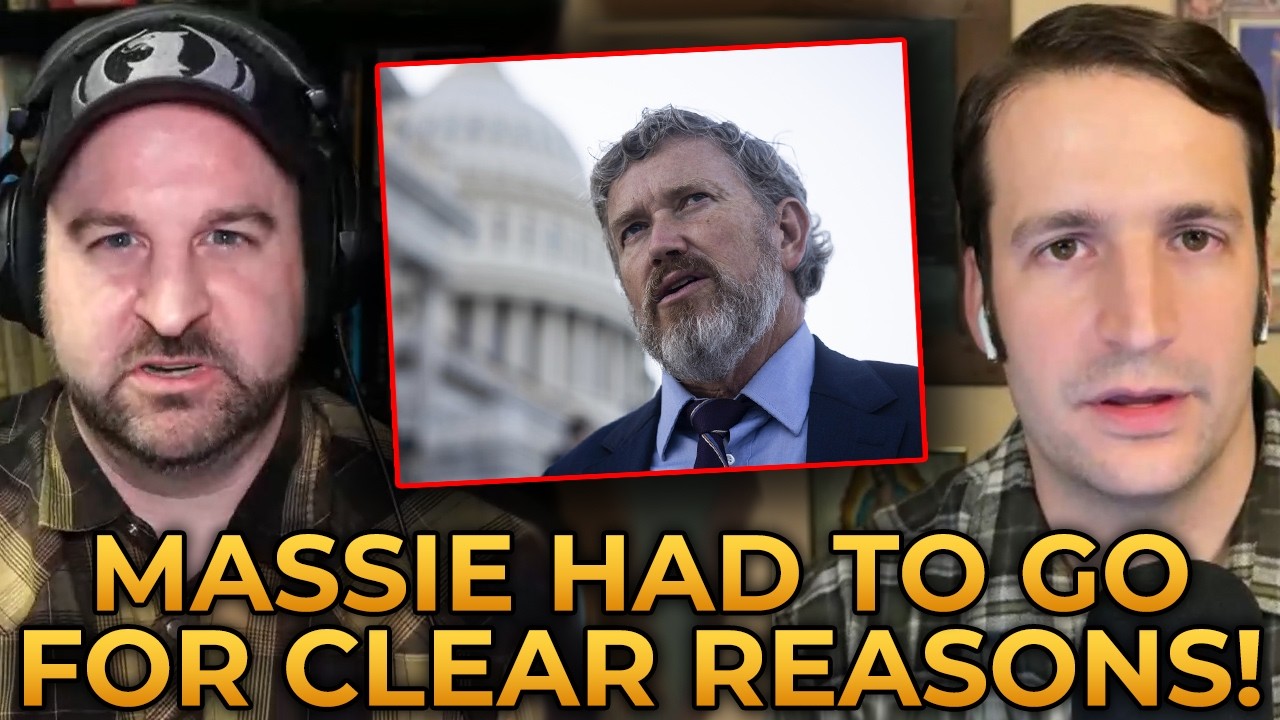
The Primary That Became a National Story
On paper, this was a congressional primary in Kentucky. In reality, it turned into a national spectacle involving tens of millions of dollars, high-profile political commentators, and competing interpretations of what “America First” really means.
Massie, a long-standing libertarian-leaning Republican known for his skepticism of military intervention and federal spending, faced a well-funded challenger backed by major donors and political action committees. According to critics in the discussion, the race saw an extraordinary influx of outside money—reportedly around $32 million—flowing into the district.
Supporters of Massie argue that this spending was decisive. They claim it overwhelmed local dynamics, saturated the media environment with advertisements, and reframed the race through national narratives rather than district-level concerns.
His opponent, however, was portrayed by allies as a more conventional Republican aligned with party leadership and national conservative priorities.
What made the race unusual was not just the money—but the meaning attached to it afterward.
Thomas Massie: A Maverick Inside the Republican Party
To understand why this primary attracted so much attention, it helps to understand who Massie is inside American politics.
Thomas Massie has built a reputation as one of the most consistently anti-establishment Republicans in Congress. An MIT-trained engineer and former county official, he entered Washington with a technocratic, libertarian mindset and quickly became known for voting against large spending bills—even when most of his party supported them.
He has frequently opposed emergency spending packages, surveillance expansions, and foreign aid measures, arguing that Congress has drifted far from constitutional constraints. In doing so, he has often found himself isolated within his own party.
Yet Massie’s political brand is also unusually stable. He has historically won reelection with comfortable margins in his district, suggesting that his positions—while controversial in Washington—have strong local support.
This makes his recent primary defeat (or near-defeat, depending on interpretation) especially significant to commentators who view him as a rare example of ideological consistency in Congress.
Money, Influence, and the Shadow Debate
A central theme in the discussion surrounding the race is the influence of large donors and political networks. Names frequently mentioned by commentators include wealthy financiers and donors such as John Paulson, Paul Singer, and Miriam Adelson.
Some critics argue that these donors, often associated with pro-Israel political advocacy, have outsized influence in shaping U.S. foreign policy debates through contributions to political action committees such as AIPAC and aligned fundraising networks.
It is important to note that these claims are heavily disputed in mainstream political analysis. Supporters of such donors and organizations argue that their contributions are standard forms of political participation and that policy outcomes reflect shared strategic interests rather than external control.
Still, in the narrative advanced by Massie’s defenders, the primary became a case study in how concentrated funding can shape electoral outcomes even in districts with strong incumbents.
They point to the scale of advertising, the sophistication of messaging, and even the use of modern AI-generated campaign materials as evidence of a new kind of political warfare—one where perception can be engineered at scale.
The Role of Donald Trump and Party Alignment
Another major thread in the debate is the role of President Donald Trump in shaping Republican politics.
Trump has had a complicated relationship with Massie over the years. At times, the congressman has opposed Trump-backed spending bills or emergency measures. At other moments, he has supported the administration or aligned with it on broader ideological goals.
This inconsistency has made Massie both valuable and controversial within the GOP: valuable because he appeals to libertarian and anti-war voters, controversial because he is willing to break ranks on key votes.
In the aftermath of the primary, some commentators argued that Trump’s influence was decisive in shaping voter perceptions. Others countered that while Trump remains dominant in the Republican Party, local races are still driven more by money, messaging, and turnout mechanics than presidential endorsement alone.
What is clear is that the Republican coalition is not monolithic. It includes establishment conservatives, populists, libertarians, and foreign policy hawks—all competing for influence within the same party structure.
Massie has often positioned himself on the libertarian edge of that spectrum.
The Media War: Competing Realities
Beyond money and party politics, the discussion reveals a deeper struggle over media narratives.
On one side are traditional conservative media outlets and aligned commentators who frame the race as a referendum on party unity and legislative effectiveness. From this perspective, representatives who frequently vote “no” on major bills are seen as obstructive, regardless of ideological reasoning.
On the other side are independent media figures who argue that those same “no” votes often reflect resistance to surveillance expansion, foreign intervention, or deficit spending that would otherwise go unchecked.
The emergence of independent media platforms—podcasts, streaming interviews, and alternative news ecosystems—has fundamentally changed how political narratives are constructed. Figures like Massie can now bypass traditional gatekeepers and speak directly to national audiences.
This shift is central to why the primary gained national attention at all. What would once have been a local story is now part of a broader ideological ecosystem.
The Generational Divide
One of the most striking themes in the discussion is the apparent generational split in political support.
Younger voters, particularly those consuming independent media online, are often portrayed as more skeptical of foreign intervention and more receptive to Massie’s arguments about spending and civil liberties.
Older voters, especially those relying on traditional television news sources, are described as more supportive of establishment messaging and more responsive to national security framing.
Whether or not this divide is as clean in reality as it appears in commentary, it reflects a broader trend in American politics: information fragmentation. People no longer consume the same narratives, and as a result, they often inhabit different political realities entirely.
Foreign Policy, War, and Legislative Battles
At the center of Massie’s political identity is his opposition to military intervention and expansive foreign aid. He has frequently voted against defense-related spending packages and has supported efforts to increase congressional oversight over war powers.
Supporters argue that this makes him one of the few consistent anti-war voices in Congress. Critics argue that his approach can be politically impractical or disconnected from geopolitical realities.
In the broader debate, these positions intersect with contentious discussions about U.S. support for Israel and Middle East policy. Massie’s critics often frame his votes as opposition to mainstream bipartisan consensus, while his supporters frame them as principled constitutional restraint.
This tension—between principle and practicality—runs through nearly every aspect of his political career.
Could Massie Run for President?
Perhaps the most speculative part of the discussion is the idea that Massie could run for president in 2028.
On the surface, this seems unlikely. He has no national campaign infrastructure, limited executive political experience, and operates on the ideological margins of his party.
But supporters argue that modern politics has already upended traditional pathways to power. Outsider candidates with strong media ecosystems can now build national followings without relying on establishment structures.
They point to past surprises in American politics as evidence that unconventional candidacies can succeed under the right conditions.
Still, even sympathetic analysts acknowledge major obstacles: party nomination mechanics, fundraising competition, and the challenge of expanding beyond a niche ideological base.
More realistically, a presidential run—if it ever happened—might function less as a pathway to victory and more as a platform for shaping national debate.
The Bigger Question: What Does This Moment Represent?
Stripped of its personalities, the controversy surrounding Massie’s primary raises a broader question about American democracy:
Is electoral politics becoming more responsive to grassroots voters—or more dominated by high-level financial and media ecosystems?
For some, the answer is clear: money and institutional power still dominate, and local elections increasingly reflect national and even global influences.
For others, the system is still fundamentally responsive, with elections reflecting voter preferences filtered through modern campaigning techniques.
What is undeniable is that the tools of politics have changed. Campaign financing, digital media, algorithmic messaging, and real-time narrative warfare have transformed even local races into national events.
Conclusion: A Sign of Things to Come
The story of Thomas Massie is not just about one election. It is about the collision of three forces shaping modern American politics:
money at unprecedented scale,
media ecosystems that no longer agree on basic facts,
and a fragmented political coalition struggling to define itself.
Whether Massie’s political future includes continued congressional service or a more ambitious national campaign, the debate surrounding him is unlikely to fade.
If anything, it is likely to intensify.
Because beneath the arguments about one primary lies a much larger struggle—over what kind of political system the United States is becoming, and who ultimately gets to shape its direction.