Tucker Carlson and John Kiriakou Reveal How Israel HIJACKED US Foreign Policy
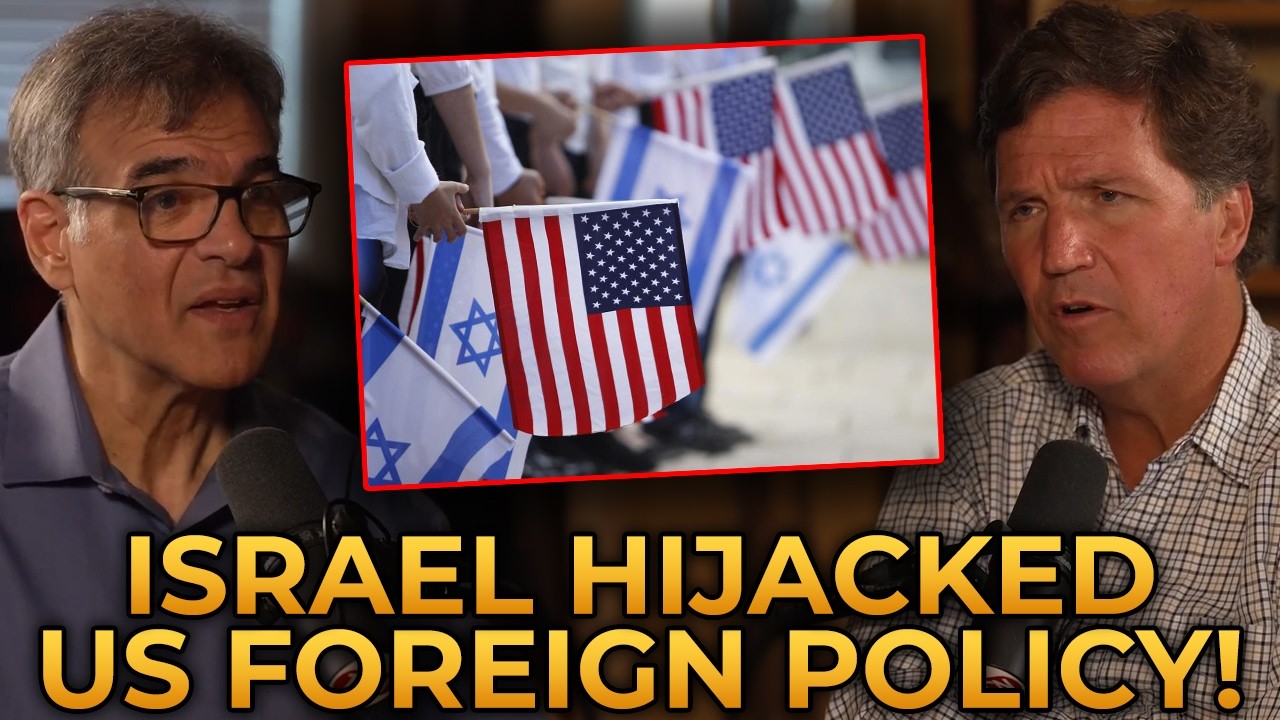
Did Israel Drive America Into War With Iran? Tucker Carlson and John Kiriakou Raise Questions That Washington Can’t Ignore
The most controversial political conversations aren’t always the loudest. Sometimes they’re the ones that ask uncomfortable questions that many people believe the political establishment would rather avoid.
In a recent discussion, former Fox News host Tucker Carlson and former CIA officer John Kiriakou explored one of the most explosive issues in American foreign policy today: Why did the United States become directly involved in military action against Iran despite repeated intelligence assessments suggesting Iran was not actively building a nuclear weapon?
Whether you agree with their conclusions or reject them entirely, the conversation forces Americans to confront a deeper question. Who really shapes U.S. foreign policy—the elected government in Washington, or powerful outside interests capable of steering American decisions?
It’s a debate that touches intelligence, military strategy, lobbying, presidential decision-making, and America’s decades-long involvement in the Middle East. And it raises questions that stretch far beyond a single conflict.
The Question That Started Everything
One exchange during the interview immediately stood out.
Kiriakou, a former CIA counterterrorism officer who later became known for exposing the CIA’s torture program, argued that the justification for attacking Iran rested on intelligence that did not match the conclusions of America’s own intelligence community.
Carlson asked a simple but pointed question.
If U.S. intelligence agencies reportedly concluded Iran was not actively pursuing a nuclear weapon, why would an American president rely on information provided by Israel instead?
For critics of the administration’s Middle East policy, this wasn’t merely a question about intelligence.
It was a question about influence.
The implication is enormous: if foreign intelligence played a greater role in shaping policy than America’s own assessments, it would represent a remarkable shift in how national security decisions are made.
Whether that claim is ultimately correct is heavily debated. But the discussion illustrates why the issue continues to divide analysts, policymakers, and voters alike.
The Core Argument: Was the War Built on a False Premise?
At the center of the debate lies Iran’s nuclear program.
For years, U.S. intelligence agencies have publicly assessed that while Iran has enriched uranium and developed significant nuclear capabilities, they have not concluded that Tehran had decided to build a nuclear weapon. This distinction is critical.
Enriching uranium—even to high levels—is not the same as manufacturing a nuclear bomb.
During the interview, Kiriakou argued that this distinction was intentionally blurred in public discourse.
According to him, many media commentators presented Iran as being only moments away from deploying nuclear weapons capable of threatening the United States.
He dismissed those claims as exaggerated.
Instead, he argued that Iran’s missile capabilities are primarily regional, capable of threatening neighboring countries but not presenting an imminent strategic threat to the U.S. homeland.
Carlson echoed this criticism, suggesting that dramatic warnings about nuclear attacks on American cities helped build public support for military action.
Their broader contention is that the case for war relied more on fear than verified intelligence.
Whether one agrees with that assessment or not, it reflects a longstanding debate in American politics: how intelligence is communicated to the public before major military interventions.
Echoes of Iraq
For many observers, comparisons with Iraq are unavoidable.
More than two decades ago, the United States invaded Iraq after repeated claims that Saddam Hussein possessed weapons of mass destruction.
Those weapons were never found.
The Iraq War fundamentally changed how many Americans evaluate official claims about national security threats.
Kiriakou suggested that today’s debate over Iran carries uncomfortable similarities.
In his view, once again the public was presented with certainty where intelligence remained far more nuanced.
Carlson argued that hindsight has only strengthened skepticism.
If intelligence agencies themselves reportedly stopped short of declaring that Iran had an active nuclear weapons program, critics naturally ask why political messaging often sounded much more definitive.
For opponents of intervention, this pattern reinforces concerns that policymakers sometimes present worst-case scenarios as established reality.
The Intelligence Community Versus Political Messaging
One of the most striking themes in the discussion is the apparent disconnect between intelligence assessments and political rhetoric.
According to Kiriakou, people he remains in contact with inside the intelligence community insist there was no evidence that Iran was actively producing nuclear weapons.
If true, that raises another difficult question.
How does intelligence evolve into policy?
National security decisions are rarely made solely by intelligence agencies.
Presidents receive input from military commanders, diplomats, political advisers, allied governments, and congressional leaders.
Intelligence is only one piece of a much larger puzzle.
Carlson nevertheless questioned why intelligence from a close ally might appear to receive greater weight than assessments produced by American agencies themselves.
That question lies at the heart of the broader debate over U.S.-Israel relations.
America’s Relationship With Israel
Few alliances are as politically sensitive—or as strategically significant—as the relationship between the United States and Israel.
Supporters argue that Israel is America’s closest democratic ally in the Middle East, sharing intelligence, technological innovation, and common security interests.
Critics, however, argue that Washington often places Israeli security concerns ahead of broader American interests.
Carlson’s conversation explored this second perspective.
Rather than portraying Israel as merely influencing U.S. policy, the discussion suggested that Israeli priorities have, at times, become deeply intertwined with American decision-making.
This is hardly a new debate.
For decades, scholars, diplomats, military officials, and policymakers have argued over the extent to which lobbying organizations, strategic partnerships, domestic politics, and regional alliances shape American foreign policy.
The disagreement is not about whether Israel has influence—virtually every close ally seeks to influence U.S. policy—but rather about how significant that influence is compared with other national security considerations.
How Presidents Normally Make Decisions
Kiriakou also described what he considers the traditional decision-making process before major military operations.
According to him, presidents typically receive:
Intelligence estimates from multiple agencies.
Assessments from the CIA.
Recommendations from the Departments of Defense and State.
Advice from national security officials.
Input from allied governments.
The purpose of this process is not simply gathering information.
It is meant to reduce uncertainty by exposing decision-makers to multiple perspectives before committing military force.
Kiriakou argued that this process appeared far less visible in the lead-up to confrontation with Iran.
Whether that reflects an actual departure from established practice remains debated.
Still, the interview raises broader questions about transparency in wartime decision-making.
Why Consulting Allies Matters
One of Carlson’s more practical questions focused on diplomacy rather than ideology.
Why consult allies at all?
Kiriakou argued that consultation is about far more than political courtesy.
Military action can disrupt global energy markets, shipping routes, supply chains, and diplomatic relationships.
Countries affected by these consequences benefit from advance coordination.
Without it, allies may find themselves dealing with economic fallout they had little opportunity to prepare for.
This perspective highlights how military conflicts increasingly produce global economic consequences far beyond the battlefield.
Energy Prices and Economic Consequences
Another recurring theme throughout the discussion is economics.
The interview argues that escalating tensions with Iran have contributed to higher energy prices, increased uncertainty in global markets, and additional financial burdens on ordinary citizens.
The speakers contend that Americans often pay indirect costs for overseas military engagements through inflation, higher fuel prices, and growing national debt.
Whether every economic effect can be directly attributed to a particular conflict is debated among economists.
Nevertheless, the broader point resonates with many voters.
Foreign policy is no longer viewed solely through the lens of national security.
Increasingly, Americans judge international decisions by how they affect everyday life at home.
The Debate Over “America First”
Underlying the entire conversation is a philosophical disagreement about America’s global role.
Carlson repeatedly returns to an “America First” framework.
Under this view, military power should primarily serve one purpose: defending the United States itself.
Interventions intended to reshape foreign governments or manage regional disputes are seen as costly departures from that mission.
Supporters argue that decades of intervention have produced enormous financial costs while delivering limited strategic gains.
Opponents counter that disengagement could create power vacuums, embolden adversaries, and ultimately threaten American security.
This debate has become one of the defining ideological divides within modern conservatism.
A Conservative Movement Divided
The discussion also reflects a broader split inside the American political right.
Traditional Republican foreign policy has generally favored strong military alliances, robust support for Israel, and an active U.S. role overseas.
A newer faction, represented by figures such as Tucker Carlson and others, argues that endless military commitments have weakened rather than strengthened America.
This newer perspective emphasizes national borders, fiscal restraint, reduced foreign intervention, and greater skepticism toward intelligence-driven military campaigns.
The Iran debate has become one of the clearest examples of this divide.
Rather than disagreements between Republicans and Democrats, many of today’s fiercest foreign policy debates now occur within the conservative movement itself.
The Limits of Intelligence
An important takeaway from the interview is that intelligence is rarely absolute.
Agencies produce assessments based on available information, probabilities, and confidence levels—not certainties.
Political leaders, meanwhile, must make decisions under conditions of uncertainty.
This creates room for disagreement, interpretation, and sometimes politicization.
The challenge is determining where legitimate strategic judgment ends and political narrative begins.
That question has surrounded nearly every major American military intervention over the past half-century.
Public Trust After Decades of War
Perhaps the strongest undercurrent running through Carlson and Kiriakou’s conversation is distrust.
After Vietnam, Iraq, Afghanistan, Libya, and numerous other interventions, many Americans simply no longer assume official justifications are accurate.
Whether that skepticism is always warranted is another matter.
But it has become a defining feature of modern political discourse.
Each new military conflict is now viewed through the lens of previous intelligence failures.
Government credibility, once lost, is extraordinarily difficult to rebuild.
The Bigger Question
Ultimately, the interview is about much more than Iran.
It asks who shapes American foreign policy.
Is it intelligence agencies?
Military planners?
Congress?
The President?
Foreign allies?
Lobbying organizations?
Or some combination of all of them?
These questions have no easy answers.
Foreign policy has always involved competing interests, imperfect information, and political calculations.
But conversations like this demonstrate that a growing number of Americans are no longer satisfied with official narratives alone.
They want greater transparency.
They want stronger evidence before military action.
And they want reassurance that decisions involving American lives and taxpayer dollars are made primarily with U.S. interests in mind.
Whether one agrees with Tucker Carlson and John Kiriakou or not, their discussion reflects a larger shift taking place across American politics. The old assumptions surrounding foreign policy are increasingly being challenged, and debates once confined to think tanks are now reaching millions of ordinary citizens.
As tensions in the Middle East continue to evolve, these questions are unlikely to disappear. Instead, they may become even more central to future elections, future wars, and the future direction of American foreign policy itself.