Viral Canada Warning Sends Shockwaves Through America Over Islamism, Immigration, and Free Speech
Viral Canada Warning Sends Shockwaves Through America Over Islamism, Immigration, and Free Speech
Washington, D.C. — A viral video warning of an alleged “Islamic takeover” in Canada has erupted across American conservative media, reigniting one of the most sensitive debates in the West: when does immigration become cultural transformation, and when does concern about Islamism cross into fearmongering about Muslims?
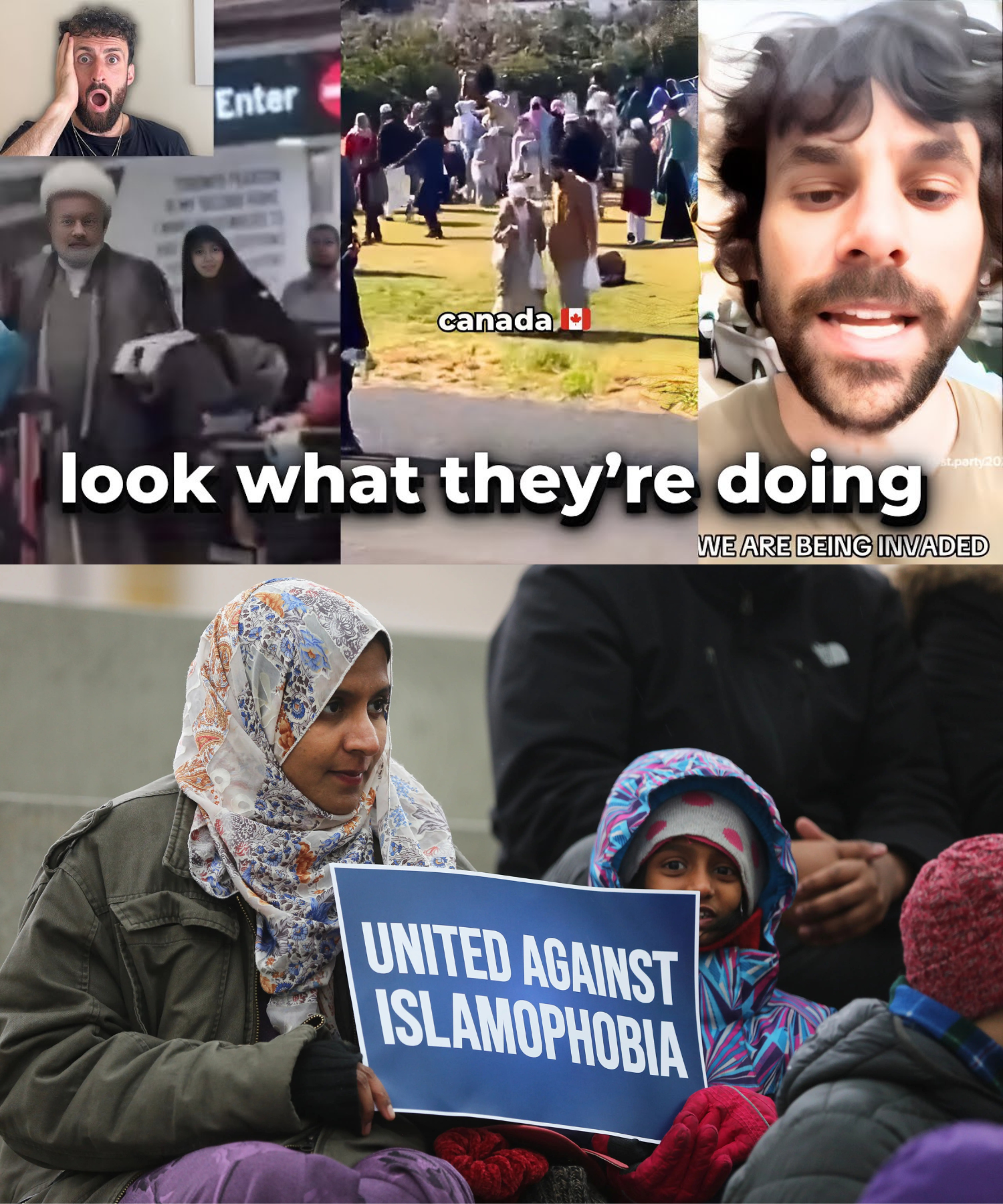
The video, widely shared among right-leaning audiences, opens with an ominous claim: Canada, Britain, parts of Europe, Australia, and even areas of the United States are facing a growing Islamist influence that critics say Western leaders are too afraid to confront. The commentator frames the issue as a modern version of an old historical pattern — conquest, demographic change, and the replacement of one civic culture with another.
The language is dramatic. The reaction has been explosive.
At the center of the controversy is Canada, a country long seen by many Americans as polite, stable, tolerant, and politically softer than the United States. But the video argues that beneath Canada’s image of calm multiculturalism, a deeper crisis is forming: rising religious separatism, pressure on speech, growing street activism, and leaders who allegedly confuse tolerance with surrender.
One clip shows a Canadian political figure saying, “Muslim values are Canadian values.” Supporters of the statement may hear inclusion, respect, and civic harmony. Critics hear something different: a political class trying to merge religious identity with national identity, while ignoring the tensions between Western liberal values and Islamist ideology.
That distinction matters.
Muslim citizens are not the problem. Millions of Muslims in Canada and the United States are peaceful, patriotic, hardworking, and fully committed to democratic life. Many came to the West to escape theocracy, war, corruption, and religious extremism. But the video argues that Western governments are failing to distinguish ordinary Muslims from Islamist movements that seek political power, legal privilege, and cultural dominance.
That is where the debate becomes dangerous — and necessary.
The most disturbing part of the transcript involves police visiting a woman over alleged online posts criticizing Canada’s prime minister and using harsh language about Israel and Zionism. In the video, officers warn that if concerning threats continue, she could be arrested and charged. The woman responds angrily, accusing authorities of wasting tax dollars and harassing her over speech.
To American viewers, that moment lands hard.
In the United States, the First Amendment protects even ugly, harsh, offensive political speech unless it crosses into true threats, incitement, or criminal harassment. Americans are deeply suspicious of police knocking on doors over political posts. The clip feeds a growing fear that Canada and parts of Europe are moving toward a speech-policing model that Americans consider incompatible with liberty.
But there is another side. If a post contains credible threats against a public official, police have an obligation to investigate. The challenge is transparency. In the clip, the woman repeatedly asks officers to show her the exact post. The officers do not clearly present it on camera. That ambiguity is what makes the video so combustible.
Was this responsible threat assessment?
Or was it intimidation dressed as public safety?
The video then features an Iranian political refugee who says he fled Islamic law and came to Canada because he believed it was free. His warning is calm but chilling. He says he recognizes the pattern: left-wing political movements forming alliances with Islamists, institutions appeasing extremists step by step, and authorities mistaking aggression for a community grievance.
That testimony carries weight because it comes from someone who says he lived under religious authoritarianism. For many Americans, immigrants who fled theocracy are among the strongest critics of Western naïveté. They are not warning from theory. They are warning from memory.
The video also highlights an alleged sermon in Canada containing hostile religious rhetoric about Jews and calls for victory for those waging jihad. The commentator presents it as proof that anti-Israel activism can sometimes conceal deeper anti-Jewish hatred. If the quoted sermon is accurate, it raises serious questions for law enforcement, religious leaders, and civil society.
Criticism of Israel is legal. Protest for Palestinians is legal. Opposition to Zionism is legal.
But calls to hate Jews as Jews, glorify violence, or “destroy enemies” enter a different moral and civic category.
This is where America’s own post-October 7 crisis appears in the background. Across U.S. campuses and cities, many Jewish Americans say anti-Israel rhetoric has blurred into antisemitism. Pro-Palestinian activists deny that accusation, saying criticism of a state is not hatred of a people. Both claims can be true in different cases. Some activists are protesting war and civilian suffering. Others have crossed into open hostility toward Jews.
The hard work is knowing the difference.
The transcript then moves to signs allegedly seen in Vancouver telling people to keep dogs away from Muslim residents because dogs are considered impure in Islam. To some, this is a small neighborhood courtesy issue. To others, it is a symbol of something larger: newcomers expecting public behavior in a Western city to adjust around religious rules.
That is why the dog sign matters more than it should.
It becomes a metaphor for assimilation.
In America, the same debate appears around public prayer, school accommodations, religious dress, halal food, gender rules, and community norms. A free society should accommodate religion where reasonable. But a free society also cannot allow any religious group to dictate public life for everyone else.
The video’s final section features Canadian academic and commentator Gad Saad discussing Canada’s future. He warns that Canada may be walking slowly toward the same type of cultural collapse he says he witnessed in Lebanon, where demographic and political shifts transformed the country over decades. He argues that societies cannot survive if they import large numbers of people who do not share foundational values.
That argument is deeply controversial.
Critics say it reduces immigrants to threats and fuels fear of Muslims. Supporters say it asks the question Western leaders refuse to answer: can a liberal democracy survive mass immigration without strong assimilation?
The answer may depend on whether governments can say two things at once.
First, Muslims belong in the West if they respect the law, individual liberty, free speech, women’s equality, and pluralism.
Second, Islamism does not belong in the West if it seeks censorship, religious supremacy, intimidation, antisemitism, or parallel legal authority.
That distinction is the line America must defend.
The danger of the viral video is that its language can encourage suspicion toward all Muslims. That is wrong and destructive. The danger of ignoring the video is that real concerns about Islamist ideology, demographic pressure, and free speech are dismissed until public trust collapses.
That may be the lesson for the United States.
Canada’s debate is not only Canada’s problem. Americans are watching because they fear the same pattern: elites celebrating diversity while avoiding hard questions about assimilation, security, antisemitism, religious extremism, and national identity.
A society can welcome immigrants.
But it must also know what it expects from them.
A society can protect religious freedom.
But it must also protect the freedom to criticize religion.
A society can oppose bigotry against Muslims.
But it must also oppose Islamist politics that attack the rights of others.
That is the narrow path America and Canada now face.
The viral warning may be exaggerated in places. It may be inflammatory. It may blur lines. But the reason it is spreading is simple: millions of people believe their leaders are not telling the truth about cultural change.
And when citizens feel that the truth is forbidden, the conversation does not disappear.
It explodes.