Dave Smith and Nick Fuentes CLASH on Wars of Choice and US Empire-Building
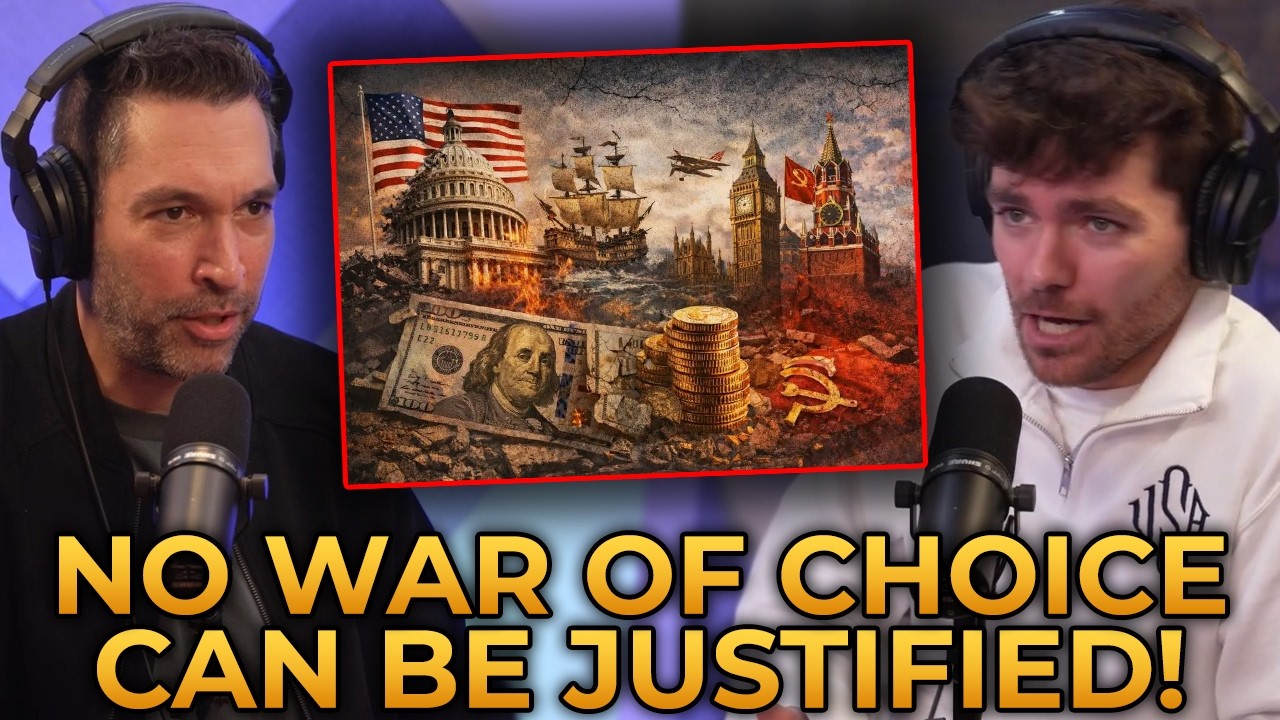
Dave Smith vs. Nick Fuentes: The Foreign Policy Debate That Exposed the Biggest Contradiction in American Conservatism
For years, America’s foreign policy debates have largely followed familiar partisan lines. But sometimes a conversation comes along that cuts much deeper—not because it settles anything, but because it exposes a contradiction that many people have never seriously confronted.
That is exactly what happened when libertarian comedian and political commentator Dave Smith sat down with Nick Fuentes to debate American interventionism.
At first glance, the disagreement appeared to be about Venezuela. Within minutes, however, it became something much larger. It evolved into a clash over the meaning of the Monroe Doctrine, the limits of national self-defense, the morality of regime change, Christian just war theory, and ultimately whether the United States should behave like a traditional republic—or an empire.
What made the exchange especially compelling wasn’t simply that the two men disagreed. It was that they largely share many criticisms of America’s recent wars. Both oppose intervention in Iran. Both criticize the Washington establishment. Both are skeptical of endless military adventures.
Yet when the conversation turned toward America’s own hemisphere, their philosophies suddenly diverged in dramatic fashion.
One argued that the United States has a legitimate right—even an obligation—to remove hostile governments operating close to American borders if they align themselves with rival great powers.
The other insisted that this logic is precisely the reasoning that has justified nearly every disastrous intervention Washington has launched over the past century.
It was a debate that reached beyond Venezuela. It forced a much broader question:
Can a nation reject endless wars while still defending a regional empire?
The answer may determine whether “America First” ultimately becomes a doctrine of restraint—or simply another version of interventionism under a different name.
Venezuela Becomes the Test Case
The central disagreement began with a surprisingly simple question.
Dave Smith asked Nick Fuentes whether he actually supported American military action in Venezuela.
Fuentes’ answer left little room for ambiguity.
He said he supported it.
Not only that, but he described it as one of the few legitimate uses of American military power.
His reasoning rested on several pillars.
First, Venezuela sits inside what he considers America’s strategic backyard.
Second, he argued that Russia and China have expanded their influence throughout Latin America through trade, intelligence cooperation, infrastructure projects, and military partnerships.
Third, he maintained that removing an unfriendly regime from the Western Hemisphere would strengthen American security while expanding access to vital energy resources.
To Fuentes, this represented an application of the Monroe Doctrine—a principle he believes gives the United States special responsibility for maintaining dominance within the Western Hemisphere.
Unlike wars in Iraq or Iran, which he viewed as distant and strategically questionable, Venezuela was different.
It was nearby.
It was comparatively inexpensive.
It involved relatively few casualties.
And, in his view, it served clear American interests.
Smith saw the issue very differently.
For him, none of these arguments answered the central moral question.
Had Venezuela attacked the United States?
No.
Was America responding to an invasion?
No.
If not, Smith argued, then military intervention was not an act of self-defense but a war of choice.
That distinction became the foundation for everything that followed.
What the Monroe Doctrine Actually Said
Much of the disagreement centered on history.
Fuentes invoked the Monroe Doctrine as justification for intervention.
Smith questioned whether the doctrine had ever meant anything of the sort.
Originally announced by President James Monroe in 1823, the Monroe Doctrine warned European powers against establishing new colonies or expanding political control within the Western Hemisphere.
Just as importantly, however, the doctrine carried another principle that is often forgotten today.
The United States itself would generally avoid involvement in Europe’s own conflicts.
In other words, the doctrine reflected mutual restraint rather than unlimited American authority over the Americas.
Smith argued that this original understanding has gradually been replaced by something entirely different.
Over time, successive administrations transformed the Monroe Doctrine from a defensive warning against European colonialism into a justification for American intervention across Latin America.
By the early twentieth century, particularly following Theodore Roosevelt’s Corollary, Washington increasingly claimed the right to intervene militarily throughout the region whenever it believed American interests were threatened.
Critics argue that this represented a profound shift.
Instead of protecting sovereignty, the United States increasingly assumed responsibility for managing the political affairs of neighboring countries.
Smith’s position was that invoking the Monroe Doctrine today often confuses these two very different historical traditions.
Trade Is Not Colonization
A particularly contentious issue involved China’s growing economic presence throughout Latin America.
Fuentes argued that Chinese investments, ports, infrastructure projects, and intelligence cooperation effectively place hostile powers inside America’s sphere of influence.
Smith rejected that comparison.
Countries trading with China or Russia, he argued, are not equivalent to nineteenth-century European colonies.
Commerce is not occupation.
Investment is not conquest.
Diplomatic relations are not military annexation.
If economic relationships alone justify military intervention, Smith warned, then almost any nation could claim the right to attack another whenever rival powers establish commercial partnerships abroad.
That logic, he argued, quickly becomes limitless.
After all, the United States itself maintains military bases, intelligence facilities, and strategic partnerships across much of the world.
Would Americans accept China launching military operations simply because Washington developed close relationships with countries near Beijing?
Almost certainly not.
Smith believed consistency demanded applying the same standards everywhere.
The Moral Problem of Wars of Choice
Perhaps the strongest portion of Smith’s argument involved moral consistency.
He repeatedly distinguished between wars of necessity and wars of choice.
A war of necessity occurs when a nation must defend itself against an actual attack or imminent threat.
A war of choice begins because policymakers believe military action might improve future strategic conditions.
That distinction has shaped debates over American foreign policy for decades.
Supporters of intervention often argue that waiting until danger becomes immediate is irresponsible.
Opponents counter that speculative threats have historically been used to justify unnecessary wars whose costs far exceed their benefits.
Smith placed Venezuela firmly in the second category.
Whatever one thinks of its government, he argued, dissatisfaction with another country’s internal politics does not provide sufficient moral grounds for invasion.
Otherwise, every government could justify attacking rivals by labeling them corrupt, criminal, or dangerous.
History offers countless examples of exactly this pattern.
Officials describe a foreign government as uniquely evil.
They claim intervention will be quick.
They promise liberation.
They predict democracy will flourish.
Reality rarely unfolds so neatly.
Christianity and Just War Theory
One of the more fascinating moments came when Smith challenged Fuentes on Christian ethics.
Smith acknowledged that he is not himself a Christian, but questioned how military intervention designed to remove governments and seize strategic advantages could fit within traditional just war theory.
Classical Christian thinkers such as Augustine and Thomas Aquinas developed strict conditions governing when war could be morally justified.
Among those conditions were legitimate authority, just cause, proportionality, and last resort.
Most importantly, defensive war occupied a fundamentally different moral category than aggressive conquest.
Fuentes argued that modern warfare complicates these ancient principles.
Nuclear weapons, cyber operations, intelligence networks, and global strategic competition mean threats often develop long before armies cross borders.
Waiting until missiles launch may no longer be realistic.
Therefore, limited operations intended to neutralize emerging dangers can, in his view, qualify as defensive actions.
Smith remained unconvinced.
If every potential future threat qualifies as self-defense, he argued, then almost any military intervention can be justified simply by expanding the definition of danger.
The result is a theory broad enough to accommodate nearly every war policymakers wish to fight.
The Empire Question
As the debate continued, the disagreement shifted from individual conflicts to the nature of American power itself.
Fuentes openly defended a form of regional hegemony.
His position was straightforward.
Major powers naturally dominate their surrounding regions.
America should do the same.
Countries close to the United States should understand geopolitical reality and avoid aligning themselves with rival superpowers.
If they choose otherwise, Washington possesses both the right and responsibility to intervene.
Smith regarded this as imperial logic.
Whether one calls it empire, regional dominance, or hemispheric defense, the practical outcome remains similar.
Powerful nations dictate acceptable political behavior to weaker neighbors.
Governments that refuse risk military coercion.
Smith warned that this approach resembles the very interventionist mindset many conservatives now criticize when discussing Iraq, Libya, Syria, or Iran.
The geographical location changes.
The underlying principle does not.
The Cost of Intervention
Near the end of the discussion, Smith shifted from moral philosophy to economics.
Here, he argued, even supporters of selective intervention face an enormous practical obstacle.
The United States already carries staggering national debt.
Federal spending continues expanding.
Interest payments consume an increasing share of government finances.
Military commitments around the globe require hundreds of billions of dollars annually.
Against that backdrop, Smith questioned whether Americans can realistically afford additional foreign interventions.
Every new military operation brings direct costs.
But there are also indirect consequences.
Borrowing increases.
Money creation accelerates.
Inflation erodes purchasing power.
Future taxpayers inherit larger obligations.
Smith argued that this cycle has become one of the defining features of modern American government.
Washington rarely pays for wars upfront.
Instead, it finances them through debt that compounds over generations.
In his view, a foreign policy of restraint is therefore not merely morally preferable—it has become economically necessary.
Lessons from the Cuban Missile Crisis
One historical comparison highlighted the broader philosophical divide.
Smith pointed to the Cuban Missile Crisis.
The Soviet Union’s deployment of nuclear missiles ninety miles from Florida represented one of the gravest threats in American history.
Yet President John F. Kennedy ultimately chose negotiation over invasion.
The crisis ended through reciprocal concessions rather than military conquest.
For Smith, this demonstrates that even severe security threats need not automatically produce war.
Diplomacy, however imperfect, can sometimes achieve what military force cannot.
Fuentes acknowledged the changing nature of strategic competition but maintained that today’s environment—defined by cyber warfare, intelligence operations, and global rivalries—requires greater flexibility than Cold War precedents alone may provide.
The disagreement again came down to one question:
How much uncertainty should governments tolerate before using force?
The Slippery Slope of “National Interests”
Perhaps the most important criticism raised throughout the discussion involved language itself.
Phrases like “national interests,” “regional security,” “criminal regimes,” and “strategic necessity” sound persuasive.
But they are also remarkably elastic.
Nearly every major military intervention in modern history has been defended using similar terminology.
Iraq supposedly threatened international security.
Libya required humanitarian intervention.
Afghanistan became necessary after terrorism.
Iran is frequently described as a destabilizing regional actor.
Supporters of intervention almost always insist that unique circumstances make military action unavoidable.
Smith argued that once governments receive broad discretion to define threats according to shifting strategic interests, meaningful limits disappear.
The exception gradually becomes the rule.
The debate ceases to concern self-defense and instead becomes a debate over which potential dangers justify preventive action.
History suggests that standard expands far more easily than it contracts.
A Debate About More Than Venezuela
Although Venezuela remained the immediate topic, the conversation ultimately became a referendum on American grand strategy.
Should the United States function primarily as a constitutional republic concerned with defending its own territory?
Or should it maintain a sphere of influence where neighboring governments are expected to align with Washington’s strategic objectives?
Neither participant questioned that great power competition exists.
Both recognized growing rivalry with China and Russia.
Their disagreement centered on how America should respond.
Fuentes viewed regional dominance as a realistic requirement of national security.
Smith feared that embracing even limited imperial assumptions would eventually reproduce the very interventionist foreign policy many conservatives claim to reject.
It is a debate that extends far beyond one administration, one country, or one military operation.
As geopolitical competition intensifies, similar questions will continue emerging across the Pacific, Eastern Europe, the Middle East, and Latin America.
How broadly should self-defense be defined?
When does deterrence become aggression?
At what point does protecting national interests become maintaining an empire?
These questions have no easy answers.
But the exchange between Dave Smith and Nick Fuentes illustrates why they matter.
One side believes strategic geography creates unique responsibilities that justify limited intervention close to home.
The other believes that once wars cease to be truly defensive, governments will inevitably stretch every justification until military force becomes routine.
Whether readers agree with Smith, Fuentes, or neither, the debate highlights an enduring tension within American foreign policy.
Can the United States remain secure without acting as a regional hegemon?
Or does abandoning that role invite greater dangers in the future?
Those competing visions are likely to shape American politics for years to come.
And if this debate demonstrated anything, it is that the sharpest disagreements over foreign policy are no longer occurring between Republicans and Democrats—but within the very coalition that claims to oppose endless war.