These Hieroglyphs Describe The Beings Who Built The Pyramids — And What The Egyptians Called Them
These Hieroglyphs Describe The Beings Who Built The Pyramids — And What The Egyptians Called Them
The first clue was never meant to be seen.
It was not carved across the grand entrance of a temple. It was not written for tourists, priests, or future kings. It was hidden deep inside the Great Pyramid, painted in red ochre on rough stone in a cramped chamber above the burial room of Khufu. For thousands of years, those marks waited in darkness. And when modern eyes finally saw them, they did not find the names of aliens, giants, or lost gods. They found something more chilling because it was real: the names of the beings Egypt trusted to raise stone into eternity.
For centuries, the pyramids have made people doubt the obvious.
How could human hands build something so huge? How could ancient workers move blocks weighing several tons? How could a civilization without steel cranes, diesel engines, or modern computers align monuments with such frightening precision? The question has haunted travelers, scholars, mystics, and conspiracy hunters alike. Every generation looks at Giza and feels the same discomfort: something about these structures seems too large for ordinary explanation.
That discomfort is exactly where legends are born.
Some people say the pyramids were built by giants. Others point to visitors from the stars. Some believe a vanished civilization passed down secret engineering knowledge before disappearing beneath flood, sand, or time. These stories survive because the pyramids do not look like normal buildings. They look like messages. They look like machines. They look like mountains that someone taught to obey geometry.
But the Egyptian hieroglyphs tell a different story.
They do not describe silver spacecraft descending from Orion. They do not name a race of forgotten giants. They do not reveal a hidden alien species working under the desert sun. Instead, the inscriptions point toward a civilization that organized labor, religion, astronomy, administration, food production, transport, and sacred kingship into one monumental act.
And yet, calling the builders merely “workers” also misses something important.
To the Egyptians, the pyramid was not just a construction project.
It was a cosmic operation.
The people who built it were not only carrying stone. They were helping create a doorway between worlds. They were serving a king who was believed to stand between humanity and the gods. They were building a horizon where the dead ruler could rise, transform, and join the eternal order of the heavens.
So when we ask what the Egyptians called the beings who built the pyramids, the answer has two layers.
On one level, they called them crews, gangs, phyles, inspectors, craftsmen, haulers, sailors, and servants of the royal house.
On a deeper level, they saw them as participants in divine work.
That is the mystery hidden in the writing.
The most famous hidden inscriptions are not polished hieroglyphs cut by master scribes for public display. They are rough construction marks. Workmen’s graffiti. Names, measurements, leveling marks, and crew labels painted quickly on stone blocks before those blocks were sealed away forever. They survive because nobody meant to decorate them. Nobody came later to clean them off. They were practical marks left by the people doing the work.
That makes them powerful.
Official inscriptions can lie. Kings can boast. Priests can reshape memory. But a work crew marking a block before it disappears into the body of a pyramid leaves behind a different kind of truth. It is less glamorous and more intimate. It feels like hearing a voice from the construction site itself.
One of the most famous names associated with Khufu’s pyramid is often translated as “The Friends of Khufu Gang.” Another crew name refers to the power of Khnum-Khufu, Khufu’s full royal name linking him with the creator god Khnum. In the pyramid complex of Menkaure, similar graffiti appears, including groups known as “The Friends of Menkaure” and, in one famous reading, “The Drunkards of Menkaure,” though some scholars interpret that word more soberly as “laborers.”
These names are strange, human, and unforgettable.
They sound less like faceless slaves and more like organized teams with identity, pride, rivalry, and humor. They suggest that the pyramid workforce was divided into groups that competed and cooperated. They had names. They had overseers. They had structure. They had a place within a vast state machine capable of feeding, housing, directing, and recording thousands of people.
That does not make the work easy.
It makes it more impressive.
The old image of pyramid building as endless lines of whipped slaves has become harder to defend. Archaeology has uncovered evidence of workers’ settlements near Giza, including bakeries, workshops, administrative spaces, and signs of a population sustained by large-scale food production. The people building these monuments needed bread, beer, meat, tools, medical care, managers, and supply chains. The pyramids were not thrown together by chaos. They were built by a society that knew how to concentrate resources with terrifying efficiency.
This is where the real wonder begins.
A pyramid is not just stone.
It is administration made visible.
Every block represents a quarry. Every quarry represents labor. Every laborer represents food. Every ration represents fields, cattle, bakers, brewers, scribes, storage, transport, and command. Behind the pyramid is an entire nation pulling in the same direction, whether by duty, belief, taxation, rotation, pride, pressure, or all of them at once.
That is more astonishing than aliens.
Because aliens explain the pyramid by removing Egypt from the story.
The hieroglyphs put Egypt back at the center.
Still, the word “beings” is not completely wrong if we understand the Egyptian mind. Ancient Egypt did not divide reality the way modern people do. The visible and invisible worlds touched constantly. Gods, kings, ancestors, spirits, animals, stars, and sacred places all belonged to a living order. The divine was not trapped in the sky. It flowed through ritual, stone, names, images, and royal power.
The Egyptians used words for divine beings that modern scholars often translate as gods, spirits, or sacred powers. One of the most important was netjer, often rendered as “god,” with netjeru as the plural. But this word carried a broader sacred charge than the English word “god” sometimes suggests. It could point toward divine forces, beings worthy of ritual, and powers embedded in the order of the universe.
The pyramids were built inside that world.
So when modern people look for “the beings who built the pyramids,” they often imagine physical creatures from outside humanity. But the Egyptians may have understood the project differently. Human crews raised the stone, but the purpose of the stone belonged to the realm of the netjeru. The king was becoming divine. The pyramid was a resurrection machine in symbolic form. The workers were constructing not only a tomb, but a cosmic ladder.
That is why the Pyramid Texts matter.
These inscriptions, carved inside later Old Kingdom pyramids, do not explain engineering methods. They explain spiritual ambition. They speak of the king rising from death, joining the imperishable stars, traveling with the sun, and entering the company of divine powers. The pyramid was not merely a grave. It was architecture designed around transformation.
Imagine being an Egyptian laborer hauling limestone under the brutal sun.
To a modern eye, you are a worker on a state project.
To the state, you are part of a royal machine.
To the priesthood, you are helping preserve cosmic order.
To your own village, you may be fulfilling an obligation that binds community, king, and gods.
That combination of hardship and sacred purpose is difficult for modern people to grasp. We tend to separate labor from worship, politics from religion, construction from cosmology. Ancient Egypt did not separate them so neatly. Building for the king was building for the divine order that made Egypt possible.
That is why the pyramids feel so strange.
They are not only feats of engineering.
They are beliefs turned into stone.
The Diary of Merer, one of the most important Egyptian papyrus discoveries ever connected to Khufu’s pyramid, brings the mystery down from the clouds into daily life. Merer was an inspector overseeing a crew that transported fine limestone from Tura to the Giza area. His logbook records movements, deliveries, travel by boat, and the working rhythm of men tied to the pyramid project.
There is something haunting about that.
For thousands of years, people asked who built the Great Pyramid. And one of the answers was sitting in a papyrus logbook written by a working official, not a magician. Merer did not describe thunderbolts from heaven or giants carrying stones on their backs. He described boats, crews, quarries, basins, and deliveries.
The myth becomes human.
But it does not become small.
In fact, the human details make it larger. Because now we can imagine the living system behind Giza: the men cutting stone at Tura, the sailors moving blocks along waterways, the overseers checking lists, the workers dragging loads, the bakers producing bread, the brewers filling jars, the administrators counting rations, the priests preparing rituals, and the royal command pushing everything toward one impossible shape on the horizon.
The beings who built the pyramids had names.
Some were written in graffiti.
Some were written in accounts.
Most were never written at all.
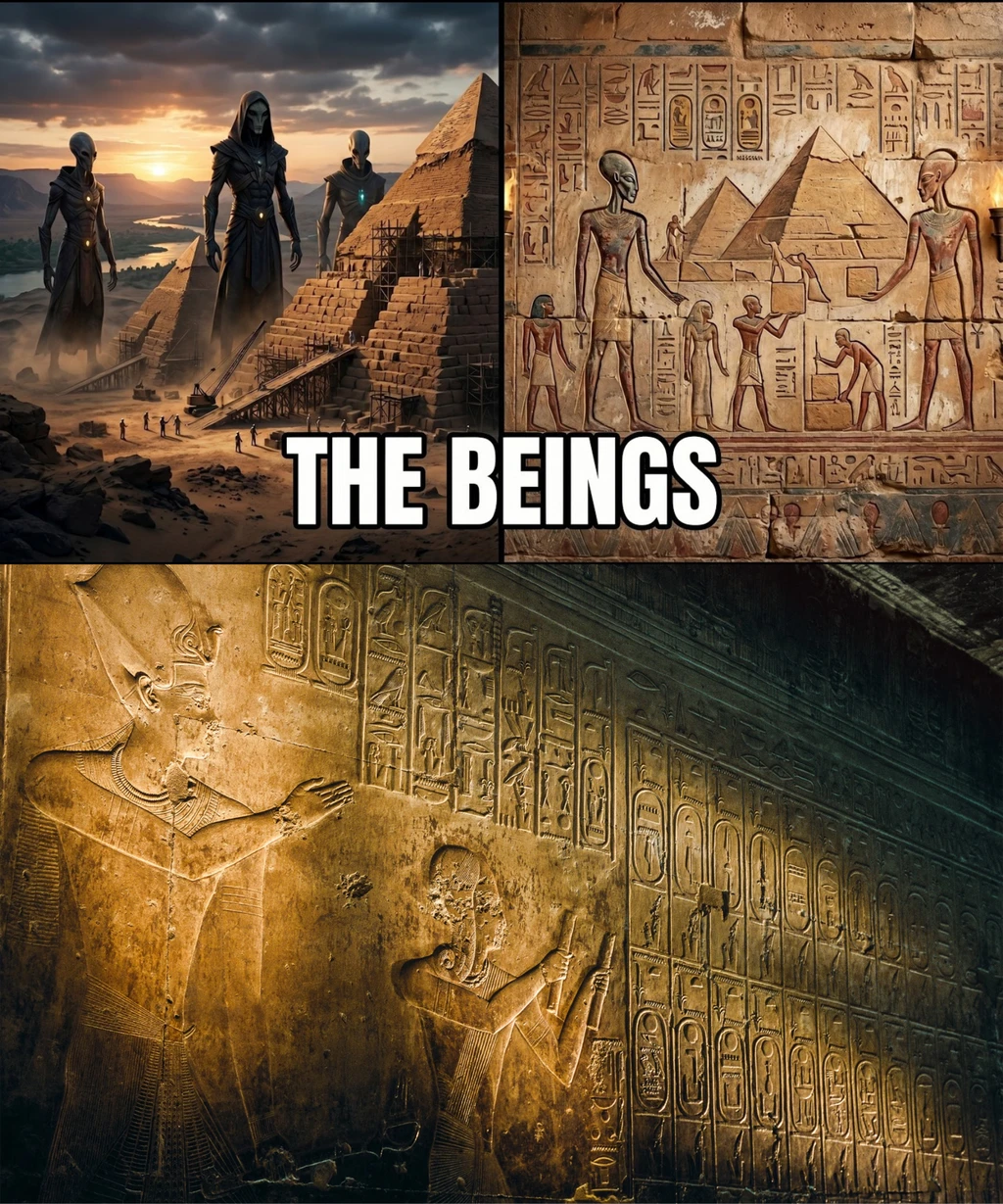
They were Egyptians from towns and villages across the Nile Valley. They were skilled artisans and temporary laborers. They were boatmen and stonecutters, haulers and foremen, scribes and cooks. They were not mythical creatures. But they lived in a mythical world, and that distinction is the key to understanding Giza.
To them, Khufu was not just a man with political power. He was the king of Upper and Lower Egypt, the living center of order, the ruler whose death required a monument capable of carrying him into eternity. His pyramid was called Akhet Khufu, often understood as “Khufu’s Horizon.” That name alone changes the way we see the monument. It was not simply a pile of stone. It was a horizon, the place where the king would rise.
A horizon is a border.
It is where earth meets sky.
It is where the visible world touches the unknown.
That is what the pyramid was designed to be.
Seen this way, the hidden graffiti becomes almost sacred by accident. The rough red marks in the relieving chambers were never meant as scripture, but they reveal the human machinery behind a sacred machine. They show us that ordinary workers left fingerprints inside a monument built for eternity. The king wanted immortality, but the crews left their own names hidden inside his stone body.
That is one of history’s great ironies.
Khufu built the pyramid to preserve his name forever.
But the names of his builders survived too.
Not all of them. Not enough. But enough to break the spell of anonymity. Enough to show that this was not the work of invisible slaves or nameless supernatural beings. It was the work of organized human groups who knew their place in a system larger than themselves.
And yet, perhaps that is exactly why people resist the answer.
A human-built pyramid is more demanding than an alien-built pyramid. If aliens built it, we can admire it from a distance and move on. But if human beings built it, then we must confront what ancient societies were capable of when belief, authority, labor, and fear all moved together. We must admit that people without modern machines could still accomplish things that make modern people feel small.
The real mystery is not whether humans could build the pyramids.
The real mystery is how a civilization convinced so many humans to give their strength to one vision.
That vision was not only political. It was spiritual. The pyramid rose because Egypt believed the king’s afterlife mattered to the order of the world. The workers may have had mixed feelings, as all workers do. Some may have felt pride. Some may have felt exhaustion. Some may have complained, joked, competed, prayed, suffered injuries, missed home, and counted the days until they could return. But they were part of a project that tied their daily labor to cosmic meaning.
That is almost impossible to recreate today.
Modern buildings usually say: money was here.
The pyramids say: eternity was here.
This does not mean we should romanticize the labor. Building the pyramids required brutal effort. Bodies broke. Hands tore. Backs bent. Accidents happened. Men died young. A monument can be magnificent and still be built through hardship. The evidence of medical care and organized support does not turn the work into a festival. It simply shows a more complex reality than the old slave-whip image.
The builders were not machines.
They were human beings inside a demanding, sacred, royal system.
That is the truth the hieroglyphs preserve.
The Egyptians called some of them gangs, crews, and phyles. They grouped them under names tied to the king. They marked their stones with phrases that carried loyalty, identity, and organization. They also lived in a world where the gods, the dead king, and the eternal stars were part of the same story. So the pyramid builders were both ordinary and extraordinary at once.
Ordinary because they ate bread, drank beer, got injured, obeyed overseers, and left work marks.
Extraordinary because their labor became part of the most enduring sacred architecture on Earth.
When people say the pyramids could not have been built by humans, they often think they are making the monuments more mysterious. In reality, they are making ancient people smaller. They are stripping away the intelligence, organization, faith, and suffering of the Egyptians who actually created these wonders.
The hieroglyphs do not do that.
They restore the builders.
They tell us that behind the Great Pyramid were crews with names. Behind the crews were towns, administrators, canals, quarries, and kitchens. Behind all of that was a worldview in which stone could serve the dead, kings could become stars, and human labor could participate in divine order.
That is more powerful than any fantasy.
Because it means the pyramids were not built by beings from another planet.
They were built by beings from another way of seeing the world.
People who believed the universe had order.
People who believed names had power.
People who believed death could be crossed.
People who believed stone could hold eternity.
And perhaps that is why Giza still unsettles us. We do not simply see ancient engineering when we stand before the pyramids. We see evidence of a human civilization that aimed its labor at forever. We see a society that could turn belief into geometry and command into stone. We see ordinary hands building something that still feels almost beyond human.
The hidden hieroglyphs do not remove the mystery.
They sharpen it.
They tell us the builders were not nameless shadows. They were crews, gangs, inspectors, haulers, craftsmen, sailors, and servants of a sacred king. They were Egyptians. They were human. But in the world they inhabited, human beings could work in the presence of gods, under the command of a divine king, toward a monument meant to pierce death itself.
That is what the Egyptians called them.
Not aliens.
Not giants.
Not strangers.
They were the friends of Khufu, the gangs of the king, the organized hands of Egypt, and the living servants of a cosmic order.
And once you understand that, the Great Pyramid becomes even more mysterious than before.
Because now the question is no longer whether humans built it.
The question is what kind of world could make humans build something like that.