I Put a Hidden Camera on an Abandoned Alaskan Island… What It Captured Shouldn’t be There!
I Put a Hidden Camera on an Abandoned Alaskan Island… What It Captured Shouldn’t Be There
The island was supposed to be empty.
No caretakers. No fishermen. No campers. No researchers. No one living there, no one visiting there, and definitely no one walking past my hidden camera at 3:17 in the morning with a lantern in his hand and his face turned toward the lens like he knew exactly where I had buried it.
That was the part I couldn’t explain.
Not the fog. Not the sound. Not the lights over the water. Alaska has a way of making strange things feel normal if you spend enough time near the coast. The weather changes too fast. The ocean lies. Shadows stretch wrong in the long twilight. Birds scream like children. Old metal sings in the wind.
But a man?
On that island?
No.
There should not have been a man there.
And when I finally watched the rest of the footage, I realized that whatever had crossed in front of my camera was only the beginning.
The Island With No Reason to Exist
I won’t give the real name of the island.
That sounds dramatic, I know. It sounds like the kind of thing people say when they want a story to feel more important than it is. But anyone who has spent time in the remote parts of Alaska understands that some places do not need more attention. Some places are already difficult enough without people arriving with drones, cameras, flashlights, and the kind of curiosity that gets them killed.
The island sits off the southern coast, beyond a stretch of black water where the currents move like something alive. On maps, it looks insignificant. A narrow strip of rock, spruce, wet moss, and cliffs. In summer, the place is green and violent with life. In winter, it disappears beneath storms.
No permanent residents.
No maintained dock.
No official tourist route.
Only the remains of an abandoned settlement on the eastern side: a broken cannery, three collapsed cabins, a radio shack with its roof half torn away, and a rusted fuel tank lying on its side like a dead animal.
Locals in the nearest fishing town called it Mercy Island.
Not because mercy had ever lived there.
Because, according to an old joke, if you got stranded there, mercy was all you had left.
Why I Went There
I had been filming remote abandoned sites for almost six years.
Old mining camps. Weather stations. Military outposts. Forgotten fishing villages. Places where humans had arrived with confidence and left behind rot, metal, and silence.
Most abandoned places feel sad.
Mercy Island felt watchful.
The first time I heard about it was from a retired fisherman named Cal, who found me at a harbor bar after seeing one of my videos online. He didn’t look like a man who believed in ghosts. He looked like a man who believed in engines, bad weather, and keeping his mouth shut unless something mattered.
“You like empty places?” he asked.
“I document them,” I said.
He laughed once. “Then document Mercy.”
When I asked what was there, he looked toward the dark windows of the bar as if someone outside might be listening.
“Nothing,” he said. “That’s the problem.”
Then he told me the story.
In the late 1940s, there had been a small seasonal fishing operation on the island. A cannery crew, maybe thirty people at peak season. Men, women, a few children. It was never a real town, but people lived there long enough to leave names carved into doors and dates scratched into bunkhouse walls.
Then, one autumn, something went wrong.
A supply boat arrived and found the place abandoned.
Not destroyed.
Not burned.
Just empty.
Meals still on tables.
Boots near doors.
A pot still hanging over a cold stove.
The radio equipment smashed.
And every mirror in the settlement turned to face the wall.
That detail stayed with me.
Mirrors facing the wall.
It sounded too specific to be invented casually.
I asked Cal if there had been an investigation.
He shrugged. “Coast Guard came. Troopers came. Nothing. They said storm panic, maybe evacuation, maybe boat accident.”
“Were bodies found?”
“No.”
“Did anyone return?”
Cal stared into his drink.
“One did.”
That was all he said.
The Camera Plan
I didn’t go to Mercy Island expecting proof of anything supernatural.
That is important.
I went because abandoned places collect stories, and stories collect attention. A remote Alaskan island with a vanished cannery crew was exactly the kind of subject viewers would click.
But I also knew I couldn’t stay overnight.
The weather window was too narrow. The boat operator who agreed to take me there gave me four hours on land, maybe five if the water stayed calm. He refused to wait past sunset.
So I decided to leave equipment behind.
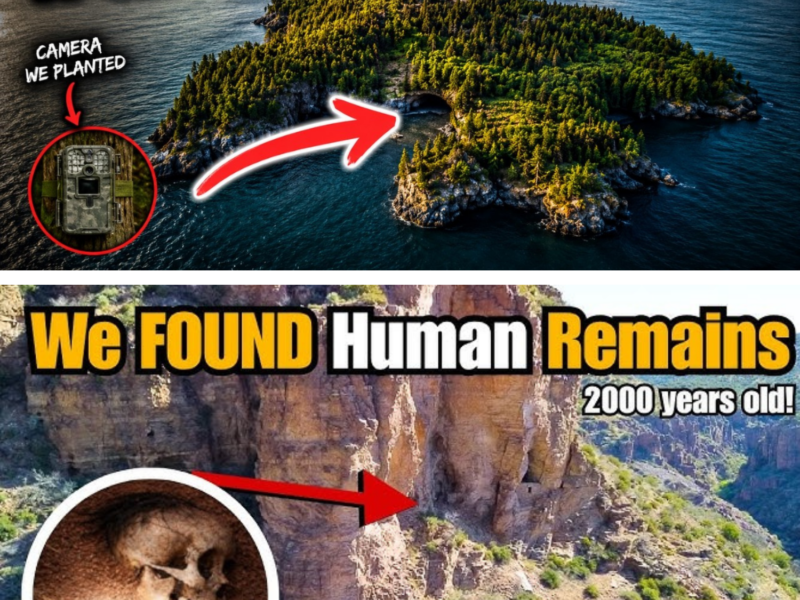
A trail camera.
Weather-sealed.
Infrared capable.
Motion triggered.
Thirty-day battery pack.
I planned to hide it near the old radio shack, pointed toward the main footpath between the cabins and the beach. If animals moved through, I’d get footage. If trespassers visited, I’d know. If nothing happened, I’d still have a good framing device for the video.
The boat captain didn’t like the idea.
“You leave something there,” he said, “you may not want what comes back with it.”
I thought he was joking.
He wasn’t smiling.
First Landing
Mercy Island smelled like wet bark, salt, and rust.
The beach was not sand but dark stone, slick with kelp and tide pools. Above it, the old path climbed through grass so tall it brushed my waist. The settlement appeared slowly through the fog: gray boards, broken windows, roofs sagging under moss, a world abandoned so completely it felt embarrassed to still be standing.
The cannery was the largest building.
Its walls leaned inward. Inside, metal tables sat under a layer of orange rust. Fish hooks hung from beams. Old cans were stacked in one corner, their labels long gone. The floor was soft in places, and every step sounded too loud.
The cabins were worse.
One had a child’s bed frame still inside.
Another had newspapers stuffed into wall gaps for insulation.
In the third cabin, I found a mirror.
It was cracked, oval, and nailed above a wooden washstand.
It faced the wall.
I did not touch it.
I told myself someone had moved it years later. Some explorer. Some teenager. Some fisherman sheltering from weather.
But then I found another mirror in the bunkhouse.
Also facing the wall.
Then a third in the radio shack.
Also facing the wall.
That was when the island stopped feeling like a story and started feeling like a warning.
Where I Hid the Camera
The radio shack stood at the edge of a small clearing, maybe fifty yards from the beach.
It was the only building with a clear view of the path. Behind it, the land rose sharply into thick spruce and rock. In front, the path curved toward the cabins, then down to the water.
I placed the trail camera low, inside the remains of an old crate, covered with moss and splintered wood. The lens had a narrow opening. Unless someone knew exactly where to look, they would never see it.
Before I left, I tested it by walking across the path.
The red sensor blinked once.
Good.
Then, while packing up, I heard a sound from inside the radio shack.
A click.
Like someone tapping glass with a fingernail.
I turned.
Nothing.
Another click.
This time from behind me.
The captain’s horn blasted from the beach before I could investigate. Fog was coming in fast. I grabbed my bag and left the camera behind.
As the boat pulled away, I looked back at the settlement.
For just a second, I thought I saw someone standing in the radio shack doorway.
Tall.
Still.
Facing the water.
Then the fog swallowed the island.
The First Week of Footage
I returned thirty-two days later.
The camera was still there.
That alone surprised me. I half expected weather or animals to destroy it. But the crate was undisturbed, the moss still in place, the memory card dry.
Back at my rented room above a bait shop, I opened the files.
Most were exactly what I expected.
Wind-triggered clips.
Rain.
Foxes.
Birds.
A black bear moving through the clearing at noon, sniffing the cabin wall, then lumbering away.
At night, the infrared turned everything silver. Grass glowed white. The path looked like bone. Mist drifted past the lens in low sheets.
For the first six nights, nothing strange happened.
Then came night seven.
At 2:43 a.m., the camera activated.
The clearing was empty.
No animal visible.
No movement.
Then the audio picked up something faint.
A bell.
Not a church bell. Not a buoy bell from the ocean. This was smaller. Handheld. Slow.
Three rings.
Then silence.
The camera stopped.
At 2:51 a.m., it activated again.
This time, something moved near the radio shack.
A light.
Small, yellow, flickering.
A lantern.
It bobbed slowly from left to right, as if carried by someone walking behind the wall.
But no person appeared.
Just the lantern glow.
Then it vanished.
I watched the clip five times before I admitted what bothered me most.
The light did not reflect on the wet ground.
The Man on Night Twelve
Night twelve was the footage that made me stop breathing.
The timestamp read 3:17 a.m.
Rain fell lightly. The path glistened. Fog moved between the cabins.
Then a man walked into frame.
He came from the direction of the beach.
Not stumbling. Not lost. Walking with purpose.
He wore a long dark coat, heavy boots, and a cap pulled low. In his right hand, he carried an old lantern—the same yellow light from night seven.
The camera captured him clearly for six seconds.
Long enough to see that his clothing was wrong.
Not modern outdoor gear. Not fishing rainwear. Old clothing. Heavy wool, maybe. Something from another century.
His face was pale and narrow, with a short beard darkened by rain.
At first, he looked past the camera.
Then he stopped.
Slowly, he turned his head.
He looked directly into the lens.
Not near it.
Not vaguely toward it.
At it.
The infrared reflected in his eyes, but not the way it does with animals. His eyes looked flat. Dark. Almost empty.
Then he raised one finger to his lips.
A clear, deliberate gesture.
Be quiet.
The clip ended.
The next file began eleven minutes later.
The path was empty.
But the crate covering the camera had been moved slightly to the left.
He had found it.
And left it running.
I Tried to Explain It
I did what any rational person would do.
I tried to destroy my own fear with logic.
Maybe it was a fisherman.
Maybe someone had camped illegally.
Maybe the island wasn’t as empty as locals claimed.
Maybe historical reenactors had somehow chosen the worst possible location in Alaska for a private performance at 3:17 in the morning.
Maybe the clothing looked old because the footage was grainy.
Maybe the lantern was modern but styled to look antique.
Maybe he saw the camera because of the infrared glow.
One by one, the explanations failed.
The boat captain had told me weather was rough that week. No one should have landed. No fresh footprints had been visible when I retrieved the camera. No campfire remains. No trash. No boat tracks. No new disturbances.
And then there was the next clip.
Night thirteen.
4:02 a.m.
The man returned.
This time, he was not alone.
The Line of People
The camera activated to the sound of footsteps.
Many footsteps.
At first, the frame was empty. Then figures began passing from right to left along the path, moving from the cabins toward the beach.
A woman in a long dress.
A man carrying a bundle.
A boy holding something against his chest.
Another woman with her hair wrapped in a scarf.
Then more.
At least twenty people crossed the frame in silence.
Some looked wet, as if they had walked through rain.
Others looked dry.
None looked at the camera.
Their clothing appeared old-fashioned, practical, work-worn. Not costumes. Not theatrical. Real clothing, heavy with use.
The strangest part was their movement.
They walked in single file, not hurried, but not calm either. Their faces were tense. Their eyes fixed forward. They looked like people being evacuated.
Then the last person entered the frame.
A little girl, maybe eight years old.
She stopped.
Turned toward the camera.
And smiled.
Not sweetly.
Knowingly.
Then she pointed behind the camera.
The file ended.
I sat there in the dark room, staring at my laptop screen, unable to move.
Behind the camera was the forest.
The steep rise.
The part of the island I had never explored.
The Sound From the Forest
The camera captured nothing unusual for three days after that.
Then, on night sixteen, the audio began before the video made sense.
A low sound came from the trees.
Not an animal growl.
Not wind.
Voices.
Layered voices.
At first, I thought it was interference. But trail cameras do not pick up radio stations on accident. The sound grew clearer.
People whispering.
A lot of people.
The camera showed the clearing, empty and silver under infrared.
Then every blade of grass bent at once.
Not from wind blowing across the field.
From pressure moving downward.
Something enormous passed above the camera.
The image darkened as if a shadow crossed over it.
There was no visible body.
Only the sound of the grass flattening, the trees creaking, and those whispers rising into a single phrase:
“Don’t let it see your face.”
Then the camera shook.
Not violently.
Carefully.
As if something had placed a hand over it.
For nine seconds, the screen went black.
When the image returned, all three visible cabin doors were open.
They had been closed in every previous clip.
The Mirror Footage
Night twenty was the worst.
The camera activated at 1:11 a.m.
Rain. Fog. Empty clearing.
Then a sound from inside the radio shack.
Click.
Click.
Click.
Like fingernails on glass.
The door of the radio shack slowly opened.
No one came out.
Instead, the mirror appeared.
The same oval mirror I had seen facing the wall.
It was now in the doorway, standing upright, though there was no visible support.
In the infrared, the mirror reflected only darkness.
Not the path.
Not the camera.
Not the trees behind it.
Just black.
Then something moved inside the reflection.
A face pressed against the other side.
Not the man.
Not the little girl.
Something pale and stretched, with features too close together, as if a human face had been remembered incorrectly.
Its mouth opened.
The audio picked up a voice.
My voice.
It said, “I shouldn’t have come here.”
The mirror fell forward.
The clip ended.
I played it again.
And again.
And again.
It was my voice.
Not similar.
Mine.
But I had not been on the island when that clip was recorded.
I was across the water, in town, asleep above the bait shop.
The Return Decision
I should have stopped there.
Any sane person would have copied the footage, called someone, posted nothing, and stayed away.
But fear has a strange relationship with curiosity. Once you see something impossible, part of you wants to run, and another part wants to stand closer until it makes sense.
I called Cal.
I told him some of what I had captured.
Not everything.
When I mentioned the lantern man, he went silent.
Then he asked, “Did he look at you?”
“At the camera.”
“That’s enough.”
“Do you know who he is?”
Cal breathed heavily through the phone.
“My grandfather said one man came back from Mercy after the evacuation. A foreman. Name was Elias Rowe. He wouldn’t speak for three days. When he finally did, he said they didn’t leave because of a storm.”
“Why did they leave?”
Cal did not answer immediately.
Then he said, “Because something came up from the old well.”
There was no well marked on my map.
But I already knew where it would be.
Behind the camera.
In the trees.
Where the little girl had pointed.
The Second Landing
The boat captain refused to take me.
I found another man willing to do it for twice the price, but only if we landed at noon and left before four. He didn’t ask why I wanted to go back. I think he already knew curiosity makes people stupid.
The island felt different the second time.
The buildings looked the same, but the silence had changed. It was not empty silence anymore. It felt occupied.
I went straight to the radio shack.
The mirror was back on the wall.
Facing inward.
Not toward the wall anymore.
Toward the room.
I did not go inside.
Instead, I walked behind the camera location and climbed into the trees.
The forest was thicker than it looked from below. Moss swallowed my boots. Branches scratched my jacket. Everything smelled wet and old.
After twenty minutes, I found the well.
It was made of stone, almost completely hidden under roots and ferns. The opening was covered by rusted metal bars bolted into a square frame.
On the bars were scratches.
Not animal scratches.
Words.
DO NOT ANSWER.
I leaned over and shined my flashlight down.
The beam vanished after maybe twenty feet.
No bottom.
No water reflection.
Just black.
Then, from somewhere deep below, a bell rang once.
What Came From Below
The recording I made at the well is the only file I have never uploaded.
I don’t know if I ever will.
Because after the bell rang, something answered from inside my backpack.
My trail camera.
It was powered off. Battery removed. Memory card in my pocket.
Still, from inside the bag, the camera made the soft electronic chime it makes when it activates.
Then a voice came from the well.
Not loud.
Not echoing.
Close.
“Put it back.”
I ran.
I wish I could say I stayed calm, gathered evidence, filmed everything, behaved like an investigator.
I did not.
I ran through the trees, slipped twice, tore my hand open on a branch, and nearly fell down the slope into the clearing. Behind me, the bell rang again and again, faster each time.
When I reached the beach, the boat was already pushing away from shore.
The captain saw my face and came back.
I jumped in before the bow fully touched the rocks.
As we pulled away, I looked up at the island.
Every cabin door was open.
In the radio shack doorway stood the lantern man.
Beside him was the little girl.
Behind them, filling the windows, were faces.
Dozens of them.
Watching.
The Final File
I thought that was the end.
It wasn’t.
Three nights after I returned, a new file appeared on my laptop.
That should have been impossible.
The camera was in my storage case.
The memory card had been copied and removed.
The laptop had no internet connection at the time.
But there it was.
A video file with no name.
I opened it.
The footage showed my rented room above the bait shop.
From the corner near the ceiling.
Looking down at me while I slept.
The timestamp read 3:17 a.m.
In the video, I lay motionless in bed.
Then the room door opened.
The lantern man stepped inside.
He crossed the room slowly and stood beside me.
He looked down at my sleeping face.
Then he turned toward the hidden viewpoint and raised one finger to his lips.
Be quiet.
After that, the little girl entered.
She carried the oval mirror.
Together, they placed it at the foot of my bed.
The reflection showed not my room, but the island.
The well.
The trees.
The open cabins.
And something rising from the dark below the bars.
The file cut off before I could see its face.
What I Think Happened
I do not think Mercy Island is haunted in the simple way people use that word.
I do not think the figures on the camera were just ghosts repeating old movements.
I think the missing people from the settlement are still there somehow.
Not alive.
Not dead.
Held.
Waiting.
Maybe protected from what came from the well.
Maybe trapped by it.
Maybe serving it.
I think the mirrors were turned to the wall because something used reflection to look out.
I think the radio was smashed because voices were coming through it.
I think Elias Rowe came back because something let him leave.
And I think when I put that camera on the island, I did something worse than record it.
I gave it a way to look back.
That is what cameras do, after all.
We think they only capture what is in front of them.
But maybe some places understand being watched.
Maybe some places watch in return.
Why I’m Telling This Now
I waited months before writing any of this.
I told myself I was protecting the location.
Then I told myself I was protecting the footage.
Then I told myself I was protecting myself.
But the truth is simpler.
I was afraid that if I told the story, it would become real again.
Last week, I received a package.
No return address.
Inside was my trail camera.
Not the one from my storage case.
That one is still here.
This was another one.
Same model.
Same scratches.
Same strip of moss caught in the side latch.
Inside was a memory card.
One file.
I have not opened it yet.
On the outside of the camera, carved into the plastic with something sharp, were four words:
WE SEE YOU NOW.
I don’t know who sent it.
I don’t know how it got here.
I don’t know whether the island wants me to return or wants me to understand that I never really left.
But I know this:
Mercy Island is not empty.
It may never have been empty.
And whatever my hidden camera captured out there was not trespassing on abandoned land.
I was.
Because some places do not become deserted when people leave.
Some places are abandoned because something else has already moved in.