Viral Debate Between Cam Higby and Muslim Guest Ignites Firestorm Over Quran Verses, History, and “Islamic Conquest” Claims
Viral Debate Between Cam Higby and Muslim Guest Ignites Firestorm Over Quran Verses, History, and “Islamic Conquest” Claims
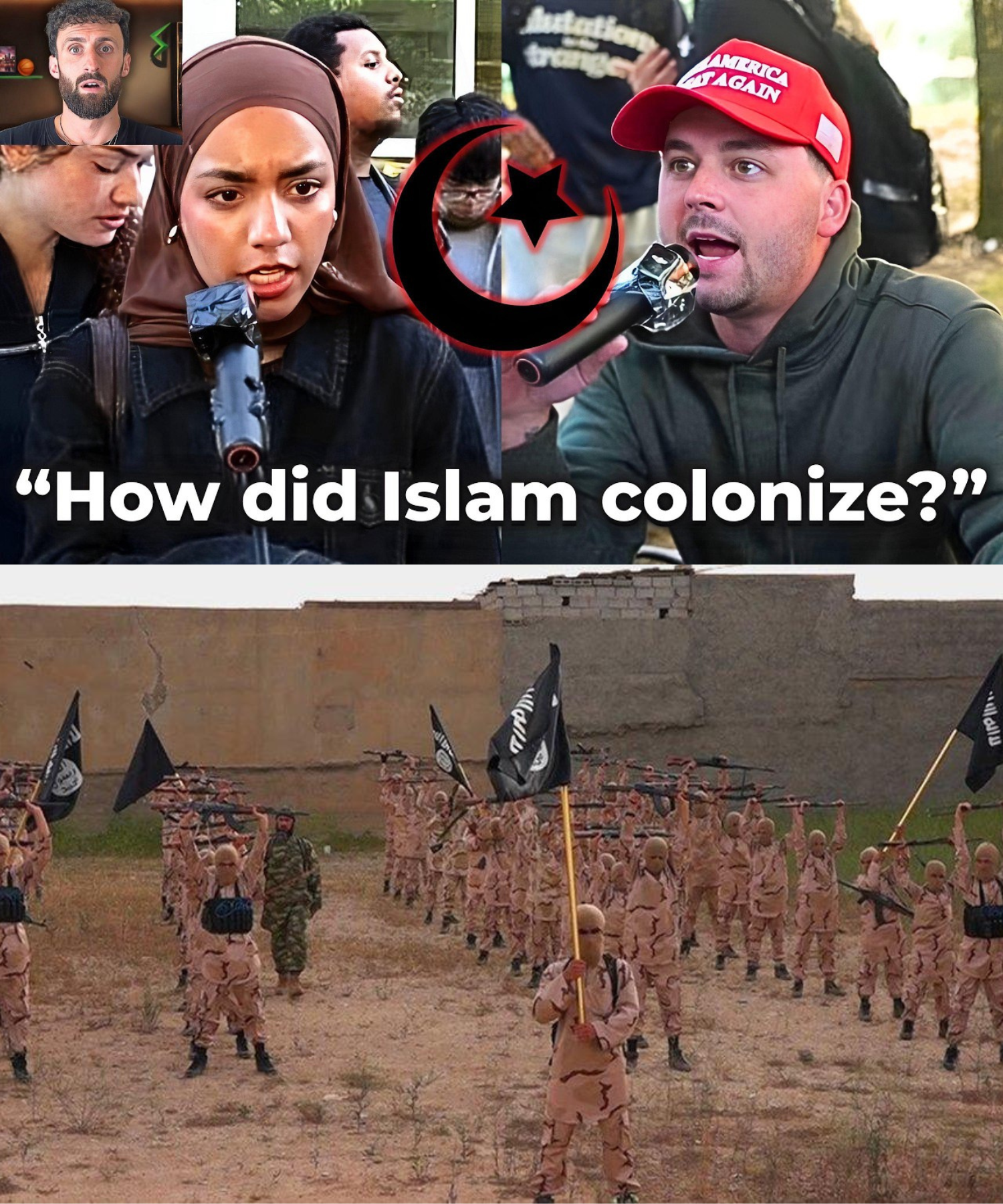
New York — A heated on-camera debate between conservative commentator Cam Higby and a Muslim guest has gone viral, triggering a fierce international argument over Islamic scripture, historical conquest, colonialism, and the origins of Israel and Palestine.
The exchange, which quickly spread across social media platforms, begins with a direct and highly controversial claim from Higby referencing Islamic texts. He cites Surah Muhammad 47:4, arguing that it instructs believers to strike the necks of disbelievers in battle. The Muslim guest immediately challenges the interpretation, asking whether he understands the historical context in which the verse was revealed.
What follows is not a simple disagreement — but a full-scale collision over religion, history, and identity.
Higby insists that the verse, along with certain hadith narrations, supports a broader narrative of violence against non-believers, including a disputed reference to end-times prophecies involving conflict with Jews. His argument escalates as he connects these texts to modern political movements, including Hamas, which he describes as an Islamic resistance organization that cites similar traditions.
The Muslim guest pushes back, arguing that the verses are being taken out of historical context. She explains that many Quranic passages were revealed during specific conflicts and refer to wartime conditions, not general commands against all non-Muslims. She rejects the idea that the texts justify indiscriminate violence, emphasizing interpretive tradition and historical scholarship.
But the debate quickly moves beyond scripture.
The conversation shifts to the Israel–Palestine conflict, where both participants clash over the legitimacy of Palestinian national identity. Higby argues that “Palestine” as a historical sovereign state never existed in the modern political sense, stating that the region was previously under Ottoman control and later under British mandate before the establishment of Israel in 1948.
The guest challenges this framing, arguing that people identifying as Palestinians have deep historical roots in the land, with family lineages stretching back generations in cities like Jaffa, Haifa, and Safed. She contends that the modern state of Israel emerged through displacement and war, making the “right of return” a central moral issue.
This is where the debate becomes especially volatile.
Higby responds by diving into historical etymology, arguing that the name “Palestine” derives from the Roman renaming of the region “Syria Palaestina” after suppressing Jewish revolts in antiquity. He claims the term is historically linked to the Philistines, an ancient Aegean people unrelated to modern Arabs. From this perspective, he argues that Palestinian national identity is a modern construct layered over older historical realities.
The guest counters that historical naming does not erase lived population continuity, pointing to generations of Arab families who lived in the region long before the modern political conflict.
As the debate intensifies, it expands into broader historical claims about conquest and colonialism.
Higby argues that Arab expansion in the 7th century involved military conquest across the Middle East and North Africa, followed by cultural and linguistic transformation. He frames this as a form of colonial expansion similar to European imperial history.
The Muslim guest challenges the comparison, asking for clarity on how “conquest” differs from “colonialism,” suggesting that Western historical narratives often apply inconsistent standards to different civilizations.
Higby responds that colonialism involves forced cultural imposition and taxation systems such as the jizya tax imposed on non-Muslims in historical Islamic governance. He describes dhimmi systems as second-class status arrangements, citing historical agreements like the Pact of Umar as evidence of institutional inequality.
The guest questions whether these historical systems are being fairly represented, suggesting that interfaith relations under Islamic rule varied widely across time and geography, and that many accounts are more complex than modern political interpretations allow.
The argument then turns to crusader history.
Higby claims the Crusades were largely defensive responses to Muslim expansion into historically Christian territories, particularly referencing Spain and the Levant. The Muslim guest disputes this framing, arguing that Crusader campaigns involved widespread violence against civilian populations and cannot be reduced to simple defense narratives.
At this point, the debate becomes less about specific events and more about competing civilizational narratives.
Each participant accuses the other of selective history.
Higby argues that Islamic expansion and modern Islamist movements reflect a continuous ideological thread stretching from early conquest to contemporary conflicts. The guest rejects this, emphasizing that modern political violence cannot be simplistically mapped onto religious scripture without context, interpretation, and historical nuance.
One of the most controversial moments comes when Higby argues that clarity about historical identity is essential to resolving modern conflict. He claims that without agreement on historical foundations — including whether Palestine existed as a sovereign state — meaningful dialogue becomes impossible.
The Muslim guest responds that such framing erases Palestinian historical identity and reduces a lived population to a historical footnote.
The debate then touches on broader themes of assimilation, identity, and nationalism. Higby argues that many Middle Eastern societies suffer from tribal fragmentation and lack of unified national identity, which he contrasts with the integration model he attributes to Israel’s diverse Jewish population.
The guest challenges this characterization, arguing that diversity does not inherently cause instability and that many factors — including colonial borders, foreign intervention, and economic inequality — shape modern state outcomes.
As the video concludes, neither participant reaches agreement. Instead, the exchange escalates into a broader reflection of the current global information war surrounding Israel, Islam, and Western historical memory.
Supporters of Higby’s position argue that he is exposing uncomfortable historical truths that are often softened in mainstream discourse. Critics say the framing risks reducing complex religious and historical traditions into simplified narratives that fuel division.
Meanwhile, supporters of the Muslim guest argue she is defending contextual interpretation and lived identity against sweeping generalizations. Critics of her position argue that her responses avoid direct engagement with difficult scriptural and historical questions.
What makes the clip go viral is not resolution — but irreconcilability.
Every major claim in the debate connects to a larger unresolved global conflict:
Who owns historical memory?
Who defines colonialism?
Who interprets religious texts?
Who has legitimacy in contested land?
And can any shared truth exist when every side believes the other is rewriting history?
For American audiences, the debate resonates far beyond academic interest. It reflects a growing domestic struggle over how history, religion, and geopolitics are discussed in public spaces — from universities to social media to political commentary.
The video ends without consensus.
But the argument it represents is far from over.