Former Shia Muslim’s Testimony Stuns American Christians as He Says One Gospel Message Shattered a Lifetime of Fear
Former Shia Muslim’s Testimony Stuns American Christians as He Says One Gospel Message Shattered a Lifetime of Fear
A gripping testimony from a former Shia Muslim from Iran is spreading through American Christian circles, after he described the moment he says one simple message about Jesus Christ broke through years of religious striving, fear, self-punishment, and spiritual exhaustion.
The account is not framed as a polite interfaith discussion. It is raw, emotional, and deeply personal. The speaker describes growing up in a world where faith was not casual, cultural, or optional. It shaped every part of life — identity, family, fear, worship, death, and destiny. In his telling, Islam was not merely a religion he practiced. It was the atmosphere he breathed.
Then he met Rasul.
Rasul, also from a Muslim background, had converted to Christianity. That alone shook the speaker. In the world he came from, becoming something else did not make sense. He had been taught that a person was born Muslim, lived Muslim, and died Muslim. Fate was sealed. Allah had ordained it. To say “I became a Christian” sounded impossible, almost like a man claiming he had overpowered the will written over his life.
At first, the former Shia Muslim reacted with anger and confusion. He challenged Rasul. He warned him. He urged him to repent. But what disturbed him most was not Rasul’s argument. It was his peace.
Rasul did not look broken. He did not look terrified. He did not look like a man who had betrayed everything and fallen into darkness. He looked calm. The speaker says he saw something in his face that bothered him — a light, a steadiness, a kind of peace he could not explain.
After hours of conversation, Rasul finally gave the sentence that would change everything.
He told him that Jesus had been beaten, bruised, cut, crucified, and had shed His blood for his sake. If he believed in that, Rasul said, he would have eternal life.
For the speaker, that message landed like a thunderclap.
He had spent his life trying to earn acceptance. He had tried to prove devotion. He had known religious mourning, fear, self-denial, and sacrifice. But now someone was telling him that the work had already been done. Salvation was not something he could achieve by wounding himself, striving harder, or carrying the burden of guilt forever. It had been accomplished in Christ.
He says he fell to his knees.
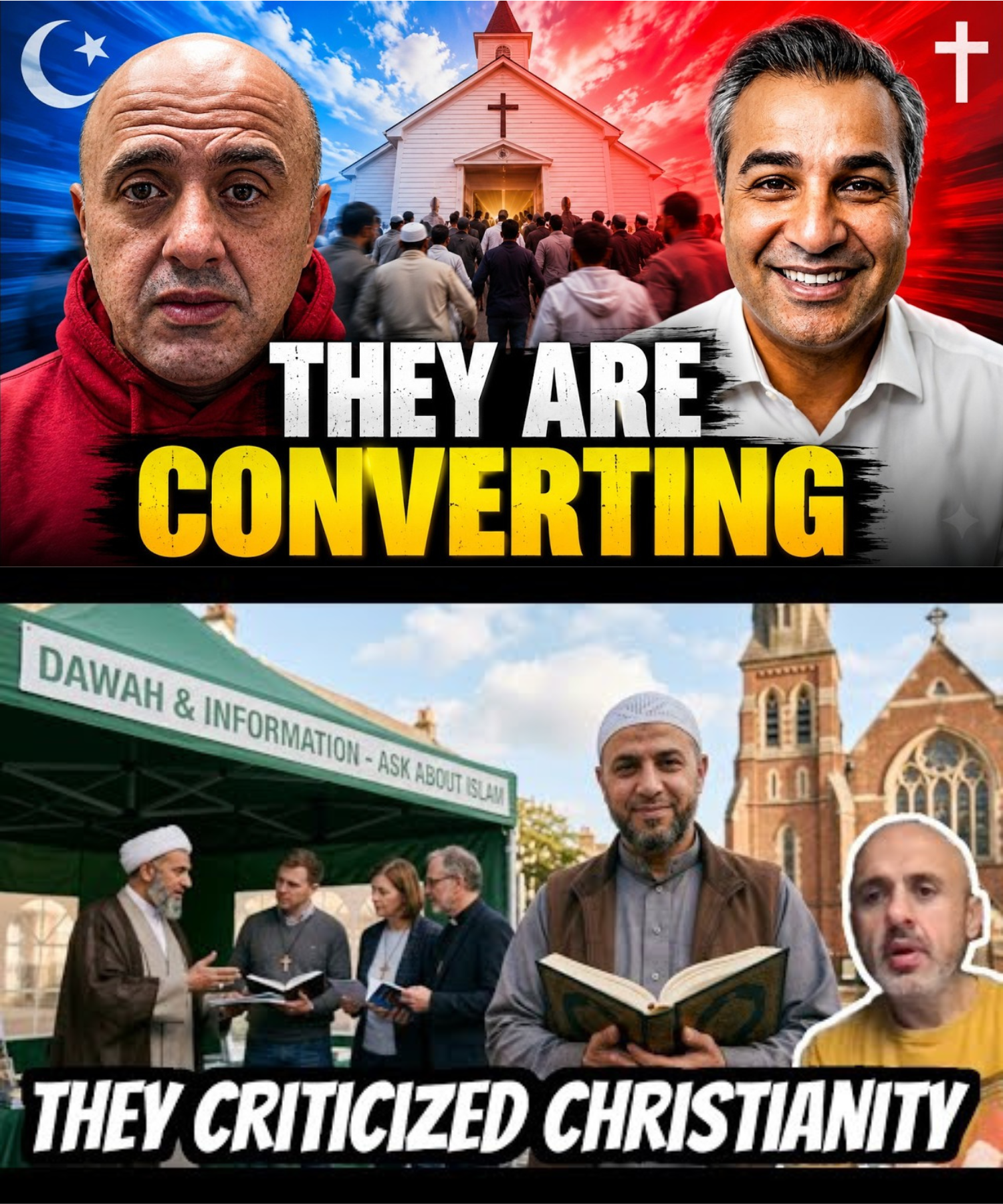
In that moment, he prayed. He repented. He asked Jesus to become the Lord of his life. And when he opened his eyes, he claims the world itself looked different. He describes seeing colors as if for the first time — green, blue, red, life itself. More than that, he says he felt peace, the kind of peace he had spent years trying to manufacture through religious effort but had never possessed.
For American Christians listening, the testimony strikes a nerve because it contrasts two visions of faith: religion as burden, and gospel as rest.
The former Shia Muslim says his crisis did not come before conversion, as it does for many others. His crisis came after. Once he believed Jesus was real, his mind began racing. What about his family? What about the Iranians around him? Had everyone he loved been deceived? Could he trust what had happened to him? Was this experience emotional, supernatural, psychological, or true?
That tension pushed him into a search.
He wanted to know if the Jesus he had encountered was truly the Jesus of history and Scripture. But in Iran, he says, getting access to the Bible was not simple. He describes the Bible as unavailable in ordinary public life, not something a person could simply buy without danger or difficulty. Two weeks after his conversion, he went to church for the first time.
Even walking into a church felt strange.
He had been taught that Christians were spiritually unclean. He entered with discomfort, suspicion, and fear. But the moment he walked into the sanctuary, he says he was overwhelmed by what he describes as the presence of God. He felt surrounded, embraced, and internally heard the words: “You’re home.”
That moment changed the meaning of church for him.
The worship service shocked him. Christians clapped. They sang. They celebrated. From his Shia background, worship had often been connected to mourning, death, sadness, and self-humiliation. Joyful worship seemed almost impossible to understand. But then he realized the reason: Christians were not worshiping a dead prophet or visiting a tomb. They were celebrating a resurrected Savior.
That idea became central.
Jesus had died, but He had not remained dead. And if Jesus had risen, then hope was not a theory. It was alive.
After the service, a friend gave him a New Testament in Farsi and told him it was the living Word of God, written for him. The phrase sounded strange at first. He thought Christians were exaggerating. But when he began reading, he felt as if the text knew him.
Matthew 11 hit him with force: “Come to me, all who labor and are heavy laden, and I will give you rest.”
He says that verse felt impossible. How did the book know he was weary? How did it know the burden he carried? How did it know that his soul needed rest?
Then Mark 5 struck even deeper. The story of the demon-possessed man living among the tombs, cutting himself, crying out, and then being freed by Jesus felt, to him, like his own life written on the page. He connected it to his past experiences of fear, self-punishment, and spiritual bondage. In his testimony, he says Jesus set him free not only from fear, but from a life built on trying to earn what Christ had already given.
He read the Gospels repeatedly.
Matthew, Mark, Luke, and John became more than religious literature. He says they felt like fire in his hands, like a living voice exposing his need and offering freedom.
The testimony then moves beyond one man’s conversion and into a broader claim about what is happening among Iranians and Afghans. He says he now works with Persian-speaking communities, including Iranians and Afghans, and has witnessed stories of dreams, visions, Bible distribution, and underground house churches. One story involved an Iranian woman who said she had dreamed of a man in white offering her bread. The next day, Christians gave her a New Testament and showed her the passage where Jesus calls Himself the bread of life.
She accepted the message immediately, according to his account.
To many American believers, these stories sound like the Book of Acts unfolding in modern form — dangerous, hidden, personal, and supernatural. To skeptics, they may sound impossible to verify. But even skeptics cannot miss the emotional intensity of the testimony. It is a story about fear meeting peace, striving meeting grace, and a man discovering a faith he says did not merely change his beliefs, but changed his entire inner world.
The speaker also issued a warning to Christians: know your faith.
He argued that former Muslims exploring Christianity need more than emotional stories. They need Scripture, doctrine, the Trinity, the historical Jesus, and the true gospel. Without that grounding, he warned, some converts can be pulled into confusion or teachings that distort core Christian belief.
That may be the most important takeaway for American churches.
If these testimonies are real, then people coming out of closed or high-pressure religious worlds do not need shallow slogans. They need discipleship, courage, community, Scripture, and patient love. They need believers who can explain what Christians mean when they say Jesus is the Son of God, why the crucifixion matters, why the resurrection matters, and why grace is not weakness but freedom.
For the former Shia Muslim, the message is simple.
He says he spent years trying to reach God through effort, fear, and pain.
Then he heard that Jesus had already come for him.
And that, he says, changed everything.