Douglas Murray Niqab Debate Goes Viral as Free Speech, Religion, and Integration Clash Explode Across the West
Douglas Murray Niqab Debate Goes Viral as Free Speech, Religion, and Integration Clash Explode Across the West
New York — A heated public debate involving British author and political commentator Douglas Murray has gone viral across social media after his remarks on the niqab and cultural integration reignited one of the most sensitive issues in Western politics: how liberal societies should respond when religious expression conflicts with public visibility norms.
The discussion, originally recorded at a public forum in East London, quickly escalated into a broader clash over identity, religious freedom, social cohesion, and the limits of multiculturalism in modern Europe and North America.
At the center of the controversy is Murray’s argument that face coverings such as the niqab are “highly undesirable” in public life, and should be discouraged — or banned — in certain public settings such as courts, schools, and government institutions.
The statement immediately sparked backlash and support in equal measure.
“We Live in a Society Where People Show Their Faces”
Murray’s core argument is rooted in what he describes as a basic requirement of liberal society: face-to-face interaction.
He argues that in Western societies, much of social life depends on visible facial expression — in communication, trust-building, identity recognition, and legal accountability. In his view, full-face coverings create practical and cultural barriers to interaction, particularly in civic spaces such as courts and public institutions.
While acknowledging that enforcement of a full public ban would be difficult, Murray argues that restriction in institutional settings is both “practical and desirable,” especially where identification is necessary.
His comments reflect a growing debate across Europe, where several countries — including France and Belgium — have already implemented partial or full restrictions on face coverings in public spaces.
However, critics argue that such policies disproportionately affect Muslim women and risk framing religious expression as a security problem.
Muslim Participant Pushes Back on “Fear Narrative”
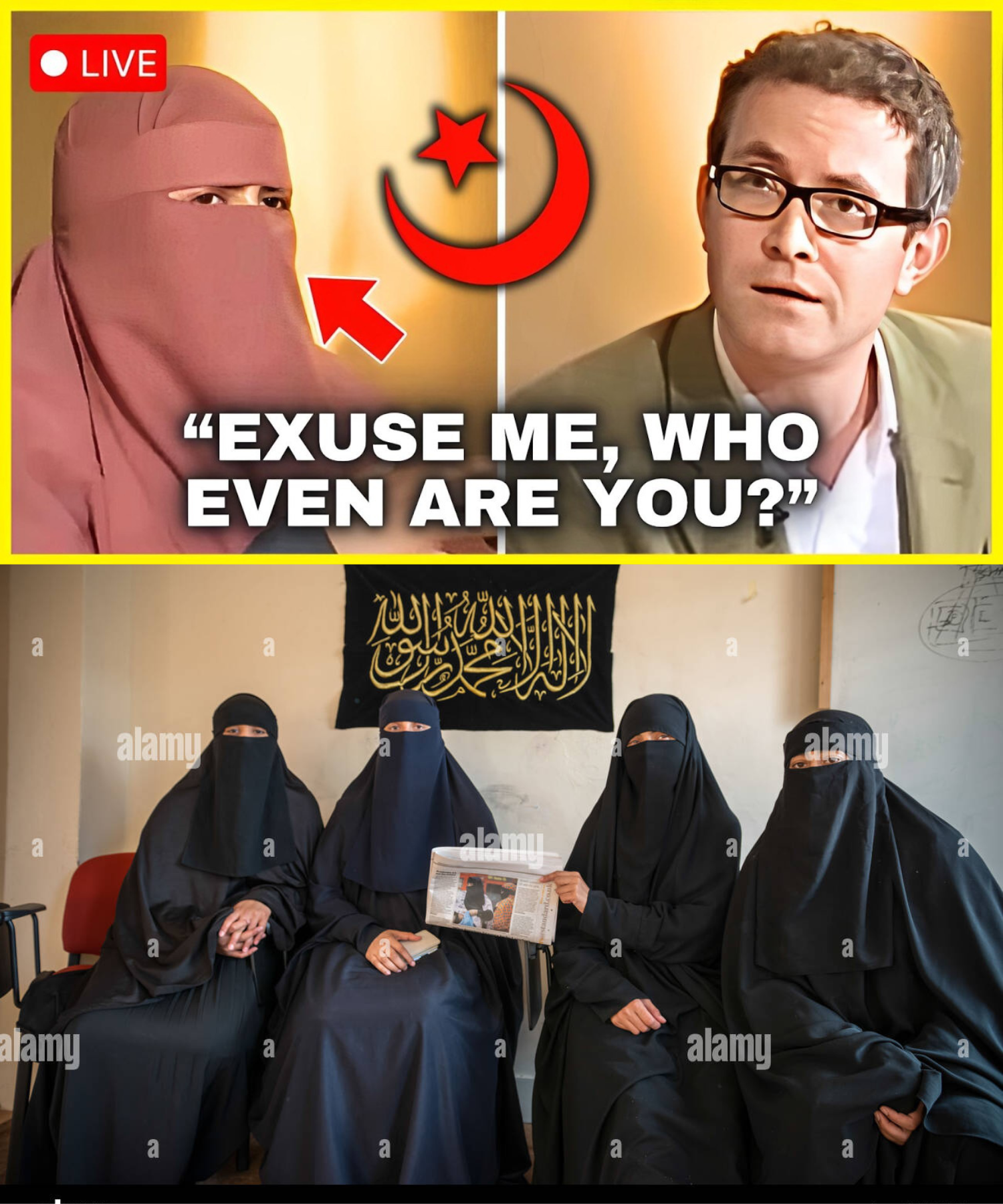
In the exchange, a Muslim woman identified as Fatima challenges Murray’s framing, arguing that public perception of the niqab is shaped more by unfamiliarity than genuine harm.
She points to East London as an example of a multicultural environment where face veils have become increasingly common and, in her view, socially integrated.
She argues that people who regularly interact with women wearing face coverings rarely express discomfort, suggesting that opposition is often driven by lack of exposure rather than real-world conflict.
Her position reflects a broader argument often made by civil rights advocates: that visibility of minority religious practices is part of multicultural coexistence, not a threat to it.
The Question of “Majority Discomfort”
The debate intensifies when polling data is introduced, suggesting that a majority of British respondents feel uneasy about full-face veils in public spaces and struggle with how to interact with veiled women.
Murray responds by arguing that public policy cannot ignore widespread social discomfort, particularly if it affects communication, identification, or institutional function.
The Muslim participant counters that discomfort itself should not determine rights, arguing that societies evolve through exposure and interaction rather than restriction.
At this stage, the discussion moves beyond the niqab itself and into a deeper philosophical conflict: should liberal societies prioritize individual expression or collective cohesion?
“We Must Show Faces in Public Institutions”
Murray attempts to draw a distinction between private life and public institutions.
He argues that even if individuals choose to wear face coverings in public streets, there should be stricter rules in environments such as courts, schools, and government buildings, where identity verification is essential.
He emphasizes that religious accommodation already exists in Western societies — citing turbans, yarmulkes, and other forms of visible religious expression — but insists that face coverings are fundamentally different because they obscure identity entirely.
This distinction is central to his argument: accommodation should not override functionality.
Tension Over Integration and “Imported Traditions”
The conversation then shifts into more politically sensitive territory when Murray argues that Europe is experiencing cultural friction due to the rapid arrival of communities with different traditions and expectations around public life.
He warns that societies must decide which cultural norms they are willing to adapt and which they are not.
His critics interpret this as a veiled critique of Muslim immigration. His supporters say it is a necessary discussion about integration and shared civic identity.
The Muslim participant pushes back, arguing that such framing risks treating entire communities as incompatible with Western society, rather than focusing on individual behavior and legal frameworks.
Free Speech and Cultural Limits
One of the most heated moments in the debate comes when Murray emphasizes free speech as a non-negotiable Western value.
He warns that societies that fail to protect free expression risk undermining their own democratic foundations. He references violent attacks on journalists in Europe as evidence that speech-related tensions can escalate into real-world consequences.
His point is that integration debates are not abstract cultural discussions — they are tied to real security concerns.
Critics argue that linking immigration with threats to free speech risks stigmatizing entire populations and oversimplifying complex social dynamics.
“Muslim Exceptionalism” and Equality Before Law
Murray further argues that laws must apply equally to all citizens without creating “religious exceptions” that undermine shared civic standards.
He describes what he calls “Muslim exceptionalism” — the idea that certain cultural or religious practices are treated differently under law — as a growing concern in Western governance.
His position is that equality before law requires consistency in public rules, particularly regarding identification and institutional access.
Opponents argue that equal treatment does not always mean identical treatment, especially when accommodating religious practices is part of pluralistic democracy.
A Debate That Mirrors a Larger Western Crisis
The viral exchange has resonated strongly in the United States, where similar debates over religious expression, immigration, and cultural identity are increasingly visible in politics, education, and public policy.
From campus speech controversies to debates over public prayer, face coverings, and immigration integration, the issues raised in the UK discussion reflect broader tensions across Western democracies.
At its core, the debate is not only about the niqab.
It is about whether liberal societies can maintain shared public norms while accommodating deep cultural diversity.
No Clear Resolution
By the end of the exchange, neither side fully concedes.
Murray maintains that restrictions on face coverings in certain public settings are necessary for social cohesion and institutional function. His opponent argues that such restrictions risk marginalizing Muslim women and misunderstanding the nature of religious expression.
What remains clear is that the issue is far from settled — in Britain, in Europe, and increasingly in the United States.
The question now facing Western societies is not whether diversity exists.
It is whether shared civic rules can survive it.