Campus Debate Between Christian Apologist and Muslim Students Erupts Into Viral Clash Over Forgiveness, the Quran, and the Truth About God
Campus Debate Between Christian Apologist and Muslim Students Erupts Into Viral Clash Over Forgiveness, the Quran, and the Truth About God
A tense exchange on an American university campus has exploded online after a Christian apologist and two Muslim students clashed over one of the most profound questions in religion: how can God forgive human sin and still remain perfectly just?
The debate began calmly, almost academically. A Muslim student stood before longtime Christian campus speaker Cliff and asked a direct moral question about Christianity’s central claim — that Jesus Christ died for the sins of humanity. To the student, the idea sounded deeply unfair. Why should an innocent person die for someone else’s wrongdoing? Why could God not simply forgive directly through mercy?
It was the kind of question that has fueled centuries of Christian-Muslim theological disagreement. But on this campus, in front of students, cameras, and passersby, the issue quickly became more than theology. It became a confrontation over justice, scripture, language, history, and whether sincere disagreement can still survive in America’s increasingly tense public square.
Cliff answered by laying out the Christian doctrine of atonement. In his explanation, sin is not a minor mistake that God can simply ignore. When a person lies, cheats, steals, abuses, or devalues another human being, that act is not only against the victim — it is also an offense against the God who created that person. If God is just, Cliff argued, then evil cannot simply be waved away as if it does not matter.
The Muslim student pushed back immediately. If God demands death as payment, he asked, does that make God bloodthirsty? If divine mercy is real, why must there be a death penalty at all?
Cliff did not soften his answer. According to him, Christianity teaches that God’s forgiveness is not cheap. Either human beings pay the debt of sin themselves, or God, in the person of Christ, steps into history and pays it on their behalf. In Christian belief, that is what happened on the cross: justice was not ignored, but fulfilled, and mercy was offered freely.
The student countered with the Islamic view. In his explanation, God can forgive because God knows the heart. If a person repents sincerely, God sees the sincerity and may forgive. No mediator, no crucifixion, and no divine death are required. God’s mercy, he said, is enough.
That difference became the central fault line of the debate.
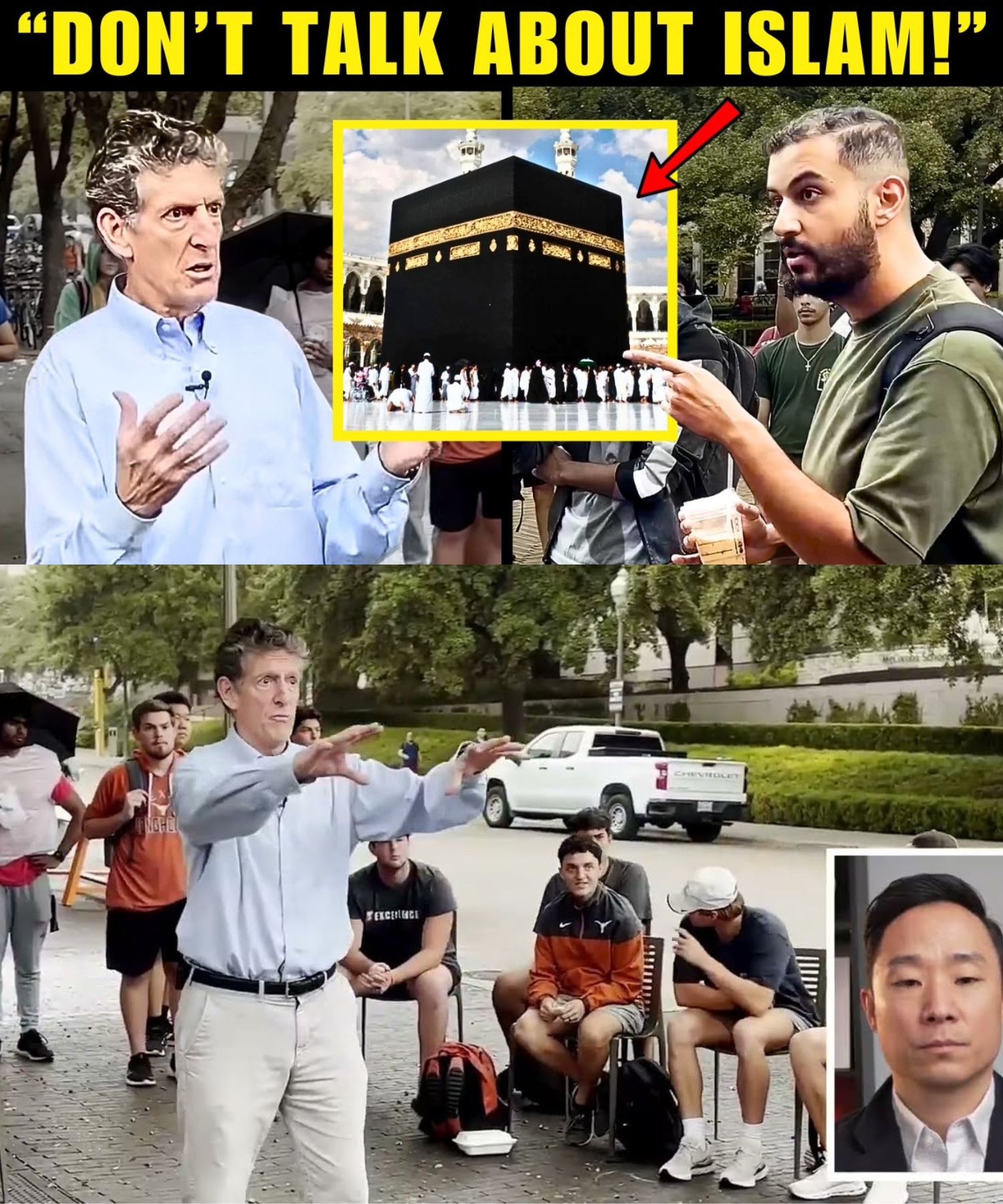
To Cliff, forgiveness without justice risks becoming moral corruption. He compared it to a human judge releasing a murderer simply because the criminal said he was sorry. To the Muslim student, the Christian answer made God dependent on blood payment, which he found morally troubling. Both sides were speaking about mercy, but they were working from completely different definitions of justice.
Then the conversation shifted sharply toward scripture.
The Muslim student argued that he trusted the Quran because, in his view, it had been preserved in one authentic form, unlike the Bible, which exists in many translations and manuscript traditions. Cliff responded by challenging that claim, raising the historical issue of Caliph Uthman’s standardization of the Quran and the reported destruction of variant written materials that did not match the official recension.
That moment changed the tone.
The student demanded proof. Cliff told him not to take his word for it and urged him to study the history himself. The debate became more intense, but it remained controlled. Cliff’s point was that the Muslim argument about the Quran’s single preserved form is more complicated than many casual believers realize. The student’s response was that historical claims require real evidence and cannot simply be asserted in public debate.
For American viewers watching the clip online, this section struck a nerve because it mirrored a larger cultural pattern. On campuses across the United States, religious debates often begin with questions of faith but quickly move into questions of evidence, authority, and who gets to define truth.
The next flashpoint came over language.
Cliff argued that Islam’s central miracle is the Quran, and to fully understand that miracle in its pure form, one must understand Arabic. The student responded that Arabic preserves the meaning and protects the revelation from distortion. But Cliff pressed the point further. If God’s clearest revelation can only be fully accessed in one language, he asked, what does that mean for the billions of people who do not speak Arabic?
He contrasted that with Christianity, arguing that Christianity’s central miracle is not a book but a person — Jesus Christ. Because of that, he said, Christianity is not bound to one language or one nation. The message of Jesus, in his view, crossed cultures, continents, and languages, moving from Jerusalem into Africa, Europe, Asia, the Americas, and beyond.
That claim triggered the most heated moment of the exchange.
A second Muslim student stepped in and accused Cliff of misrepresenting Islam. He insisted that Islam is not only for Arabs, not limited to one nation, and not restricted to one people. He said Muslims come from every background and speak countless languages. To him, Cliff’s argument sounded like a distortion — or worse, a deliberate attempt to make Islam appear culturally narrow.
Cliff pushed back, saying he had not claimed Islam was only for Arabs. He clarified that his argument was about Islam’s relationship to Arabic as the authoritative language of revelation, not about the ethnic diversity of Muslims. But by then, the tone had changed. The second student accused him of gaslighting and spreading misinformation. Cliff’s supporters nearby defended him, saying the student was interrupting and misunderstanding the argument.
For a few minutes, the debate became less about theology and more about communication itself. One side said the argument was being misheard. The other side said the argument was being disguised.
That is what made the clip so compelling online.
It was not a screaming match. It was something more revealing: a public collision between two religious worldviews, each convinced the other was missing the central truth.
The discussion eventually turned to tolerance and conversion. One Muslim student said he did not want to force anyone into religion and did not care about converting others. Cliff responded that disagreement itself is not disrespectful. In a university environment, he argued, people should be able to exchange ideas, contradict each other, and still treat each other with dignity.
That may have been the most American part of the entire exchange.
In a country where campus debates increasingly end in outrage, cancellation, or emotional shutdown, this moment showed both the difficulty and the necessity of open conversation. The students were frustrated. Cliff was challenged. Accusations were made. But the conversation did not collapse into violence or silence.
It ended with both sides still unconvinced.
The Muslim student argued that the Quran remains a present miracle because it can still be held, read, and recited. Cliff found that argument unconvincing and returned to his central claim: Christianity rests on Christ, not merely a text. The student accused him again of misinformation. Cliff urged him again to study the history.
No one walked away converted. No one admitted defeat.
But the video went viral because it captured something larger than a single debate. It showed America’s campuses becoming battlegrounds not only for politics, but for ultimate questions: What is justice? What is mercy? Can God forgive without cost? Is scripture preserved by language, manuscript evidence, or living faith? And can people who disagree deeply still speak honestly face to face?
In the end, the confrontation did not settle the argument between Christianity and Islam.
It revealed why the argument still matters.
Because beneath the words, beneath the accusations, beneath the tension, both sides were fighting over the same question every human being eventually faces:
If God is real, how can sinners be forgiven?