Viral Free Speech Debate Explodes Over Gaza, Colonialism, and Western “Narrative Control”
Viral Free Speech Debate Explodes Over Gaza, Colonialism, and Western “Narrative Control”
New York — A heated public debate on free speech, colonial history, and the Israel–Gaza war has gone viral across social media, igniting a global firestorm over how truth is defined, who controls “the Western narrative,” and whether Western democracies truly offer the freest speech in the world.
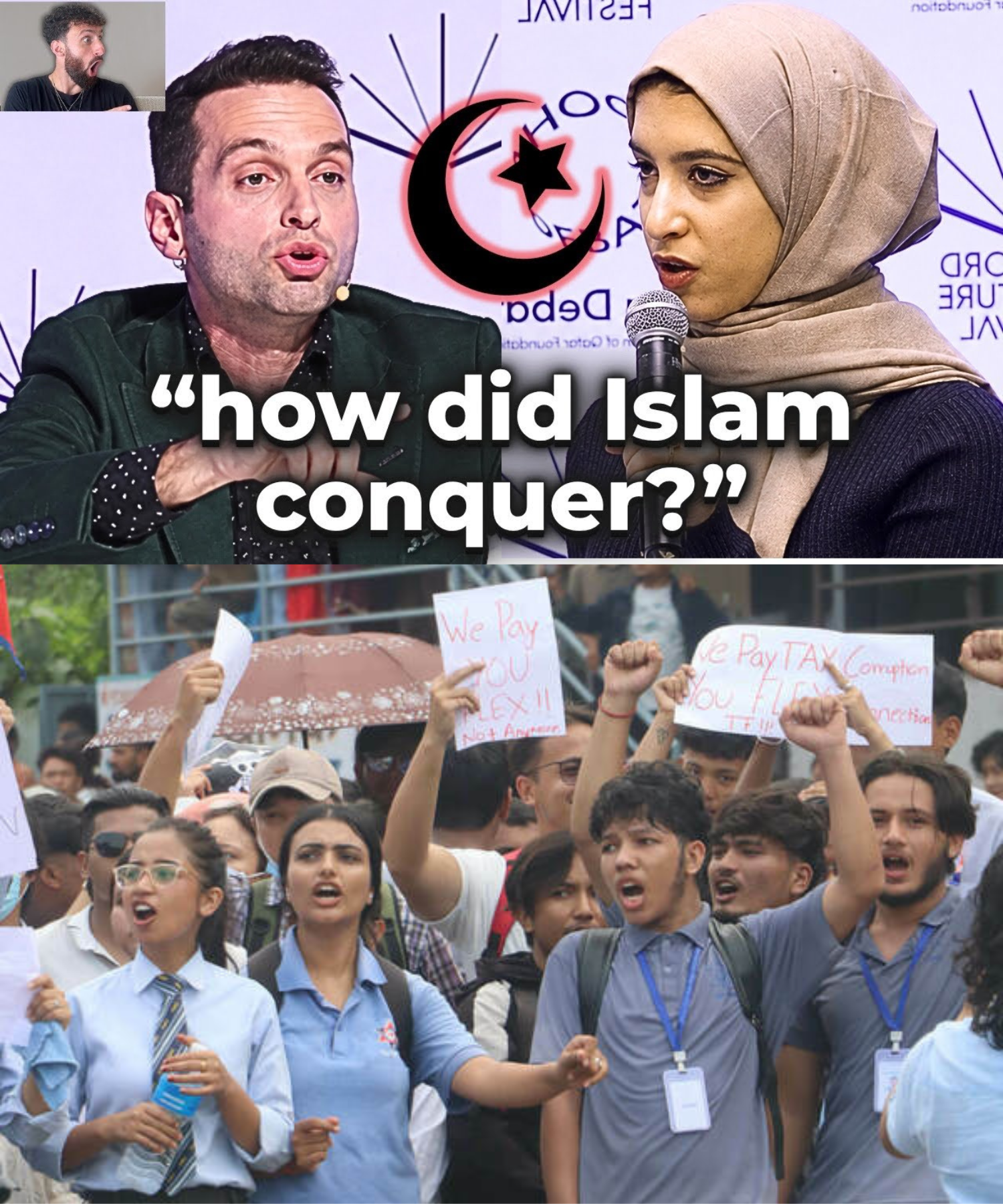
The footage, widely circulated across platforms in the United States, the United Kingdom, and the Middle East, shows a tense exchange between a pro-Western free speech advocate and a Muslim guest discussing Gaza, colonialism, historical conquest, and whether Western societies genuinely allow unrestricted expression.
The conversation quickly escalates into one of the most emotionally charged online debates of recent months, touching on genocide allegations, slavery history, imperialism, and the limits of ideological tolerance in modern democracies.
“What Is the Western Narrative?” — The Debate Begins
The discussion opens with a fundamental disagreement over whether a “Western narrative” even exists.
The guest argues that the concept is vague and inconsistently defined, suggesting that claims about a unified Western ideological framework are often used rhetorically rather than descriptively.
The host responds by framing the West as the global benchmark for free speech, arguing that Western democracies — particularly the United States and the United Kingdom — allow citizens to criticize governments, religions, and institutions more freely than most other regions in the world.
He asks a direct question: where else in the world can people speak more freely than in the West?
The guest challenges the framing, arguing that speech restrictions exist in multiple contexts and that freedom of expression varies even within Western societies depending on political and cultural sensitivity.
This disagreement sets the tone for a broader clash over values, history, and global power structures.
Gaza War and Genocide Accusations Spark Immediate Tension
The most explosive moment in the exchange comes when the conversation turns to the Israel–Gaza war.
The guest refers to the conflict as a “genocide,” arguing that the scale of civilian casualties and destruction supports that characterization.
The host rejects the term, describing the situation instead as an “intense military operation” in which all sides ultimately suffer, and warns against simplifying a complex conflict into a single moral label.
The exchange highlights a central global divide in public discourse: whether the Gaza war should be understood through the lens of international law and human rights advocacy, or through military strategy and geopolitical conflict analysis.
Experts note that “genocide” is a legally defined term under international law, requiring proof of intent, and its application to ongoing conflicts remains highly contested among scholars, governments, and advocacy groups.
Free Speech vs. Propaganda Restrictions
A key theme in the debate is whether governments have the right to restrict what is considered propaganda.
The host argues that no country is obligated to allow “enemy propaganda” to circulate freely within its borders, comparing modern restrictions to historical wartime measures such as those during the Cold War.
He suggests that even societies committed to free speech may impose limits when national security is at stake.
The guest pushes back, arguing that labeling speech as propaganda can be subjective and historically abused, citing examples such as apartheid-era South Africa and segregation-era United States, where dissenting voices were often silenced under state authority.
This disagreement reflects a longstanding philosophical tension: whether freedom of speech is absolute or conditional.
Colonialism, Slavery, and Historical Interpretation
The debate then shifts into colonial history and slavery, where the host presents a strongly revisionist framing of Western historical responsibility.
He argues that slavery was a universal institution practiced across civilizations, including African kingdoms, the Ottoman Empire, Native American societies, and European powers.
He further claims that the British Empire played a decisive role in ending global slavery, citing naval enforcement efforts and anti-slavery campaigns across multiple continents.
The guest challenges this framing, questioning whether colonial conquest can be separated from exploitation, and whether imperial expansion can be justified in retrospect as a force for good.
Historians note that while Britain did lead major abolitionist efforts in the 19th century, it also benefited economically from earlier participation in the transatlantic slave trade, making the historical record complex and deeply debated.
“Every Civilization Was Built Through Conquest”
The host broadens the argument, stating that nearly all major civilizations — including Russia, Islamic caliphates, and Western empires — expanded through conquest and military dominance.
He argues that colonialism is not unique to the West and that historical critique often ignores similar patterns in non-Western empires.
The guest responds by questioning whether this historical framing justifies or excuses colonial violence, suggesting that acknowledging universal conquest does not eliminate moral responsibility for specific historical outcomes.
This exchange reflects a broader academic debate over whether historical comparison dilutes accountability or provides necessary context.
Free Speech Comparison: West vs Other Regions
The conversation then returns to the question of whether the West truly offers the strongest model of free speech.
The host argues that Western societies, despite imperfections, remain the most open systems for criticism of government and religion.
He contrasts this with countries such as Russia and China, where speech about the state is heavily restricted and often punished.
The guest argues that even in the West, speech is increasingly constrained by laws such as online safety regulations and social pressure, suggesting that freedom of expression is not absolute anywhere.
Experts say both perspectives reflect partial truths: Western democracies generally provide broader legal protections for speech, but also maintain evolving restrictions related to hate speech, misinformation, and national security.
Civilizational Competition Narrative Emerges
As the debate intensifies, the host frames global history as a competition between civilizations, including Western Christian, Islamic, Chinese, and Indian civilizations.
He argues that the West’s success is rooted in values such as individual liberty, free markets, and government by consent.
The guest challenges whether those values alone explain global inequality or whether geography, resources, and historical contingency also play significant roles.
This exchange reflects a broader intellectual divide over whether Western dominance is primarily ideological or structural.
Social Media Reaction: Deep Polarization
The viral spread of the debate has generated sharply divided reactions across social media platforms.
Supporters of the host argue that he effectively exposes inconsistencies in anti-Western narratives and defends free speech as a uniquely Western achievement.
Critics argue that the framing minimizes Western colonial history and oversimplifies non-Western political systems, while also using emotionally charged comparisons that escalate rather than clarify debate.
Experts Warn of “Narrative Warfare”
Media analysts and political scientists warn that online debates like this increasingly function as “narrative warfare,” where competing ideological frameworks replace factual consensus.
They note that complex topics such as genocide allegations, colonial history, and free speech law are often reduced to binary positions in viral content, making constructive dialogue more difficult.
No Resolution in Sight
As the video continues to circulate, no consensus has emerged.
Instead, the debate has become part of a broader global struggle over how history is interpreted, how freedom of speech is defined, and who has authority to shape public narratives about war, empire, and identity.
For some, the exchange represents a necessary confrontation with uncomfortable historical and political truths.
For others, it reflects an increasingly polarized media environment where complex issues are compressed into confrontational soundbites.
What remains clear is that the questions raised — about Gaza, colonialism, and free speech — are far from resolved, and continue to shape global discourse across borders.