MIT Professor Explains What Changed Her Mind On JESUS
MIT Professor Explains What Changed Her Mind On JESUS
CAMBRIDGE, Mass. — For years, Rosalind Picard approached the world with the cool, calculated precision you would expect from an MIT professor. As an engineer, inventor, and pioneer in the field of artificial intelligence, her universe was built entirely on what could be coded, calculated, and mathematically proven. To her, the physical world was the ultimate boundary of reality, and anything outside of it was a placeholder for things science simply hadn’t measured yet.
As for religion? She dismissed it as a psychological crutch for people who lacked a rigorous understanding of the universe.
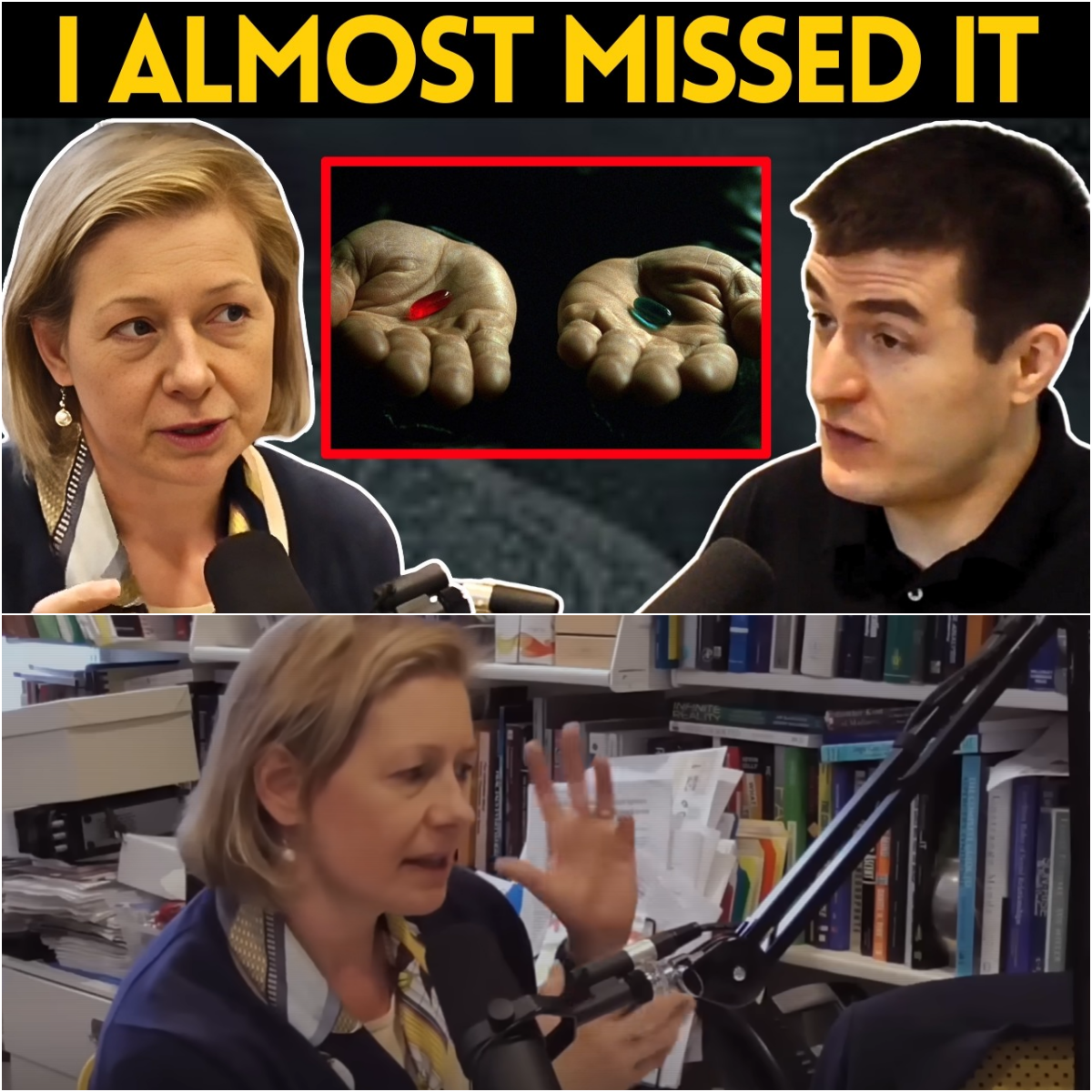
Yet today, Picard stands as one of MIT’s most prominent faculty members who openly identifies as a Christian. Her transition from a staunch atheist to a dedicated believer in the historical Jesus did not happen through a sudden, blinding revelation. Instead, it unfolded as a methodical, intellectually challenging journey—one that forced her to confront the limitations of her own scientific discipline and rethink the very nature of truth.
The Blind Spots of Scientism
Picard’s shift began with a philosophical realization that many modern intellectuals struggle to face: the acknowledgment that science, for all its immense power, is fundamentally myopic.
In intellectual circles, there is a dominant, often unspoken ideology known as scientism—the belief that the scientific method is the only valid path to authentic knowledge. For the first part of her life, Picard was a devout practitioner of this worldview. She assumed that if something couldn’t be quantified or replicated in a laboratory, it simply didn’t exist.
Eventually, she recognized the inherent logical flaw in that premise. Restricting reality to what can currently be measured is a useful constraint for a laboratory experiment, but it is a deeply flawed way to live a human life.
Consider how we process history. No one can recreate the Holocaust or the signing of the Magna Carta in a pristine lab setting to prove they happened. We don’t prove historical events through reproducible experiments; we verify them through a different framework of knowledge—namely, eyewitness testimony, historical evidence, and the observable impact those events left on human civilization.
The same limitation applies to the most profound aspects of the human experience, such as love or grief. A scientist can track the oxytocin levels in a person’s brain or map their neurological activity on an fMRI machine, but those metrics will never fully capture or explain the lived reality of loving someone.
When we limit our pursuit of truth strictly to things we can measure and reason about mechanically, we don’t eliminate the unmeasurable—we merely make ourselves blind to it. The total sum of human scientific knowledge, when measured against the infinite mystery of the cosmos, is practically a set of measure zero. To claim that science can uncover all truth isn’t just bad philosophy; it is its own dogmatic form of faith.
Crossing the Threshold of the Bible
Acknowedging that science couldn’t explain everything was the first step, but it left a vacuum. For Picard, that void began to fill when her peers—people whose intelligence she deeply respected—challenged her to read the best-selling book in human history: the Bible.
Initially, she resisted. She expected to find an outdated collection of fairy tales and easily debunked myths. Instead, she encountered something entirely different. Reading books like Proverbs, she found herself struck by a profound, pragmatic depth of wisdom that defied her expectations.
It was an experience she likens to music. When a master musician plucks the strings of a perfectly tuned instrument, something inside the listener resonates. It is an aesthetic and intuitive recognition of truth that exists entirely apart from a mathematical equation or a computer program.
This resonance drove her to explore further. If the Judeo-Christian texts held this unexpected depth, what about the rest of the world’s major religions?
Determined to maintain her intellectual integrity, Picard launched into a rigorous study of world faiths. She visited mosques, attended services at temples, and embedded herself in communities of different beliefs. She was determined to follow the data wherever it led.
What she discovered shattered her old stereotypes. The religious people she met weren’t uneducated or looking for an emotional crutch. Many were brilliant thinkers who challenged her to look at historical data with an open mind.
As she focused her attention on the New Testament accounts, Picard found herself cornered by the sheer weight of the historical evidence surrounding the life, death, and reported resurrection of Jesus of Nazareth. Step by step, her worldview began to shift along a distinct spectrum: from an aggressive atheist, to a cautious agnostic, to a general theist, and finally, to someone who concluded that the historical claims written about Jesus were actually true.
The “Red Pill” of Practical Faith
Admitting that a historical event occurred is one thing, but allowing it to reshape your daily life is another. Picard quickly learned that Christianity is not a passive philosophy; it requires active engagement.
This turning point mirrors the famous choice presented in the science-fiction film The Matrix. A person can take the blue pill, remain in their comfortable, simulated environment, and look at the world from a safe distance. Or, they can take the red pill and step into a completely new paradigm of reality.
The catch, of course, is that you cannot see the underlying code of reality until after you take the action to step through the door.
Christianity operates on a similar cause-and-effect principle. The scriptures do not offer a set of abstract theories to be analyzed strictly from an armchair; they issue an invitation: “Seek, and you will find; knock, and the door will be opened.” It is a call to take a step of active trust based on the evidence you have, even if you don’t have every single answer mapped out in advance.
For an MIT scientist used to demanding full proof before running a program, this was a massive hurdle. But human relationships operate on the exact same logic. You cannot experience true intimacy or certainty in a marriage or a deep friendship by remaining a detached, skeptical observer. You have to invest time, extend trust, and take a relational risk. Only through that vulnerability and shared experience does the relationship grow deep, stable, and certain.
When Picard finally accepted the Christian faith—which she describes fundamentally as a free gift available to anyone, regardless of their cultural, religious, or atheistic background—the practical impact was immediate.
A New Source of Wisdom
Living out her faith didn’t squash Picard’s passion for her work. If anything, it amplified it.
Many people assume that adopting a religious faith requires a scientist to check their brain at the church door. Picard found the exact opposite to be true. Her belief in a Creator didn’t diminish her awe of the natural world; it intensified it. Every new discovery in her lab became a glimpse into a grander, more intricate design.
Furthermore, she realized that science itself relies on a foundational set of assumptions that it cannot prove. To do science, you must first have faith that truth exists, that the universe is orderly and intelligible, and that the pursuit of meaning is inherently worthwhile. Science can tell us how a cell functions or how an algorithm processes data, but it can never tell us why our lives matter.
Today, Picard openly shares her story because of the profound transformation it brought to her life. Her faith has become her ultimate source of strength, anchoring her with a deep sense of peace, joy, and wisdom that no academic accolade or technological breakthrough could ever replicate.
Her journey stands as a powerful reminder to an increasingly skeptical world: being a rigorous thinker does not mean closing yourself off to the transcendent. Sometimes, the most scientific thing you can do is admit the limitations of your tools, step out in faith, and open your eyes to a larger reality.
What are your thoughts on Picard’s journey from atheism to faith?