Blind Imam Claims “Light That Was Not Physical Sight” Appeared in Khartoum as His Entire 31-Year Faith Framework Collapsed
Blind Imam Claims “Light That Was Not Physical Sight” Appeared in Khartoum as His Entire 31-Year Faith Framework Collapsed
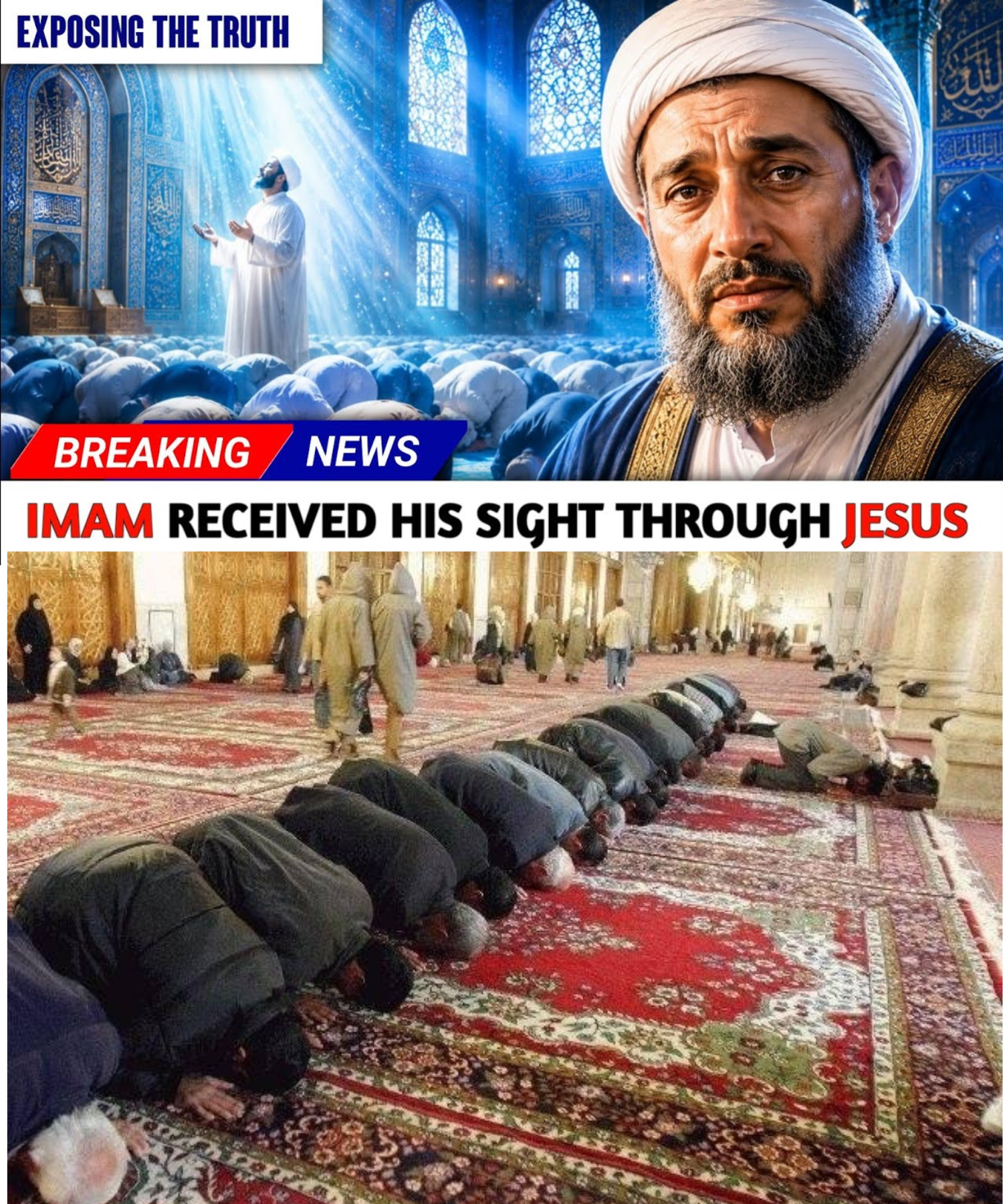
A deeply emotional and controversial first-person testimony from Sudan is drawing global attention after a blind imam described an extraordinary nighttime experience in which he says he “saw without eyes” and encountered a figure he identifies as Jesus — an event he believes permanently transformed his understanding of faith, perception, and divine presence.
The account comes from Yusuf, a 61-year-old former imam from Khartoum who has been blind since the age of 12. For more than three decades, he led a large mosque congregation, memorized the entire Quran, and built a religious life entirely through sound, memory, and spiritual discipline.
But according to his testimony, everything changed during a single night in his room at 4 a.m. — the hour he had long associated with private reflection and unanswered spiritual questions.
A Life Built Entirely Without Sight
Yusuf describes his life as one shaped not by loss, but by adaptation.
After a childhood fever left him permanently blind, his father insisted he memorize the Quran in full. With the help of tutors and years of disciplined repetition, Yusuf eventually became a hafiz and later an imam.
By his 30s, he was leading a mosque in Khartoum, guiding hundreds of worshippers through prayer without ever seeing them. He recognized his congregation not by face, but by voice, footsteps, and memory.
For 31 years, he says, he led prayers five times daily with sincerity and devotion, never questioning his faith in a public sense.
Yet privately, he carried a single unspoken question — whether he would ever “see” the God he served.
The Question No One Knew He Was Asking
Despite his authority as an imam and his deep knowledge of scripture, Yusuf admits to a recurring private thought during the silent hours of the night.
As a blind man, he understood faith through sound, language, and internal conviction — but never physical sight.
This created what he describes as a lifelong tension: a devotion rooted in certainty, yet accompanied by a quiet longing for direct perception.
He emphasizes that this was not doubt about God’s existence, but a desire for experiential clarity — a wish to perceive divine reality beyond abstraction.
This internal question, he says, remained unspoken for decades.
The Night Everything Changed
Yusuf describes the turning point occurring at approximately 4 a.m. in his room in Khartoum.
Unlike previous nights, he reports sensing a presence that was distinct from the usual silence and darkness he had lived with since childhood.
He insists the experience was not related to physical vision, stating that his eyes — damaged since the age of 12 — did not regain sight or function in any way.
Instead, he describes what he calls “light with intention” — a form of awareness not dependent on eyesight.
He claims this presence carried both calmness and clarity, unlike anything he had previously experienced.
“You Are Not Seeing With Eyes”
According to Yusuf’s account, the presence communicated with him directly.
The figure he describes identified itself as Jesus and told him that his blindness had never been the true limitation of his perception.
Instead, the message emphasized a distinction between physical sight and spiritual understanding.
The voice, as he recounts it, stated that many people with functioning eyes still “do not see,” while others without sight perceive deeper truth.
Yusuf says the communication was not auditory in a conventional sense, but perceived internally, as if meaning itself was being transmitted directly into consciousness.
A Theological Challenge Inside His Own Belief System
One of the most striking aspects of Yusuf’s testimony is that it does not come from outside his faith tradition, but from within it.
For 31 years, he taught Islamic theology in a formal mosque setting, emphasizing devotion, discipline, and worship.
According to his account, the experience in Khartoum did not erase his earlier faith but reinterpreted it.
He describes being told that his previous devotion was sincere and meaningful, but incomplete in understanding.
This reinterpretation led him to what he describes as a personal crisis of theological framework — not rejection of spirituality, but redefinition of its center.
The Moment of Recognition
Yusuf states that during the encounter, he came to recognize the figure as Jesus.
He describes this recognition not as reasoning, but as immediate awareness — similar to how a person recognizes a scent or emotion without analysis.
This moment, he says, carried overwhelming emotional weight, leading to tears and a prolonged period of silence.
He characterizes it as the first time he felt fully “seen,” despite being blind.
A Life Reframed by “Inner Sight”
Following the experience, Yusuf says his understanding of blindness changed entirely.
He no longer defines blindness as absence, but as a condition unrelated to true perception.
In his interpretation, the most significant form of sight is not physical vision, but awareness of divine presence.
He claims that this “inner sight” has remained with him continuously since that night, shaping his daily life and sense of identity.
Departure From His Role as Imam
Yusuf reports that after the experience, he eventually stepped away from leading his mosque.
He describes the decision as gradual rather than immediate, driven by an internal shift in conviction that he could no longer continue in his previous interpretive role.
He now leads a much smaller, informal group of individuals who share similar experiences or spiritual interpretations, though he does not provide detailed structure of this community for safety reasons.
He emphasizes that his withdrawal was not due to external pressure alone, but also personal transformation.
A Story That Divides Interpretation
Religious scholars and analysts responding to Yusuf’s testimony remain divided.
Some interpret the experience as a deeply psychological phenomenon shaped by sensory deprivation, long-term memory structures, and intense spiritual practice.
Others view it as a form of mystical encounter consistent with historical accounts of revelation-like experiences across multiple traditions.
Skeptics argue that subjective perception under extreme emotional and environmental conditions cannot be used as evidence of external spiritual reality.
Supporters argue that such experiences are meaningful precisely because they transcend empirical measurement.
The Question of “Seeing Without Eyes”
At the core of Yusuf’s testimony is a paradox that continues to drive debate:
What does it mean to see?
For Yusuf, sight is no longer a physical function but a form of awareness that exists independently of vision.
He claims that the most important realization of his life came not through restored eyesight, but through a different mode of perception entirely.
He describes it as “seeing what cannot be taken away.”
Conclusion: A Testimony Between Experience and Interpretation
Whether viewed as spiritual revelation, psychological transformation, or personal narrative, Yusuf’s account has become part of a wider global conversation about how humans interpret extreme internal experiences.
It raises fundamental questions about faith, perception, and the boundaries of human consciousness.
For Yusuf, the conclusion is simple.
He says he spent 31 years teaching others how to pray.
But in one night, he believes he learned something else entirely:
how to see without eyes.