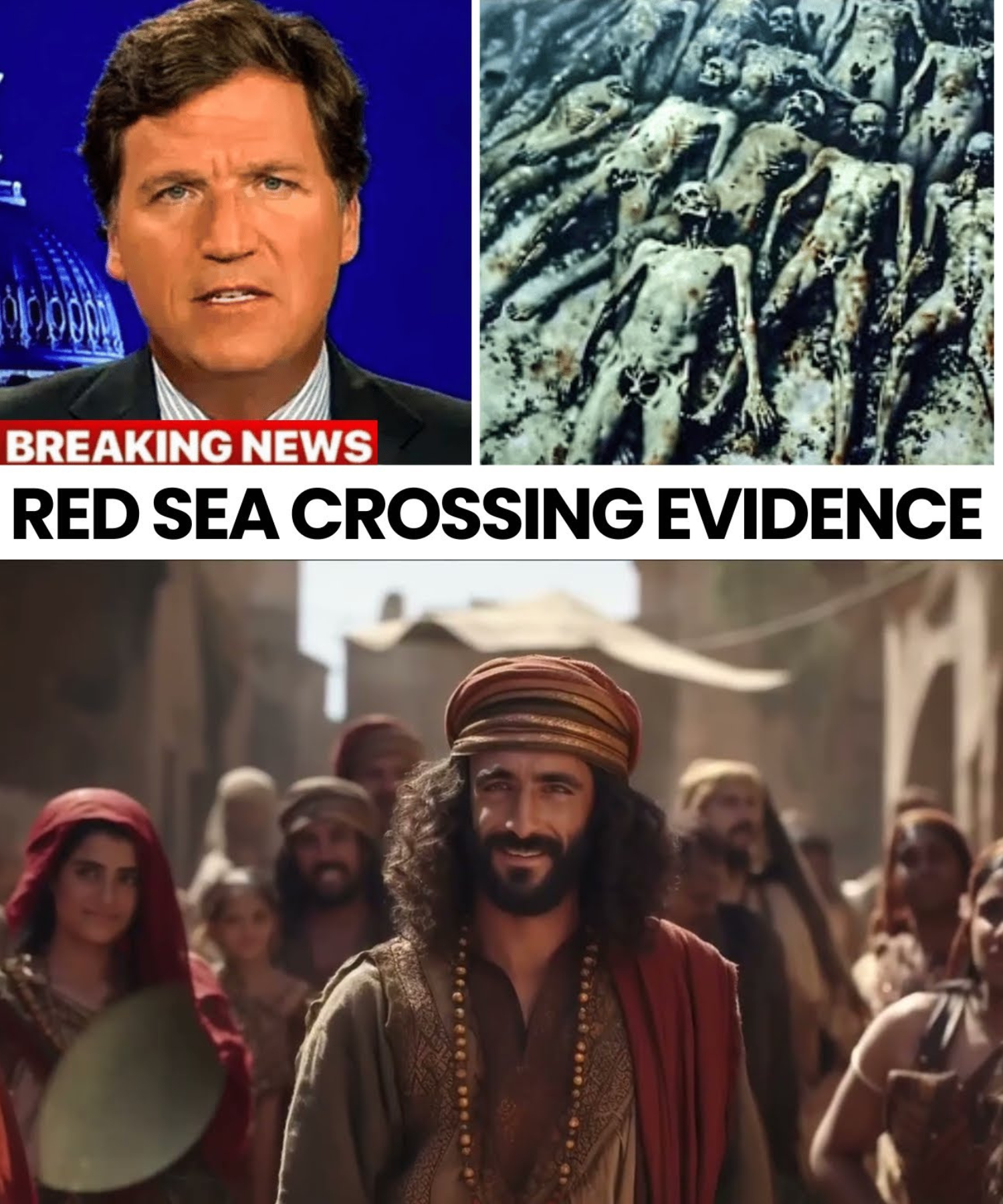
Scientists FINALLY Found Evidence For The Red Sea Crossing
“Ancient Miracle or Misread History?” New Documentary Claims Evidence of Red Sea Crossing Ignites Global Scientific and Religious Debate
A viral documentary-style narration exploring alleged archaeological evidence of the biblical Red Sea crossing has sparked renewed global debate over one of the most iconic stories in religious history — the Exodus of the Israelites from Egypt.
The video, which blends biblical storytelling with archaeological claims, suggests that modern discoveries in Egypt, Saudi Arabia, and the Gulf of Aqaba may provide physical evidence supporting the ancient narrative described in the Book of Exodus.
While supporters argue the findings represent long-awaited confirmation of a historical miracle, critics caution that the evidence remains highly disputed and subject to interpretation.
At the center of the discussion is a centuries-old question:
Did the Red Sea crossing truly happen — or is it a powerful myth shaped by tradition and belief?
The Biblical Narrative Revisited Through Modern Lens
The documentary begins by retelling the Exodus story in cinematic detail, describing the Israelites’ departure from Egypt under Moses after centuries of slavery.
According to the biblical account, the Israelites fled Egypt following a series of devastating plagues, culminating in the death of the firstborn. Pharaoh then allowed them to leave, only to later pursue them with his army.
The Israelites, trapped between the advancing Egyptian forces and the Red Sea, are said to have witnessed a divine intervention in which the waters parted, allowing them to cross safely on dry ground.
The narration emphasizes the emotional and spiritual significance of the event, portraying it as both a historical turning point and a foundational moment in religious identity.
Nuweiba Beach and the Gulf of Aqaba Theory
A major focus of the documentary is the theory that the Red Sea crossing may have occurred at Nuweiba Beach, located on the Gulf of Aqaba rather than the traditionally accepted location in the Sinai Peninsula.
Proponents of this theory argue that the geography of the Gulf of Aqaba — with its deep underwater land bridge and steep surrounding terrain — better matches descriptions of a large-scale crossing event.
The video highlights claims that the Israelites could have traveled through mountain passes before reaching this specific coastal region, where they were allegedly trapped between water and Egyptian forces.
This interpretation remains controversial, as mainstream biblical archaeology continues to debate the exact location of the crossing, with no universally accepted consensus.
The Discovery of “Monumental Pillars”
One of the most striking claims presented in the documentary involves the discovery of red granite pillars allegedly found near Nuweiba in the late 20th century.
According to the narrative, these pillars were partially buried in sand and featured inscriptions interpreted by some as references to biblical figures such as Moses, Pharaoh, and Yahweh.
A matching pillar is also said to have been found across the Gulf in the Arabian Peninsula, suggesting a symbolic connection between both sides of the alleged crossing site.
However, historians and archaeologists note that the authenticity, dating, and interpretation of these inscriptions remain highly contested, with limited peer-reviewed confirmation.
Underwater “Chariot Evidence” Controversy
The documentary further claims that underwater explorations in the Gulf of Aqaba revealed artifacts resembling ancient Egyptian chariot wheels, axles, and structural components.
Some of these objects are described as having six-spoked wheel designs consistent with Egyptian chariot technology from the New Kingdom period.
Supporters argue that these findings support the possibility of a mass military pursuit that ended in catastrophic flooding.
However, skeptics emphasize that underwater environments naturally accumulate geological formations that can resemble human-made objects, and that no widely recognized archaeological authority has confirmed the interpretation as evidence of the Exodus.
Saudi Arabia’s Desert Discoveries and Parallel Claims
Additional claims in the video reference discoveries on the opposite shore of the Gulf in Saudi Arabia, including scattered metal fragments and wheel-like structures.
These are presented as potential remnants of Egyptian chariots carried across the seabed during a catastrophic event.
The narrative suggests that matching findings on both sides of the Gulf strengthen the argument for a historical crossing.
Yet experts caution that without controlled excavation, stratigraphic analysis, and verified dating, such interpretations remain speculative.
Mount Sinai: Egypt or Saudi Arabia?
The documentary expands beyond the Red Sea crossing to address the location of Mount Sinai, where Moses is traditionally believed to have received the Ten Commandments.
While the Sinai Peninsula in Egypt has long been accepted in religious tradition, alternative theories propose that Mount Sinai may actually be located in northwestern Saudi Arabia, in the historical region of Midian.
Proponents of this view point to geographical matches with biblical descriptions of wilderness terrain, as well as potential rock inscriptions and archaeological remains.
Critics argue that these claims rely heavily on reinterpretation rather than direct evidence, and that the traditional Sinai site remains strongly supported by centuries of religious and historical continuity.
Science, Faith, and the Limits of Archaeological Proof
The central tension highlighted in the documentary lies between scientific methodology and religious interpretation.
On one side, proponents of the discoveries argue that archaeology is beginning to uncover tangible traces of biblical events long considered purely theological.
On the other side, academic researchers emphasize that extraordinary historical claims require rigorous verification, including controlled excavation, carbon dating, and peer-reviewed publication.
Most mainstream archaeologists maintain that while the Exodus narrative may reflect historical memory or symbolic storytelling, no conclusive physical evidence currently proves a mass migration event as described in the Bible.
The Enduring Power of the Exodus Story
Beyond the scientific debate, the documentary underscores the cultural and spiritual significance of the Red Sea crossing narrative.
For millions of believers, the story represents divine deliverance, faith under pressure, and the idea of miraculous intervention in human history.
Even among skeptics, the narrative is recognized as one of the most influential foundational myths in Western religious tradition.
The video suggests that ongoing archaeological interest reflects humanity’s desire to connect physical evidence with spiritual belief systems.
Online Reaction: A Sharp Divide
Following its release, the documentary has generated intense reactions across social media platforms, religious forums, and academic discussion spaces.
Supporters describe the evidence as compelling and long-overdue validation of biblical history, arguing that modern science is gradually catching up to ancient records.
Critics counter that the claims rely on selective interpretation and unverified findings presented outside established archaeological consensus.
The debate has quickly become symbolic of a broader cultural divide between faith-based historical interpretation and scientific skepticism.
Conclusion: Between History and Belief
The renewed attention on the Red Sea crossing highlights the complex intersection between archaeology, theology, and narrative tradition.
While new claims of underwater artifacts and desert discoveries continue to circulate, no definitive scientific conclusion has been reached regarding the Exodus story.
For believers, the evidence is seen as affirmation of ancient truth preserved through scripture.
For scholars, it remains an open question requiring further investigation.
Ultimately, the debate reflects not only a search for historical fact — but a deeper human desire to understand where faith ends and history begins.