Viral Jubilee Debate Over Islamists and Christianity Sparks U.S. Firestorm Over Faith, Fear, and Free Speech
Viral Jubilee Debate Over Islamists and Christianity Sparks U.S. Firestorm Over Faith, Fear, and Free Speech
New York — A tense clip from a Jubilee-style debate has ignited a fierce reaction across American social media after a sharp exchange over Islamists, Christianity, conversion, religious freedom, and the meaning of “radicalism” turned into one of the most explosive culture-war conversations of the week.
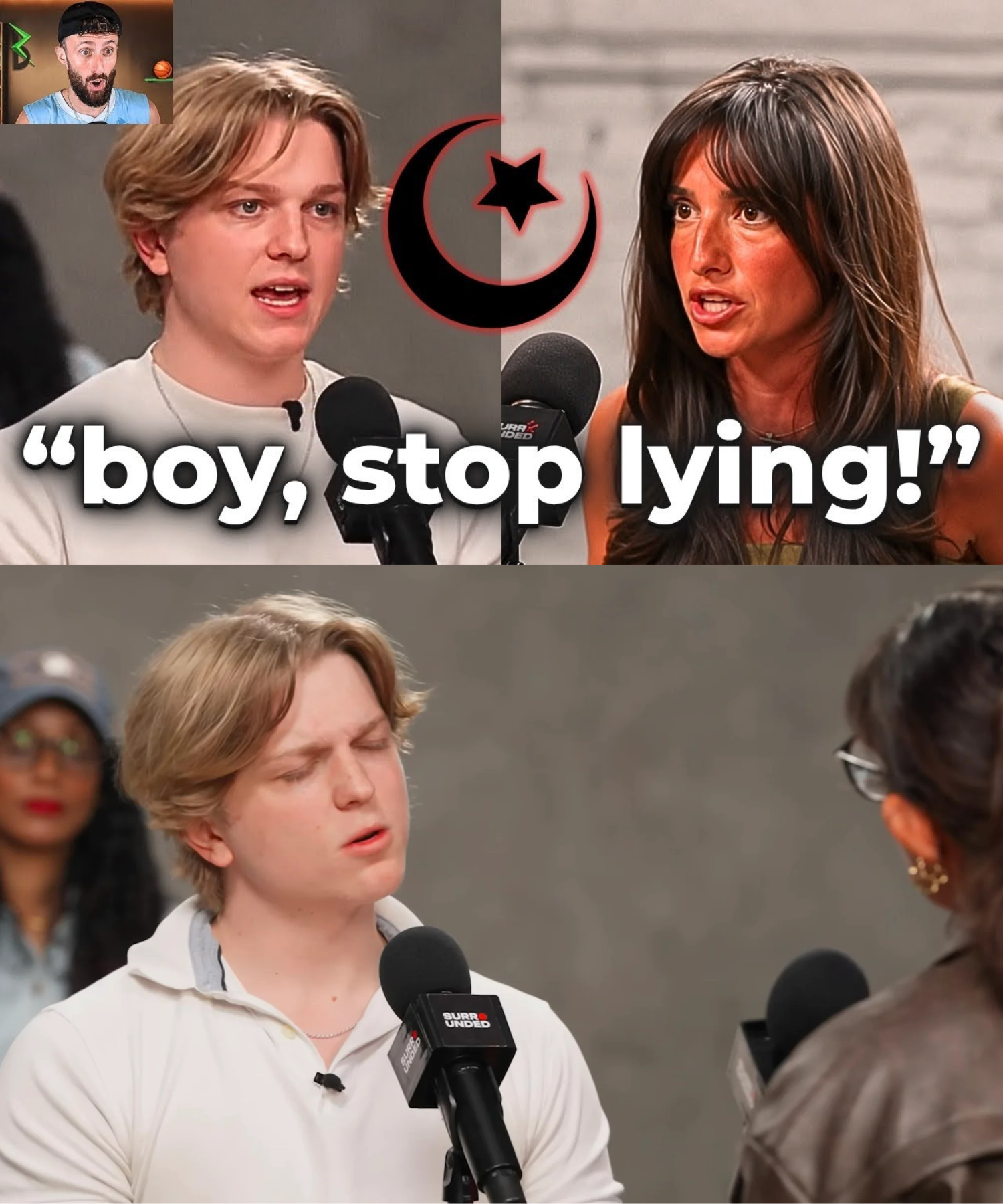
At the center of the viral moment is commentator Liz Benichu, who challenges the idea that critics are labeling Islamists “radical” simply because they pray in public. She argues that the issue is not prayer, visibility, or religious devotion — but the political goal voiced by some Islamist movements: to spread Islamic rule into every country, every society, and ultimately every household.
Her opponents attempt to compare that desire with Christianity, asking whether Christians also want the whole world to accept their faith and go to heaven.
For a moment, the room seems to shift.
If Christians want everyone to be Christian, does that make them extremists too?
Then Benichu asks the question that sends the debate into chaos: do Christians believe people who reject Jesus should be killed?
The answer from the circle is immediate: no.
Her response is the clip’s breaking point.
She argues that the key distinction is not whether a religion wants converts. Most religions do. The distinction is whether rejection of that religion is met with persuasion, debate, prayer, and evangelism — or with coercion, punishment, violence, or state-backed repression.
That is why the clip has gone viral.
It cuts into the exact fear many Americans now feel: that the West is losing the ability to distinguish between personal faith and political domination.
The Difference Between Mission and Coercion
The most important point in the debate is simple but powerful.
A Christian missionary may want every person to accept the gospel. A Muslim believer may want everyone to accept Islam. A Jew, Hindu, Buddhist, atheist, or secular humanist may hope others see the truth as they understand it.
That alone is not extremism.
Persuasion is not violence.
Preaching is not coercion.
The explosive question is what happens when someone says no.
Benichu’s argument, as echoed by supporters online, is that Islamism becomes dangerous when religious belief is fused with political power and when nonbelief is treated not merely as disagreement, but as rebellion against divine authority.
That distinction has become central to the American debate over Islam, Islamism, and religious liberty.
Muslim advocacy groups quickly pushed back, saying the clip risks painting ordinary Muslims with a broad brush. They argue that millions of Muslims in the United States live peacefully, support constitutional democracy, reject terrorism, and believe faith should never be imposed by force.
Still, Benichu’s defenders say that criticism of Islamist ideology is not the same as hatred of Muslims.
“Everybody Wants Converts — Not Everybody Wants Blood”
The clip’s most viral logic is the contrast between religious evangelism and religious punishment.
A speaker in the debate suggests that Christians also want everyone to accept Christianity. But Benichu’s supporters argue that the comparison collapses when violence enters the conversation.
Christians may believe salvation comes through Christ, but in modern Western democracies, mainstream Christian institutions do not call for killing those who reject the gospel.
Critics of Islamism argue that certain jihadist movements, clerics, and militant groups have historically treated apostasy, blasphemy, and refusal to submit as punishable offenses — sometimes violently.
That does not mean all Muslims believe this. It does not mean every mosque teaches this. It does not mean Muslim citizens are guilty by association.
But it does mean the question cannot be dismissed as bigotry.
In America, where religious freedom is protected by the First Amendment, the debate has immediate force. The law protects the right to believe, preach, convert, leave a faith, mock a faith, criticize a faith, and reject a faith.
Any ideology that seeks to punish dissent becomes a direct challenge to that constitutional order.
The Post-9/11 Shadow
The debate exploded online partly because America still carries the memory of 9/11.
For many Americans, public debate about Islam remains haunted by the attacks, the wars that followed, and the long struggle to separate peaceful Muslim citizens from violent Islamist movements.
That distinction was supposed to be settled after 9/11: the enemy was not every Muslim, but radical Islamist ideology.
Yet two decades later, the language remains contested.
Some activists argue that terms like “Islamist” or “radical Islam” are often weaponized to smear Muslims generally. Others argue that refusing to name Islamist ideology leaves the public unable to discuss real threats honestly.
The Jubilee clip reopens that wound.
It asks whether America has become so afraid of sounding intolerant that it struggles to discuss the ideological roots of terrorism, martyrdom culture, or religiously justified violence.
The Gaza, Lebanon, and West Bank References
The commentary surrounding the debate points to places like Gaza, southern Lebanon, and parts of the West Bank, arguing that martyrdom rhetoric and jihadist language are not theoretical.
Supporters of Benichu’s argument say these are regions where violent movements have used religious vocabulary to glorify killing Jews, Christians, or other perceived enemies.
Critics respond that such rhetoric exists in specific militant contexts and should not be generalized to Muslims worldwide.
That pushback matters.
The Muslim world is vast, diverse, and internally divided. A secular Muslim in Brooklyn, a Sufi in West Africa, a liberal Muslim student in California, and a Hamas fighter in Gaza do not represent the same political reality.
But the debate is not about whether Muslims are diverse.
It is about whether Western societies are willing to confront the segments of Islamic political ideology that openly reject liberal democracy.
The Christian Comparison Backfires
The Christian comparison was meant to expose hypocrisy.
Instead, for many viewers, it clarified the issue.
Yes, Christians want converts.
But if someone rejects Christianity in America, they are not legally punished. They can mock the Bible, leave the church, criticize pastors, marry outside the faith, become atheist, or campaign against Christianity.
The same applies to Judaism and other faiths under American law.
The question raised by the video is whether Islamist political movements would allow the same freedom if they controlled the state.
That is the line supporters say the debate exposed.
Not belief.
Power.
A Debate About America’s Future
The clip is spreading because the issue is no longer limited to foreign policy. It is now part of America’s domestic argument over immigration, free speech, campus activism, religious pluralism, and whether liberal tolerance can survive illiberal ideologies.
Conservative commentators see the exchange as a wake-up call.
Progressive critics see it as a dangerous oversimplification.
Muslim Americans see a familiar risk: that legitimate criticism of extremism can quickly become suspicion of their entire community.
All three reactions are real.
That is why the debate is so volatile.
The Challenge for the West
The viral Jubilee clip leaves America with a hard question.
How does a free society defend religious liberty while also defending itself from movements that may not believe in religious liberty at all?
If the answer is silence, the public loses trust.
If the answer is collective blame, innocent people suffer.
The only workable answer is precision: protect Muslims, Jews, Christians, atheists, and all citizens as individuals — while refusing to excuse any ideology that calls for coercion, violence, or the replacement of constitutional freedoms with religious rule.
The debate became famous because it turned one comparison into a moral test.
Wanting people to believe is one thing.
Threatening those who refuse is another.
And in America, that difference is not minor.
It is the foundation of freedom itself.