Campus Erupts as Conservative Speaker Calls “White Privilege” a Lie and Students Fire Back
Campus Erupts as Conservative Speaker Calls “White Privilege” a Lie and Students Fire Back
A fiery campus debate over race, privilege, police, slavery, abortion, and personal responsibility has exploded across American social media after conservative commentator Vince Ellison clashed with students who accused him of dismissing the lived experiences of Black Americans.
The confrontation began with a phrase that has divided the United States for more than a decade: white privilege.
For many progressives, the term describes historical and institutional advantages that white Americans have inherited from past systems of exclusion — housing discrimination, unequal access to banking, segregated schools, and wealth passed down through generations. For Ellison, however, the phrase is not a serious social diagnosis. It is, in his words, a lie.
That declaration set the room on fire.
One student opened by quoting Leviticus, arguing that justice requires Americans to judge fairly and acknowledge wrongs committed in the past. She insisted that white privilege was not meant to elevate white people or degrade Black people, but to recognize how historical injustice shaped the present. She pointed to Congress, generational wealth, and the ability of previous generations to own property and build financial security.
Ellison rejected the premise immediately.
He said he does not believe in collective punishment. In his view, no white student in the room should be held responsible for what someone else did generations ago. Likewise, he said he would not accept assumptions about himself based on the behavior of other Black people. His framework was blunt: judge every individual by his or her own actions.
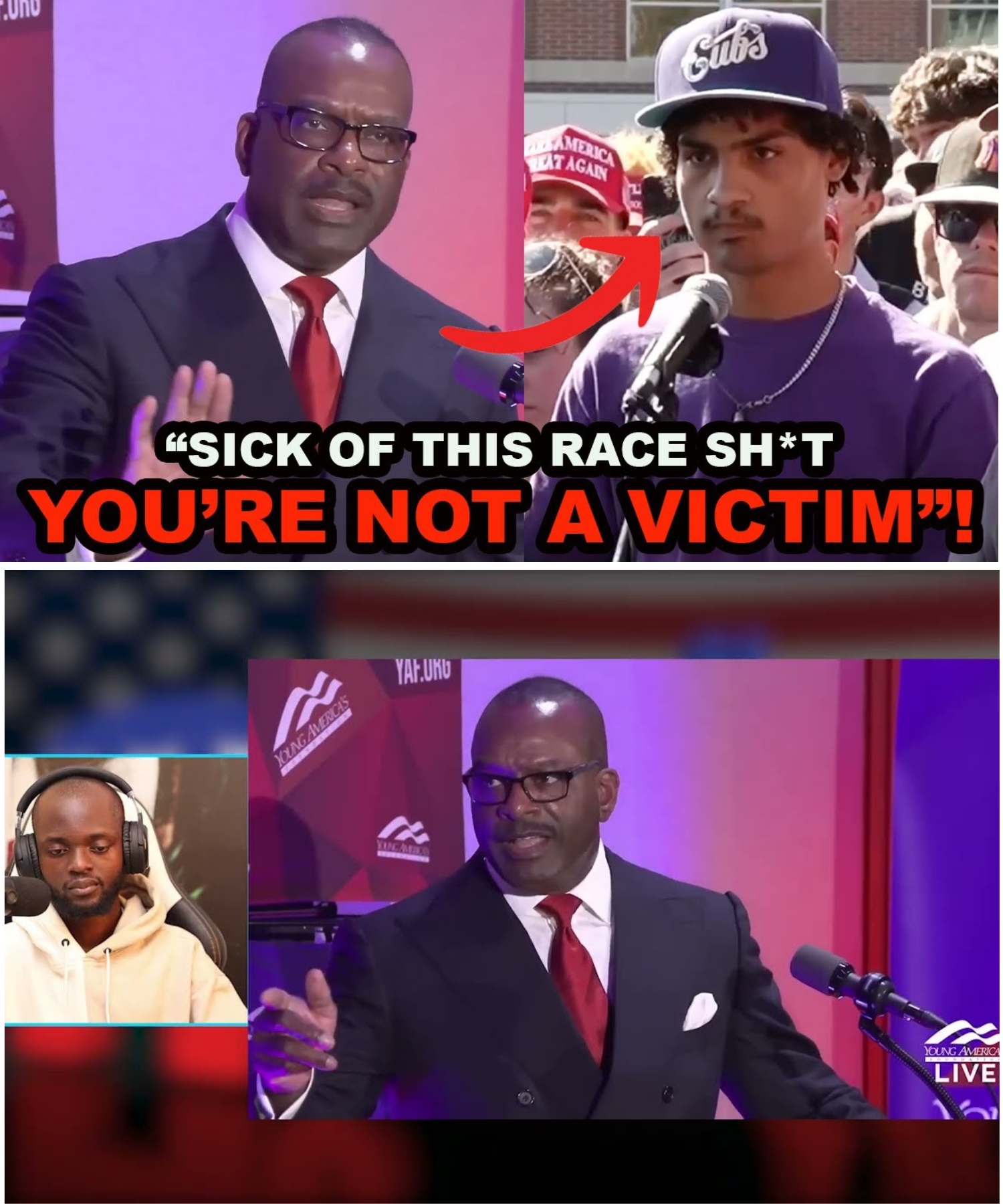
When the student said her family had inherited advantages because her ancestors could own homes, use banks, and pass down wealth, Ellison fired back that she had no privilege over him. He called the idea absurd and demanded proof that any white person in the room had power over his life.
The exchange revealed the core divide.
The student was talking about systems, history, and accumulated advantage. Ellison was talking about individual agency, personal responsibility, and present-day choices. Neither side seemed willing to surrender its definition.
Then the debate moved into slavery.
One student asked whether Ellison’s comments implied that enslaved people could have freed themselves if they had simply tried hard enough. Ellison answered in a way that shocked the audience. He argued that freedom often requires a willingness to resist, fight, risk death, or refuse mental defeat. He pointed to figures like Frederick Douglass and Harriet Tubman as examples of people who saw themselves as free even before the law recognized it.
To his supporters, that was a message of courage: never accept victimhood as destiny. To critics, it sounded like a brutal oversimplification of one of the most violent systems in American history.
A Black female student challenged him directly.
She said enslaved people did not choose chains. They did not choose cotton fields, generational trauma, or degradation. She said she had worked hard to reach a predominantly white institution and wanted her ancestors’ sacrifice to be acknowledged. Her voice carried anger, pain, and pride. She was not asking for pity. She was demanding recognition.
Ellison answered that she should stop thinking like a slave and start thinking like a Christian.
That line became one of the most explosive moments of the night.
The student pushed back immediately. She said honoring ancestors is not a slave mentality. It is gratitude. She made clear that she was not trying to win approval from white people but to love herself, honor her history, and recognize the struggle that made her presence on campus possible.
Ellison responded that the past is the past and that people must deal with individuals, not racial groups. He said white people and Black people have both helped and harmed him, and that character — not skin color — should determine how people are judged.
The debate then turned to police brutality.
A student asked why Ellison could not understand the fear many Black Americans feel around police. She said that if she walked near an officer and pulled out her phone, she believed she was likely to get shot. Ellison rejected that fear as a governing principle. He said he had lived 61 years without serious problems with police because of how he carries himself, speaks to people, and shows respect.
He argued that some activist movements and leaders teach young Black men behaviors that escalate encounters with police: disrespect, hostility, refusal to comply, and performative confrontation. He insisted that the human element matters — if a person treats officers with respect, he believes most officers will respond in kind.
That answer drew fierce reactions.
Supporters saw it as practical wisdom: stay calm, be respectful, do not escalate. Critics saw it as ignoring real cases where respectful people still faced discrimination, excessive force, or death. The gap between those two worldviews is one of the deepest wounds in modern America.
A philosophy student then challenged Ellison more methodically. If white privilege does not exist, he asked, could Ellison define the term? Ellison said no — because, in his view, it does not exist. He compared it to a fairy or unicorn: the word exists, but the thing itself does not.
The student pressed him: how can someone debate a term he refuses to define?
Ellison answered that he was responding to what he believes progressives mean when they use the phrase — a belief that white people hold automatic power over Black people in present-day America. He said that belief gives white liberals a sense of moral importance and gives some Black Americans permission to accept failure as someone else’s fault.
Then came the data question.
The student cited federal sentencing disparities, arguing that Black Americans receive longer sentences and face bail disadvantages compared with white Americans. Ellison did not accept race as the automatic explanation. He argued that class, money, education, legal representation, and family resources may explain much of the difference. He said his own Black family, with education and means, did not face the same problems, which to him proved that race alone cannot explain outcomes.
That answer again split the room.
One side heard realism about class. The other heard minimization of racial bias.
The abortion exchange was equally heated. A Black Christian student asked why Ellison spoke about abortion as if men could control women’s bodies, especially in cases of rape or assault. Ellison replied that women control their bodies, but the unborn child’s body is not the same body. He argued that the circumstances of conception do not determine the value of the life conceived.
The room grew tense.
By the end, the debate had become a snapshot of America’s racial and moral civil war. One side sees white privilege as a necessary acknowledgment of history and continuing inequality. The other sees it as a psychological trap that replaces responsibility with resentment. One side believes systems still shape outcomes. The other believes individuals must stop giving systems control over their identity.
No one left convinced.
But everyone saw the fault line.
This was not just a campus Q&A. It was a collision between two Americas: one demanding historical recognition, the other demanding personal accountability.
And in that room, neither side was willing to blink.