Palestinian Christian Student Confronts Conservative Speaker in Tense Campus Exchange Over Israel, History, and Belonging
Palestinian Christian Student Confronts Conservative Speaker in Tense Campus Exchange Over Israel, History, and Belonging
A quiet university walkway in the United States turned into the center of a fierce national argument after a Palestinian Christian student stepped forward and asked one question that cut through decades of politics, history, and pain.
The exchange, filmed on an American college campus, began without shouting, without protest signs, and without the chaos that has defined so many recent debates over Israel and Palestine. But within seconds, the mood shifted. A young Palestinian Christian student faced conservative speaker Nick Fred and asked how he should understand the claim, repeated by some Christians, that European Jews who arrived in the region before the creation of Israel had more right to the land than families like his own.
For the student, the question was not abstract. It was not a slogan. It was personal.
He said his ancestors had lived on the land for generations, possibly tracing their Christianity back to the earliest followers of Jesus. He described family members who, according to his account, were forced from their home during the turmoil surrounding the creation of Israel. He said his family still kept a key to a house in Palestine, now unreachable, now symbolic of loss passed down across generations.
In a country where the Israeli-Palestinian conflict has become one of the most explosive issues on college campuses, the moment carried unusual weight. The student was not speaking as a distant commentator. He was speaking as someone caught between faith, heritage, and the American political arguments being made around him.
Nick Fred responded by trying to widen the historical frame. He argued that the conflict could not be understood as beginning only in 1947. According to him, the land had been controlled by many different peoples and empires over thousands of years: Canaanites, Philistines, Israelites, Egyptians, Persians, Greeks, Romans, Byzantines, Arabs, Ottomans, and the British.
His point was clear: in a region with such a long and violent history, claims of ownership are rarely simple.
Fred said there had always been a Jewish presence in the land and argued that the Jewish people had an ancestral connection to the region. He also said that the idea of creating a Jewish state after World War II made sense to many Jews who feared persecution and wanted a government capable of defending them.
But the Palestinian student pushed back hard.
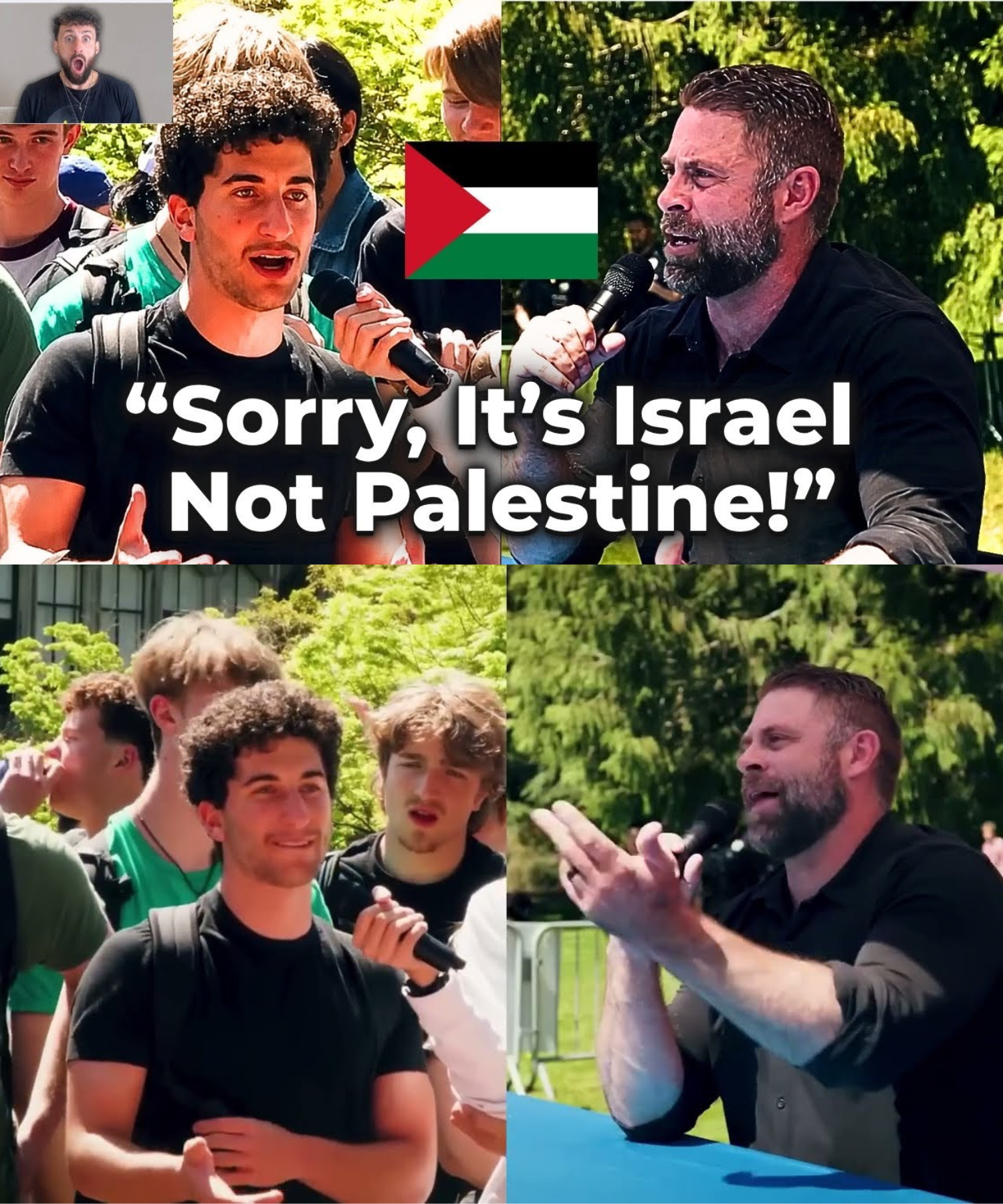
He said the issue was not whether Jewish people had history in the land. He acknowledged that Jews had lived there and had a right to exist. His objection was to the creation of a state on land where other people were already living. He argued that British colonial power had helped redraw the future of a land that was not Britain’s to give away.
That point turned the discussion toward colonialism, one of the sharpest words in American campus politics today.
The student framed the British and French role in the Middle East as part of a broader pattern of colonial damage. In his view, the problem was not only religion, ancient history, or national identity. It was power. A foreign empire had controlled a land, drawn lines, and left ordinary families to pay the price.
Fred replied that empires had controlled the land long before the British. Before them came the Ottomans, before them the Byzantines, before them the Romans, and before them still more ancient rulers. He suggested that singling out one colonial power could not explain the full story.
The student answered that his ancestors had survived through each of those periods. His family, he said, had remained on the land through occupation after occupation. To him, that continuity mattered more than the names imposed by empires.
The exchange then moved into the meaning of “Palestine” itself. Fred argued that the name had roots in Roman history, when the Romans renamed Judea after suppressing Jewish revolts. He described the Philistines as non-Arab people with origins connected to the ancient Mediterranean world. His broader argument was that modern political labels do not always map neatly onto ancient history.
For the student, however, the modern reality remained unavoidable. Families were displaced. Homes were lost. Communities were broken. Historical arguments, no matter how detailed, could not erase lived experience.
What made the exchange so striking was not only the disagreement, but the tone. In an American media environment often dominated by outrage, the two men did not scream over each other. They did not trade insults. They listened, challenged, corrected, and disagreed while remaining calm.
That alone made the clip stand out.
Across the United States, universities have become battlegrounds over the Israel-Palestine conflict. Students have marched, administrators have struggled to respond, donors have applied pressure, and politicians have turned campus disputes into national talking points. In that atmosphere, a direct conversation between a Palestinian Christian student and a conservative speaker carried more force than another shouting match.
The student represented a voice often overlooked in American debates: Palestinian Christians. In many U.S. political discussions, the conflict is reduced to Jews and Muslims, Israel and Hamas, security and terrorism, occupation and resistance. But Palestinian Christians complicate that simple framing. Their identity places them inside both the Christian story and the Palestinian national experience.
That was the heart of the student’s question. He was not asking America to solve the conflict in a single answer. He was asking why some Christians appear to recognize the ancient religious claims of one group while dismissing the historical presence and suffering of another Christian community that also traces its roots to the same land.
Fred’s response showed the other side of the American argument. For many supporters of Israel, Jewish history in the region, the trauma of persecution, and the failure of surrounding governments to protect Jewish communities are central to understanding why Israel exists. They see the creation of a Jewish state not as an act of theft, but as an answer to centuries of danger.
Neither side left the conversation fully persuaded. But that may be why the clip resonated. It captured the real nature of the debate: two histories colliding, two wounds speaking, two claims of belonging refusing to disappear.
The Palestinian student forced the discussion back to homes, families, keys, and memory. Fred forced it back to ancient history, Jewish survival, and the repeated wars that shaped Israel’s modern borders. Together, they exposed the central tension that continues to divide not only the Middle East, but American politics, churches, and campuses.
By the end, the most powerful part of the encounter was not a winning argument. It was the fact that both men stayed in the conversation.
In a moment when many Americans are choosing sides before hearing a word, this campus exchange showed something rarer: a painful disagreement carried out face to face, with history in the background and grief in the foreground.
And for one Palestinian Christian student standing on American soil, the question remained larger than politics.
Who gets to belong to a land when more than one people can point to history, faith, suffering, and blood as proof?
That question did not end on the campus sidewalk. It followed the video into the national conversation, where millions of Americans are still trying to answer it.