Viral Milo Yiannopoulos Debate Clip Sparks Fierce Firestorm Over Islam, Sharia Law, and Western Values
Viral Milo Yiannopoulos Debate Clip Sparks Fierce Firestorm Over Islam, Sharia Law, and Western Values
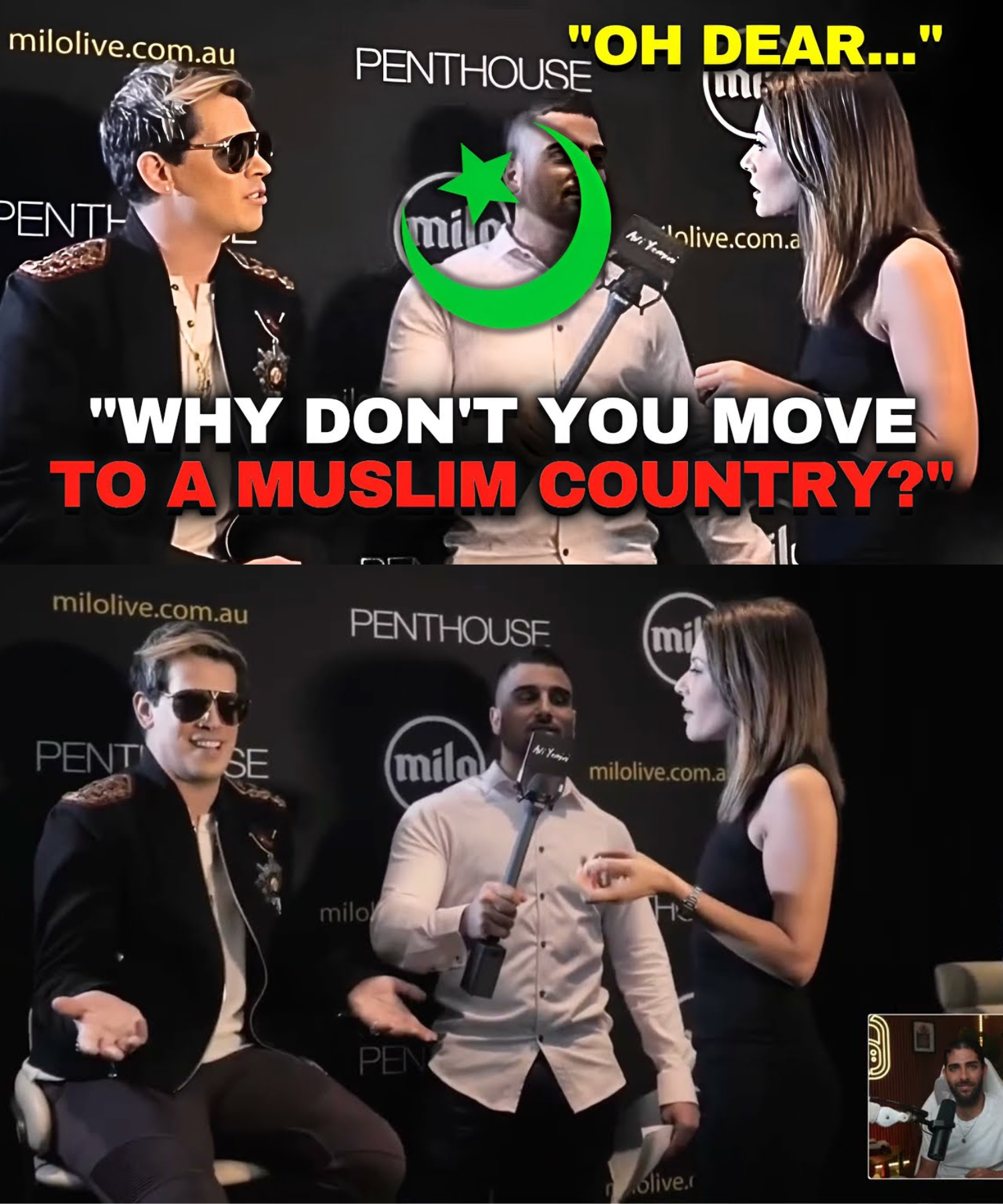
New York — A resurfaced debate-style video featuring conservative commentator Milo Yiannopoulos and an Australian Muslim participant has gone viral across social media, reigniting a deeply polarizing global argument over Islam, Sharia law, women’s rights, and whether religious doctrine can coexist with Western legal systems.
The footage, widely circulated in the United States, United Kingdom, and Europe, shows a fast-moving and emotionally charged exchange in which Yiannopoulos challenges the guest on whether Islamic principles are compatible with Western democratic values.
The conversation quickly escalates into a broader debate about religious law, interpretation of scripture, apostasy, LGBTQ rights, and the authority of Islamic scholarship.
The clip has triggered intense reactions online, with supporters calling it a “brutal exposure of ideological contradictions” and critics condemning it as a selective and adversarial framing of complex theological issues.
“Name a Muslim Country You’d Rather Live In” — The Central Challenge
One of the most viral moments in the exchange comes when the host asks the participant whether she would prefer to live in a majority-Muslim country under Islamic governance or in the Western country she currently resides in.
The guest hesitates and ultimately declines to name any country she would prefer over her current place of residence, a moment the commentator frames as evidence of incompatibility between Islamic legal systems and Western liberal societies.
Critics of the clip argue that such a binary question oversimplifies migration, governance, and personal identity, noting that millions of Muslims live in both Western and Muslim-majority countries and navigate diverse cultural environments successfully.
Supporters, however, argue that the question highlights a fundamental tension between idealized religious law and secular governance.
Sharia Law and Legal Compatibility Debate
The discussion intensifies around Sharia law, with the guest acknowledging that Islamic legal systems vary widely across countries and interpretations.
She argues that Sharia is not a single monolithic code but a collection of legal and moral interpretations that differ depending on scholars, schools of thought, and cultural context.
The host pushes back, arguing that in many Muslim-majority countries, legal frameworks derived from Sharia are incompatible with Western norms regarding gender equality, LGBTQ rights, and freedom of expression.
The exchange becomes particularly heated when examples are raised involving women’s testimony, legal inequality in certain interpretations, and criminal penalties for homosexuality in some jurisdictions.
LGBTQ Rights and Cultural Conflict
A key point of contention is whether Islamic doctrine is compatible with LGBTQ rights as understood in Western societies.
The host argues that in many Muslim-majority countries, homosexuality is criminalized and in some cases severely punished, and suggests this reflects a broader incompatibility with liberal democratic values.
The guest responds that interpretations vary significantly across the Muslim world and that not all societies apply identical legal standards.
She emphasizes that cultural context, governance structures, and political systems all play a role in how religious law is implemented.
Apostasy, Interpretation, and Religious Authority
The conversation also delves into apostasy and the question of whether leaving Islam is legally or socially acceptable in certain jurisdictions.
The host argues that in some Islamic legal systems, apostasy is treated as a serious offense, which he claims raises questions about freedom of belief.
The guest counters that interpretation of Islamic law is not uniform and depends heavily on scholarly tradition and legal context.
This leads into a broader debate about Quranic interpretation and the concept of abrogation — the idea that later revelations may supersede earlier ones within Islamic theology.
The Abrogation Controversy
One of the most technical but controversial parts of the discussion involves the concept of abrogation in Islamic scholarship.
The host claims that certain later Quranic verses, particularly those associated with conflict or jihad, are interpreted by some scholars as overriding earlier verses that emphasize peace.
He argues that this interpretive framework is central to understanding differences in how Islamic law is applied.
The guest challenges the framing, questioning sources and scholarly authority, and suggesting that interpretation depends heavily on academic tradition and theological training.
Experts note that abrogation is a recognized but complex concept in Islamic jurisprudence, and interpretations vary widely across schools of thought.
Women’s Rights and Legal Systems
The discussion further expands into women’s rights in Islamic legal contexts.
The host argues that in certain jurisdictions influenced by Sharia interpretations, women’s legal testimony or rights may differ from men’s in specific cases.
The guest responds that such legal variations are often misunderstood and that modern Islamic societies include a wide spectrum of legal reforms and interpretations.
Human rights scholars emphasize that legal treatment of women varies significantly across Muslim-majority countries, with some adopting secular legal systems and others incorporating religious jurisprudence.
Social Media Reaction: Deep Polarization
The viral spread of the debate has produced sharply divided reactions.
Supporters of the host argue that the exchange exposes contradictions in claims that Islam is fully compatible with Western liberalism, pointing to real-world legal differences between systems.
Critics argue that the clip selectively highlights controversial interpretations while ignoring the diversity of Muslim belief systems and lived experiences across billions of people worldwide.
Religious scholars warn that reducing Islam to its most restrictive legal interpretations risks misunderstanding a highly diverse global faith tradition.
Free Speech vs. Ideological Framing
The video has also reignited debate over free speech and debate formats.
Supporters argue that such confrontational questioning is necessary to test ideological consistency and expose contradictions in public claims.
Critics argue that rapid-fire questioning in adversarial settings can lead to oversimplification, especially when complex theological systems are reduced to binary answers.
Legal experts note that while free speech protects such debates, it does not guarantee that they will produce nuanced or representative conclusions.
A Broader Cultural Fault Line
Beyond theology, the clip reflects a broader cultural and political divide in Western societies over immigration, integration, and identity.
Questions about whether religious law systems can coexist with secular democratic frameworks are increasingly central in political discourse across the United States and Europe.
The debate also highlights growing tensions over how to discuss Islam in public spaces without either silencing criticism or promoting generalization.
No Resolution, Only Escalation
As the video continues to circulate, no consensus has emerged.
Instead, it has become part of a wider unresolved global debate over religion, law, and modern governance.
For some, the exchange represents a necessary confrontation with difficult ideological questions.
For others, it represents a reductive and confrontational framing of a deeply complex religious and legal tradition.
What remains clear is that the question at the center of the debate — whether Islam can fully integrate with Western liberal legal systems — continues to divide audiences across the world.
And for now, it shows no sign of fading.